
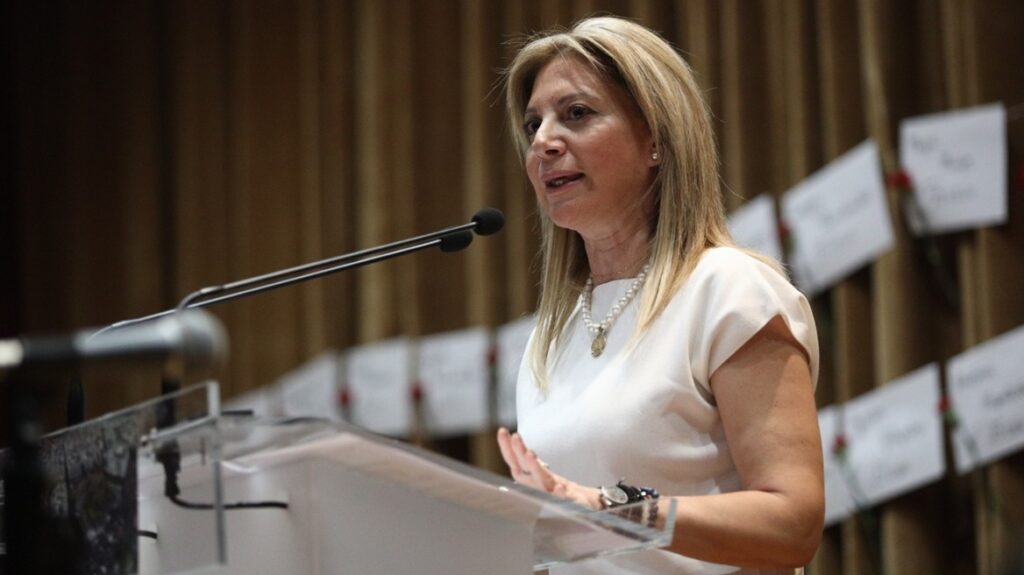
Maria Karystianou’s newly founded party “Hope for Democracy” has already seen its first departures, just one month after its establishment. Vasilis Kokotsakis, the forensic expert in the Tempi train disaster case, and retired Air Marshal Athanasios Papanikolaou both announced their resignations, while TikToker Dimitris Savvidis also distanced himself from the movement. In her first response to the departures, Maria Karystianou posted on her personal Facebook account, accusing unnamed “willing participants” of attempting to fracture the party’s unity.
“Malicious motives, even when occasionally camouflaged, are fortunately recognized — sometimes early, sometimes with a delay,” Karystianou wrote, adding: “What matters is that sooner or later, everything and everyone is exposed. So, against all odds, we press on.”
Meanwhile, in an article published in the newspaper Apogeumatini, where he regularly contributes, retired Air Marshal Athanasios Papanikolaou made clear that he “no longer has any connection with Maria Karystianou’s party, nor do I participate in it, nor does it represent me.”
According to the report, Papanikolaou — who had previously expressed his support for Karystianou in a recorded video message — claims that over time he observed the movement evolving away from an open civic movement with collective action and democratic values, and instead becoming a closed circle guided by former members of the “Niki” party, projecting a tone of “ideological and intellectual entrenchment.”
Maria Karystianou’s full statement on the departures
“Our Movement HOPE FOR DEMOCRACY has already completed one month of existence! Even within this short time, the war against us is escalating from all sides, and the mud-slinging and defamation continue relentlessly and intensively. This makes us happy!
Because it means we are doing very well! Citizens understand! The truth cannot be hidden or distorted! It is abundantly clear that the comfortable, corrupt, and manipulated system is fighting a living and active movement — one that disrupts it and places citizens first, prioritizing solutions to the problems that affect their daily lives!
In this shadowy campaign against us, those who feel threatened by our very existence are deploying every means available and every willing accomplice.
They are trying to split us apart. To sow discord. Following the well-known recipe: divide and conquer. Malicious motives, even when occasionally camouflaged, are fortunately recognized — sometimes early, sometimes with a delay.
What matters is that sooner or later, everything and everyone is exposed. So, against all odds, we press on.
We are not intimidated, we do not resign, we do not bend! We fight and struggle to the end.
Because our motives are pure — not deceitful or underhanded.
Together with you. Together with our children, for our children. For a Greece truly free from corruption, decay, impoverishment, and exploitation. At last!” Karystianou wrote in her post.
Defections from Karystianou’s party
Vasilis Kokotsakis, the forensic expert in the Tempi train disaster case, announced his resignation from Maria Karystianou’s “Hope for Democracy” party. Retired Air Marshal Athanasios Papanikolaou followed suit, while TikToker Dimitris Savvidis also made clear his distance from the movement.
In an open letter, Kokotsakis cited “serious organizational deficiencies,” stressing that “no Citizens’ Movement can function without rules, without institutions, without transparency, without accountability, and without a clear organizational framework.”
Noting that “despite repeated interventions, there was no response whatsoever,” Kokotsakis charged that “there was never any substantive discussion on any organizational, institutional, political, or other matter. The unconventional leadership never made any effort to listen to the wishes of the citizens’ movement — instead, positions and opinions emerged that reflected only those speaking, and never the broader popular base or any collective body.”
He argues that “a model of decision-making concentrated in the hands of a very few individuals gradually took shape, completely outside any notion of collective functioning,” writing of Maria Karystianou that “as the head of this endeavor, she bears the primary political responsibility for the way it was organized and operated,” since “the critical choices that defined the character, structure, and functioning of the party were made with her knowledge, tolerance, or acceptance.”
Kokotsakis also writes that “the Founding Declaration was drafted without collective processes. The Statute is announced to be drafted in the same way. The comprehensive national organizational plan submitted by the responsible organizational department was ignored in favor of a centralized model of ‘decisions by a handful of people.’ You cannot preach transparency while operating through inner courts.” He adds that “instead of discussing institutions, processes, and participation, the logic of party machinery, internal power balancing, personal influence, and behind-the-scenes rivalry began to emerge.”
According to him, Karystianou’s Citizens’ Movement has become “a structure that in practice denies the basic principles of participatory and collective functioning — one that bears absolutely no relation to the demands and expectations of the people who championed it.” He underlines that “those of us who come from the struggle over Tempi did not learn to operate according to the logic of inner courts. We learned to operate on the basis of responsibility, because we were not motivated by power — we were motivated by the need for truth. It was not ambition that united us, but the demand for justice.”
“And for this reason, I cannot accept or tolerate that a Movement born from citizens’ demand for Democracy refuses to practice democracy internally. I cannot accept that a Movement invoking Transparency will operate without institutional processes. I cannot accept that a Movement born as an expression of society will gradually be transformed into a personal political project.”
Vasilis Kokotsakis’s full letter
“On May 21, 2026, during the presentation of the Founding Declaration of what was then the movement being established, I publicly stated:
‘I wish that this new beginning will always remain faithful to what gave birth to it: the citizens’ demand for Truth, Justice, and Accountability.’
Today I feel the need to return to those words — not to revise them, but because I unfortunately believe that the fears they concealed have been confirmed.
In the Tempi case, I supported (among other things) the then-president of the Victims’ Association, as a technical advisor, in the struggle of all the bereaved families for the truth in this case.
We supported her as a technical team — scientifically and morally — not because we were seeking a role, a position, or influence, but because we believed she represented an authentic social demand for Justice and truth, as expressed by the millions of citizens who took to the streets.
And when the creation of a political party was announced, believing that we were attempting to carry into public life the message sent by millions of citizens in the streets of Greece, I declared my presence without any ambition or personal agenda.
Not to create yet another party, but to build an authentic, genuine Citizens’ Movement — as the people demanded — against the rot and corruption of the existing political system.
A movement that would be a continuation of that great popular uprising born from the tragedy of Tempi, which reached its peak in January and February of 2025.
A movement, however, that would not belong to individuals, would not be governed by inner circles and courtiers, would not operate through the logic of party machinery, excluding factions and personal allies…
One that would not reproduce the pathologies that for decades led citizens to feel alienated from politics.
Unfortunately, as time passed, I observed increasingly that the path being followed diverges substantially from what was announced.
From the very first moment, serious organizational deficiencies were pointed out. Proposals were submitted, plans were tabled, concerns were raised. Meetings and clarifications were requested. Not out of a desire for confrontation — but out of a sense of responsibility.
Because no Citizens’ Movement can function without rules, without institutions, without transparency, without accountability, and without a clear organizational framework.
And yet, despite repeated interventions, there was no response whatsoever.
There was never any substantive discussion on any organizational, institutional, political, or other matter. The unconventional leadership never made any effort to listen to the wishes of the citizens’ movement — instead, positions and opinions emerged that reflected only those speaking, and never the broader popular base or any collective body.
There was never any collective deliberation on any issue, nor was there any inclination toward institutional consolidation.
On the contrary, a model of decision-making concentrated in the hands of a very few individuals gradually took shape, completely outside any notion of collective functioning.
Maria Karystianou, as the head of this endeavor, bears the primary political responsibility for the way it was organized and operated.
I do not attribute the above findings to collaborators, advisors, or people in her circle.
The critical choices that defined the character, structure, and functioning of the party were made with her knowledge, tolerance, or acceptance.
For this reason, my criticism concerns primarily the political direction that was chosen and the leadership’s responsibility for it.
The Founding Declaration was drafted without collective processes. The Statute is announced to be drafted in the same way.
The comprehensive national organizational plan submitted by the responsible organizational department was ignored in favor of a centralized model of “decisions by a handful of people.” You cannot preach transparency while operating through “inner courts.”
The citizens’ organizations that were spontaneously formed across the country were left to operate without clear rules, without rights, without responsibilities, without institutional guarantees of participation, and without ever being asked for their opinion on any matter.
And worst of all: instead of discussing institutions, processes, and participation, the logic of party machinery, internal power balancing, personal influence, and behind-the-scenes rivalry began to emerge.
A situation that not only bears no resemblance to a Citizens’ Movement, but actually resembles precisely that political model we were supposedly trying to overcome. But there is yet another dimension I cannot ignore.
From the very first moment the endeavor was formed, dozens and then hundreds of citizens responded to our call (as happened exemplarily in Crete). Citizens’ Groups were created in many parts of Greece, made up of people who were not seeking rewards, offices, or political careers.
Working people, people of everyday life and service. People who believed we were building something different. That we were attempting to create a true Citizens’ Movement, based on participation, collectivity, transparency, and respect for democratic functioning.
These people trusted us and followed us. They invested time, effort, dignity, and hope. And it is precisely for this reason that I feel I have a particular moral obligation toward them.
I cannot ask them to continue believing in something different from what they see taking shape.
I cannot ask them to accept as a Citizens’ Movement a structure that in practice denies the basic principles of participatory and collective functioning — one that bears absolutely no relation to the demands and expectations of the people who championed it.
And above all, I cannot remain silent when I see people who worked selflessly now feeling disappointment and bitterness over the expectations they had invested.
I owe them the truth, just as I owed them the truth from day one. In stating the above, I record not personal bitterness, but sadness.
Because those of us who come from the struggle over Tempi did not learn to operate according to the logic of inner courts.
We learned to operate on the basis of responsibility, because we were not motivated by power — we were motivated by the need for truth. It was not ambition that united us, but the demand for justice.
And for this reason, I cannot accept or tolerate that a Movement born from citizens’ demand for Democracy refuses to practice democracy internally.
I cannot accept that a Movement invoking Transparency will operate without institutional processes.
I cannot accept that a Movement born as an expression of society will gradually be transformed into a personal political project.
Personally, I feel that I cannot be part of this effort. I spoke when I had to speak, and I proposed when I had to propose.
I warned when I had to warn, and I remained present as long as there was hope that the course could be corrected — but in vain.
So that tomorrow I can look in the eyes the people who trusted me and with whom we walked together for a little while…
For this reason, I declare that I am withdrawing any support from this particular political party.
I do not recognize in this party the characteristics of a Citizens’ Movement as the one we envisioned and presented to the citizens.
This decision is not directed against any individual, but concerns exclusively my assessment of the way this endeavor has been constituted, operated, and politically evolved.
At the same time, I declare clearly that I remain by the side of the people who have traveled with us throughout this period and who honored this effort with their presence, their work, their integrity, and their selflessness.
Above all, however, I remain unwaveringly where I have been from day one: in the clear struggle for truth in the Tempi case, together with our technical team. We continue our scientific work unimpeded, for the memory of the victims and the dignity of their families.
The principles that brought us here continue to be alive, and as long as they remain alive, our own path will remain open.
I am withdrawing only from a political movement that no longer represents me — just as it no longer represents the majority of all those who believed in it…”
Dimitris Savvidis distances himself
Earlier in the day, TikToker Dimitris Savvidis also posted criticism of the movement, accusing it of having made hope into a “marquee” slogan “but not turning it into action,” describing it as “a movement that promises a great deal and has so far delivered nothing {…} whose top officials have time to make videos in taverns, in cafes, and on the streets of Russia, but have no time to speak about the incredible scandals of just the last 5 days.”