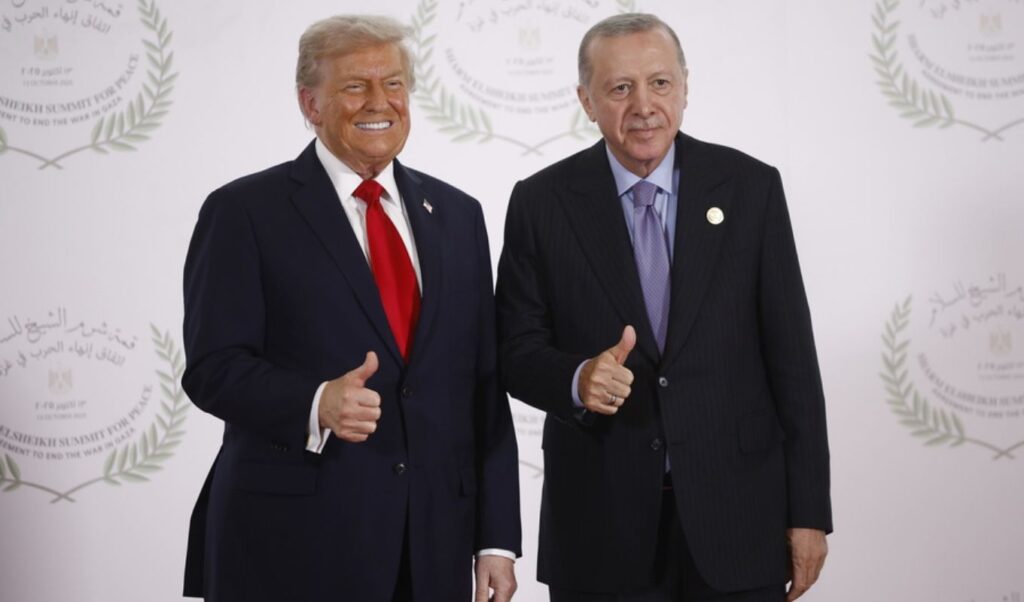
The strategic position of Turkey has been at the center of international diplomacy in recent days. The upcoming NATO summit, set to take place in Ankara next Tuesday, is only part of the picture. Turkey’s pivotal role in the US-Israel-Iran conflict, its diplomatic maneuvers in the Russia-Ukraine war, and its powerful alliances across the Middle East and Africa have firmly established it as a dominant regional player.
Read also: Turkey: Kaya Kalas’ silence, Fidan’s pressure on the Customs Union and the Cyprus veto – Angelos Syrigos: “A troubling image of Europeans rushing to please rather than criticizing Erdogan”
In Washington, the positive remarks made by US President Donald Trump about potential “gifts” to Turkey continue to stir controversy. Yesterday, yet another Republican congressman, Mike Lawler, led a new push in Congress, urging Trump to maintain the aircraft transfer ban imposed in 2019. In a letter circulated among congressional members for signatures, Lawler took direct aim at Turkey, citing “the continued aggression of President Erdogan toward America’s major partners” and noting that “Ankara continues to maintain a military presence in the Turkish-occupied northern part of Cyprus and has engaged in aggressive actions against Greece.” He further emphasized that Ankara’s acquisition of the Russian S-400 missile system made it clear that Turkey cannot participate in such a critical and technologically advanced defense program.
The European Union also appears to be strengthening its relationship with Ankara, despite ongoing concerns over human rights in Turkey. Yesterday, EU Commissioner for Economy and Productivity Valdis Dombrovskis, in an interview with the Turkish newspaper Hürriyet Daily News, stated that “the EU-Turkey relationship is of strategic importance.” According to the paper, Turkey remains the EU’s fifth-largest trading partner, with bilateral trade reaching a record high of €217.6 billion in 2025. Against this backdrop, the EU’s Economy Commissioner expressed willingness to modernize the EU-Turkey Customs Union — despite the veto of the Republic of Cyprus, which Turkey’s Foreign Minister Hakan Fidan had himself invoked just one day earlier.
Turkey’s upgraded role for Washington and Brussels: “The result of a combination of factors” — Haris Tzimitras speaks to parapolitika.gr
Haris Tzimitras, Professor of International Law and foreign affairs spokesperson for the Greek Left Alliance (ELAS), speaking to parapolitika.gr, argues that Turkey’s upgraded role in the eyes of both Washington and Brussels is the result of a combination of factors. As he explains, “First, it stems from the EU’s narrow and therefore short-sighted interpretation of security in purely military terms. Within this framework, it becomes easy to understand why Turkey’s significant military capabilities are considered indispensable. Second, it reflects the even more myopic perception of threats to Europe held by the European North, which recognizes Russia as the sole threat to European security. This, however, ignores the fact that both Greece and Cyprus face threats from Turkey — a country the EU praises, or at the very least, refrains from criticizing. It makes no sense for the EU to recognize Russia alone as a threat to its security while turning a blind eye to threats against European security emanating from a country that actively challenges the sovereign rights of EU member states. Third, it is driven by the transactional nature that increasingly characterizes both American and European foreign policy today. This largely explains the approach toward Turkey and how it is being handled. Europe proclaims it wants to become more geopolitical. In my view, this also means more transactionalism — clearly at the expense of the principles and rules that have governed it until now. This explains Europe’s silence on matters of principle and rule of law in Turkey, in favor of security cooperation.”
According to Tzimitras, given this reality, Greece needs a foreign policy grounded in realism but anchored in non-negotiable principles in order to effectively defend its interests. As he stresses, “International law is both our best shield and what sets us apart from countries that pursue revisionism through sheer force. I emphasize this because Greece must be extremely careful when government policy appears to be moving in the opposite direction. The silence over the genocide in Gaza, our participation as an observer in Mr. Trump’s peace council — which undermines the United Nations — the visits to the wanted Mr. Netanyahu in defiance of International Criminal Court decisions, a court whose statute we are party to, and statements along the lines of ‘now is not the time to discuss the legality of the intervention in Venezuela’ are, I believe, deeply problematic for us. They undermine and erode our credibility when we rightfully call, for example, for sanctions in response to Turkish provocations. Our policy must be grounded in principles and international law, and it must also be characterized by a coherent strategy with a clear beginning, middle, and end — not merely tactical maneuvering in our bilateral and multilateral relations. This naturally includes the anticipated rapprochement in EU-Turkey relations, but only if Turkey commits to dialogue based on international law.”