Two interpretations emerge from the new reality on the Russo-Ukrainian front, with two sides to every coin: on one hand, the conclusion is that the international community is watching events unfold from ground zero, while on the other, a shift in the balance of power is beginning to emerge. In what has been Russia’s most intense assault against Ukraine in recent months — following a series of mutual strikes on energy infrastructure — at least 20 civilians were killed in Kyiv and the surrounding areas. It is becoming increasingly clear that at a critical turning point in the conflict, where Moscow’s endurance is being tested, Vladimir Putin’s need to project strength is intensifying — while Ukraine is proving far too resilient to fall. Against this volatile geopolitical backdrop, the diplomatic moves of U.S. President Donald Trump are being closely watched, as he has recently been engaged in sustained efforts to implement a ceasefire agreement in the Middle East.
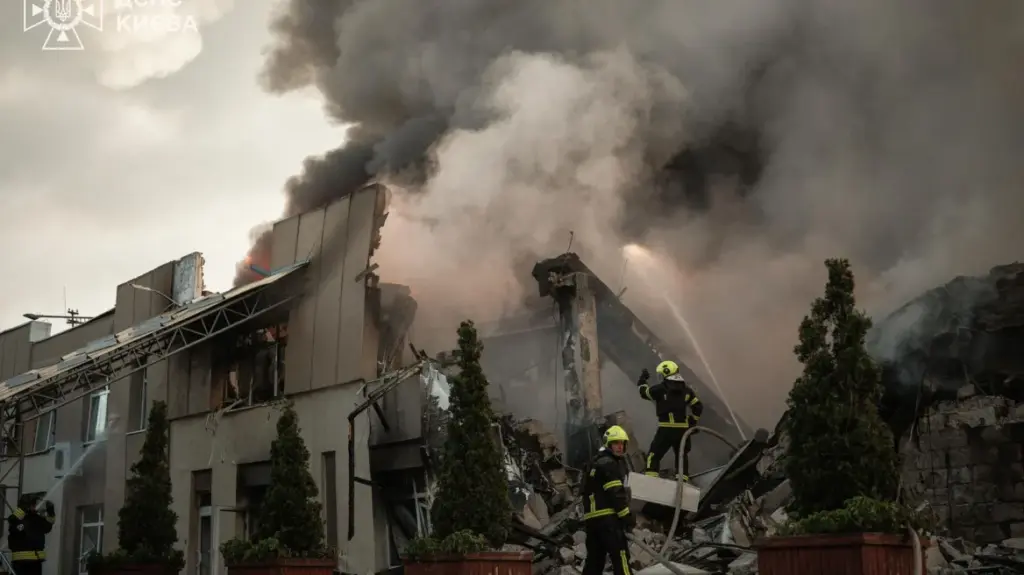
Tensions escalated dangerously when Russian forces launched a massive overnight drone and missile attack against Kyiv, killing 20 people in what the city’s mayor described as the largest attack the Ukrainian capital has ever endured. Vitali Klitschko declared Friday a day of mourning and reported that approximately 90 people were wounded, with targets including an ambulance station.
While previous attacks have resulted in higher death tolls, this strike stands out for the extraordinary number of weapons deployed and the exceptionally wide area of Kyiv that was hit. Multiple neighborhoods were evacuated as the bombardment leveled buildings across the city, just hours after Ukrainian President Volodymyr Zelensky had warned that Russia was preparing a new strike. Moscow claimed its targets were military installations, citing retaliation for Ukrainian attacks on Russian civilian infrastructure.
War in Ukraine: What Russia targeted
Kremlin spokesman Dmitry Peskov stated that Russia would “continue to increase pressure on the Kyiv regime to achieve its objectives.” Ukraine, for its part, accused Moscow of deliberately targeting civilians and stressed that the actions of an aggressor cannot be equated with those of a country defending itself. The attack on Kyiv lasted more than 11 hours and unfolded in waves, beginning with a drone strike on the city’s historic center that set a centrally located hotel ablaze.
The Ukrainian Air Force announced that Russia had launched a total of 74 missiles and 496 drones, with Kyiv as the primary target. Although the majority were intercepted, 25 ballistic missiles and 12 drones struck 33 locations across the city. In the aftermath, Kyiv called on its allies to bolster the country’s air defenses. President Zelensky formally requested that Washington grant licenses for the domestic production of Patriot missiles.
Analysis by Kostas Ifantis for parapolitika.gr
Assessing the current situation, Kostas Ifantis, Professor of International Relations at Panteion University, explains to parapolitika.gr that for a considerable period the front was essentially “frozen,” while emphasizing that Ukrainian resistance has never wavered. He points to Russia’s progressive military and economic attrition over time, noting that Russia is acting independently of the United States and launching attacks to demonstrate that it has not lost control of the situation.
One key point Professor Ifantis is keen to highlight is that whereas the international community once asked how long Ukraine could hold out, the question now is “how long Russia can hold out.” He adds that since no major ground offensive has materialized, the strategic calculus has fundamentally changed.
“Ukraine is defending its homeland,” the professor explains, noting that over the four and a half years the war has been raging, it has become apparent that “Russian forces are of low quality.” He describes the conflict as a war of attrition in which Russia is struggling to respond to Ukraine’s extraordinary resilience.
Commenting on the U.S. president’s stance, he explains that Donald Trump cannot realistically do much differently at this moment, given that the Middle East remains Washington’s top priority.
Two additional factors are worth noting in this wartime picture: whether a new round of Moscow-Kyiv talks involving the United States could be organized, and whether Ukraine would find itself in an advantageous position regarding negotiations over its eastern territories. Professor Ifantis does not rule out the possibility that a new round of talks could be organized in the near future — with Ukraine clearly in a stronger negotiating position than it has been at any previous point in the conflict.