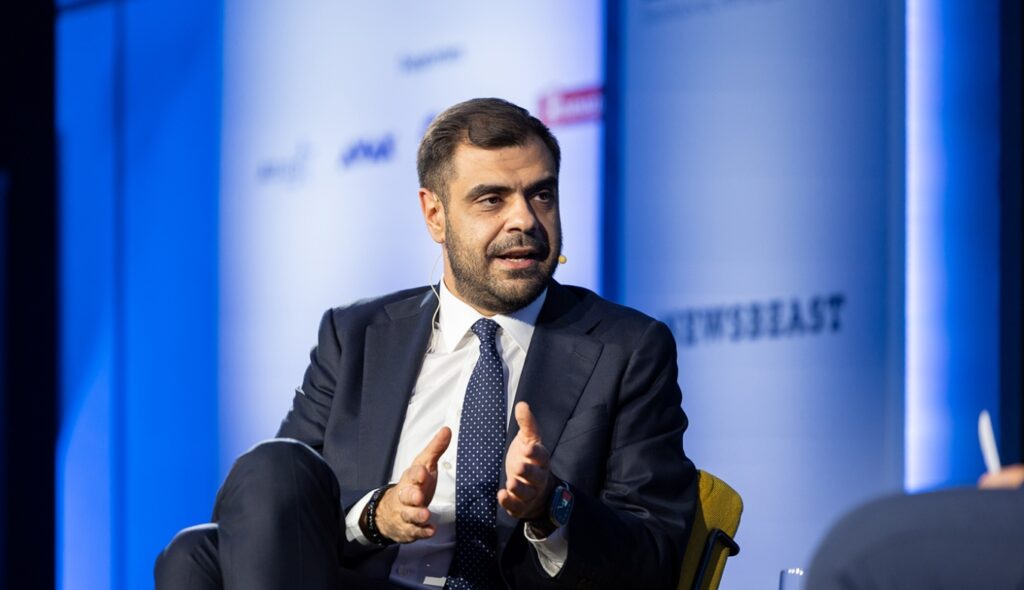
Government spokesman Pavlos Marinakis sent a message in favor of investments, evaluation and strengthening entrepreneurship, speaking at the conference “Leadership and work, investing in human capital”. The Deputy Minister to the Prime Minister referred to the differences between public and private sectors, the need for more effective evaluation in the public sector, and government choices for the economy, arguing that growth must be based on investments, new jobs and tax cuts for businesses. At the same time, he spoke about the “digital revolution” of the first governmental term, emphasized the importance of promoting new people in politics, and stressed that in the country “the numbers are thriving but not all people”. His remarks were made within the framework of a discussion on leadership, work and human capital, moderated by journalist Victor Montzelli.
Marinakis’ references on economy and development
Pavlos Marinakis gave particular emphasis to economic policy and the need for development to have specific characteristics and orientation. As he mentioned, the government considers the increase in tax revenues and surplus as a positive element, characteristically noting that “fortunately we are increasing our revenues”. At the same time, however, he noted that development cannot be based exclusively on fiscal indicators, but must create prospects for more citizens. “In our country, as in the rest of Europe, the numbers are thriving, but not all people”, he said characteristically. The government spokesman emphasized that development must be based on investments, creation of new jobs and tax cuts for businesses, arguing that this is the path to a more competitive economy. At the same time, he spoke about the need to strengthen the connection of economic policy with productivity and efficiency.
Marinakis: Evaluation in the public sector and differences with the private sector
A large part of his remarks was dedicated to the issue of evaluation and the differences between the public and private sectors. Pavlos Marinakis noted that he does not consider the portfolio he manages belongs to the “narrow public sector”, explaining that ultimately everyone is judged by results. As he mentioned, in the private sector success and failure are evaluated with more objective criteria, while conversely in the public sector there continue to be serious injustices around evaluation. “Competence and effectiveness in the private sector surpasses everything. In the public sector, unfortunately, injustices remain regarding evaluation”, he said characteristically. At the same time, he characterized evaluation as one of the biggest pending issues of the public sector, while speaking about the need to connect this process even with the Constitution, emphasizing that the government’s goal is to create a stable foundation for the country. He also referred to the “de-stigmatization” of public-private partnerships, noting that such collaborations show the way for more effective policies.
The “digital revolution” and young people in politics
The government spokesman also focused on the changes that, as he said, were made in recent years in the field of state digitization. Pavlos Marinakis characterized the first governmental term as a period of “digital revolution”, saying that “we measured and digitized everything”. At the same time, he admitted that there continue to be sectors where more interventions are required, citing universities as an example. He also made special reference to the need to give more opportunities to young people in politics and generally in leadership. “In politics, 30-year-olds can govern other countries, in Greece until 35 you are a talent and then you burn out”, he said characteristically, adding that he was lucky because he found himself “in the path of a prime minister who gives opportunities”. At the same time, he noted that in the country’s political life there have been missing younger people who have real professional experience and “credentials”, emphasizing that this constitutes a basic element for a more substantial and effective political presence.