The Middle East war appears to be acting as a catalyst for restructuring Greece’s defense strategy. Athens is adapting its strategy with the goal of emerging stronger after the crisis. Indicative of the dynamics Athens is developing in the diplomatic field is first and foremost the immediate response to the defensive armoring of the Republic of Cyprus, the deployment of Patriot missiles in Karpathos and Evros, as well as the involvement of Greek artillery in shooting down two Iranian ballistic missiles in Saudi Arabia.
Strengthening relations with Saudi Arabia, United Arab Emirates and Qatar
Through managing the Iran crisis, Greece has further strengthened relations with Gulf countries, particularly with Saudi Arabia, the United Arab Emirates and Qatar. The visit of Sheikh Al Thani to Athens the day before yesterday sealed the new strategic alliance. As Professor Emeritus of European Studies Panagiotis Ioakimidis argues, our country’s alliance with Gulf states is particularly positive as it enhances Greece’s security, however he also points out the fluidity that characterizes these regions as, he characteristically notes “one cannot say that these countries have stability over time. But the fact of alliances exists, with our country emerging strengthened from the crisis and this is positive as a fact, for as long as it lasts.” We must also not overlook that beyond defense cooperation, Athens has concluded investment agreements with Qatar mainly in the energy sector.
Within the framework of expanding its diplomatic relations with Eastern Mediterranean countries, Athens has had an open cooperation channel with Egypt since 2020, with which it signed an agreement in 2020 for partial delimitation of maritime zones. Recent visits by Giorgos Gerapetritis to Benghazi and Tripoli seek to resolve the “hot” front with Libya. The activation of technical committees that will seek agreement on EEZ delimitation largely normalizes Greek-Libyan relations.
The traditional alliance with France
Greece, however, bases its diplomatic power on its traditional alliances and one of the strongest is undoubtedly with France.
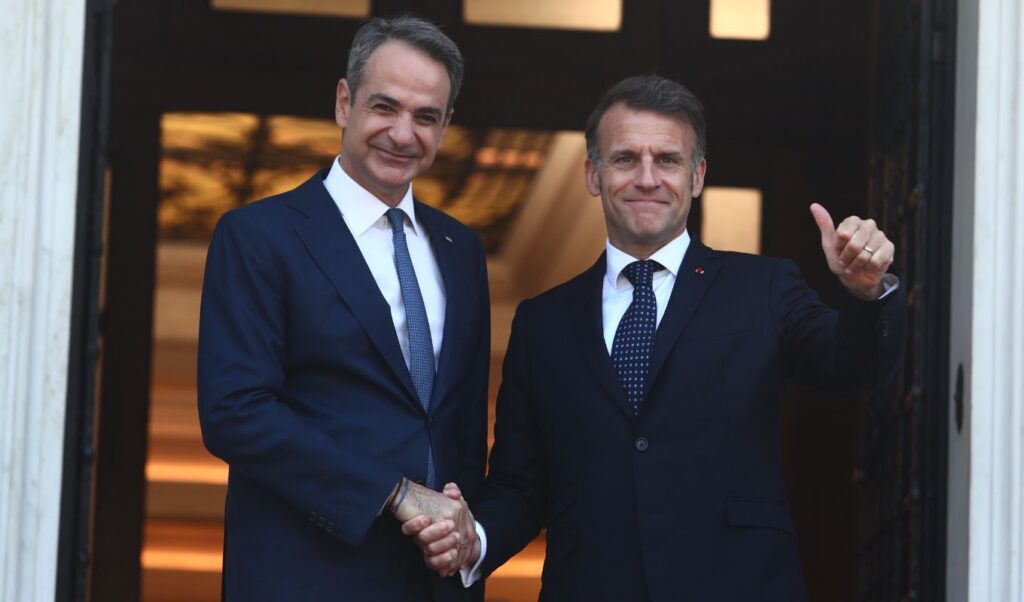
Emmanuel Macron, with his visit to Athens and Nicosia, proved in practice his strong support for defending the sovereign rights of Greece and Cyprus. Greek-French relations have historical depth, are connected by common interests in the Eastern Mediterranean, and in one month, in June in Paris, the agreement for French military presence in Cyprus will be signed, as Nikos Christodoulidis announced. Macron, with his statements and presence in Athens, strengthened the strategic alliance with Greece in a way that no one, as Mr. Ioakimidis says, “can add anything more to it.”
Article 42.7: The mutual defense clause “revives” – “It concerns the entire European Union and certainly Greece”
One of the next goals of Greek-Cypriot diplomacy as well as France is the activation of the mutual defense assistance clause by activating Article 42.7 of the European treaty. At the recent informal Summit in Cyprus, the Greek Prime Minister and the President of the Republic of Cyprus raised the issue with their allies, requesting the fortification of Europe’s southern borders. The demand is based on Trump’s open questioning of NATO and the challenges arising from military conflicts in the Middle East. As Kyriakos Mitsotakis announced, during the Greek presidency of the Council, Article 42.7 will be a priority.
It is worth noting that the rapporteur of the article is Professor Emeritus of European Studies Panagiotis Ioakimidis. He is the one who wrote the article and proposed its establishment 24 years ago. In 2002, within the framework of the European Convention for establishing the European Constitution, he proposed adopting the mutual assistance clause similar to Article 5 of the NATO Treaty, as he mentions in his article. Speaking to parapolitika.gr, he emphasizes that the war in Iran, the attacks Cyprus suffered, and the US distancing from NATO made necessary the revival of the defense assistance clause that “concerns the entire European Union, the Baltic countries and certainly Greece. At this moment it is essentially being revived,” he characteristically emphasizes.