About a year before the national elections, the changing political landscape in Macedonia, as it emerged in the recent electoral contests, represents a personal challenge for Kyriakos Mitsotakis. New Democracy remains the leading party in all polls, however it is evident that parties positioned to its right typically achieve their highest percentages in Macedonia’s electoral districts, capitalizing on the local connections of their political leaders (Velopoulos, Natsios, Latinopoulou, while Maria Karystianou will soon join the equation). For example, in the European elections in Thessaloniki A, New Democracy fell below 25% (24.33% specifically), while all parties to its right cumulatively reached 23%.
Read: Kyriakos Mitsotakis in Thessaloniki on Tuesday
The Prime Minister is therefore traveling to Thessaloniki today, where at 10:30 AM he will visit the Institute for Sustainable Mobility and Transport Networks (IMET) and subsequently visit the construction sites of the 32nd General High School of Thessaloniki and the 5th Elementary School of Ampelokipoi. Following this, Mr. Mitsotakis will visit the port of Thessaloniki. As already announced, after Easter the final pre-congress of the ruling party will be held in Thessaloniki, before the May congress in Athens. Beyond the metro that will soon be delivered to Kalamaria, the Prime Minister’s Office has set the goal for the city to have by mid-2027 a completed Eastern Inner Ring Road (flyover), new Oncology Hospital, new Pediatric Hospital, new courthouse and 17 new schools. Recently the suburban railway connected to Sindos, with a train that serves the needs of the International University as well as the industrial area. Thus, with concrete projects and tangible results, the government wishes to improve the city’s infrastructure while simultaneously regaining strong political majority in the next national elections.
After the Metro extension to Kalamaria, with five new stations, studies will begin and the search for appropriate national and European funding instruments for extending the metro to western and northwestern Thessaloniki, however without cultivating high expectations, as the maturation of studies, tender announcement and project execution will require several years in total to complete.
The public health map in Thessaloniki will change with the addition of two major hospitals. The University Pediatric Hospital of Thessaloniki Stavros Niarchos Foundation (SNF) is scheduled for completion in early 2027. As the first exclusively pediatric hospital outside Athens, it will provide secondary medical services for the greater Thessaloniki area and tertiary pediatric care for all of Northern Greece. In early 2028, the new Anti-Cancer Hospital of Thessaloniki “Theagenio” will be delivered, with a capacity of 425 beds.
Regarding public education, Mr. Mitsotakis’ commitment was that the 17 new schools being constructed through public-private partnership will be delivered on time to operate with the start of the next school year, September 2026. In higher education, the government has long been satisfied with ending, after decades, all occupations at Aristotle University of Thessaloniki and the University of Macedonia, while the ambition is for Northern Greece universities overall to attract increasingly more students from the broader Balkans region and make Macedonia, particularly Thessaloniki, a regional hub of education and innovation.
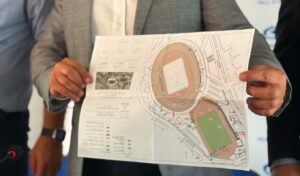
Regarding the redevelopment of the Thessaloniki International Fair (TIF), which has generated significant discussions in Thessaloniki, with signatures collected for a referendum, the government’s proposal as articulated by Mr. Mitsotakis is as follows: No hotel will be constructed, there will be no private participation, the project will be built exclusively from national resources, totaling 120 million euros. The same exhibition space footprint that exists today will remain – slightly more than 30,000 square meters, but in a new building – and there will be complete renovation and repair of the Vellidio as a modern conference center. Green space will be expanded in parallel, so that all remaining space can become a living park connected to the city’s other open areas, while a 600-space parking facility will be constructed to cover parking needs not only for the Exhibition, but for downtown Thessaloniki overall.