
Greece is bracing for an exceptionally difficult 48-hour period, as a powerful storm system is expected to develop from the early hours of Tuesday, October 13, affecting large parts of the country through Wednesday, October 14. Heavy rainfall, intense thunderstorms, localized hail, and gale-force winds are all part of the picture, with meteorological forecasts warning of an elevated risk of flash flooding. The greatest concern centers on Magnesia, the Sporades islands, and Euboea, where rainfall may persist for many hours. In Athens and the wider Attica region, the most severe conditions are expected from late afternoon through the late evening on Tuesday. The Greek National Meteorological Service has issued an emergency weather bulletin, while Civil Protection authorities are on heightened alert.
Read also: Weather alert: Clearchos Maroussakis warns of a Mediterranean tropical cyclone (Photos)
Severe weather: when will the heaviest rainfall hit Athens?
According to forecast data, the weather deterioration will begin in western Greece, with heavy rain and thunderstorms arriving from Tuesday morning in Lefkada, Kefalonia, Zakynthos, western Central Greece, and the western Peloponnese. These conditions are expected to continue in those areas through late afternoon, while Chalkidiki will also be affected from midday, with thunderstorms forecast to persist there until late at night. Gradually, the most intense activity will shift toward the Sporades, Magnesia, and Euboea. In the northeastern Peloponnese and eastern Central Greece — including the Attica region — the most powerful thunderstorms are timed for late afternoon through late Tuesday night. On Wednesday, Athens can expect intermittent rainfall, with a chance of thunderstorms mainly during the early morning hours.
Up to 150mm of rainfall expected in the most vulnerable areas
Meteorologist Giorgos Tsatrafyllias is urging particular caution, pointing out that some areas could record within 48 hours a total rainfall amount equal to — or even exceeding — an entire month’s worth for October. In Magnesia, especially around Mount Pelion, in the Sporades, and in northern and central Euboea, cumulative rainfall totals could surpass 100mm, while some forecast scenarios push those figures as high as 130 to 150mm. For context, Volos receives an average of approximately 65mm of rain in October, Skiathos around 75mm, and Chalkida around 60mm. For the Attica region, forecasts indicate 20 to 50mm in most areas, with the possibility of reaching 60 to 80mm where the most intense thunderstorms develop — compared to Athens’ October average of around 50mm.
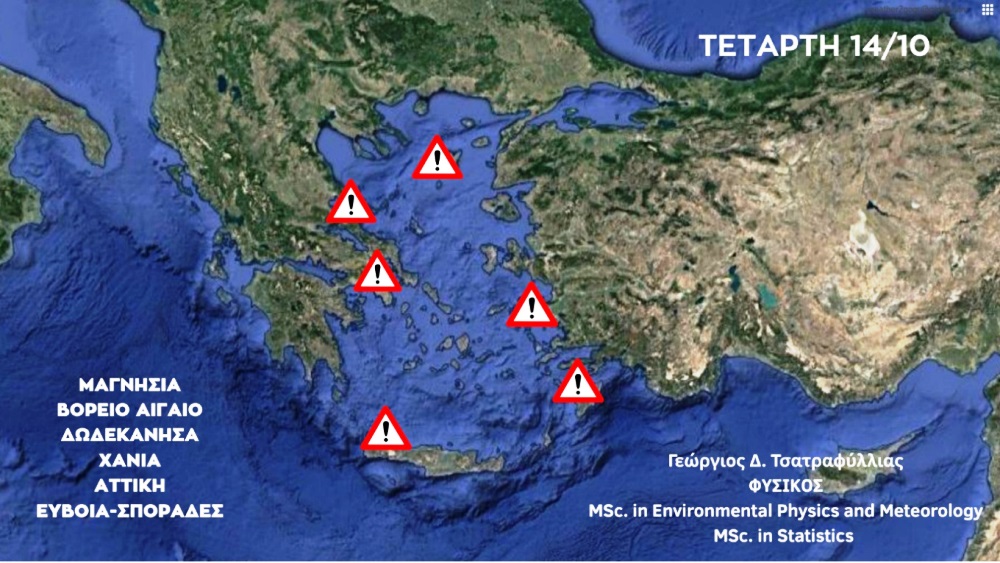
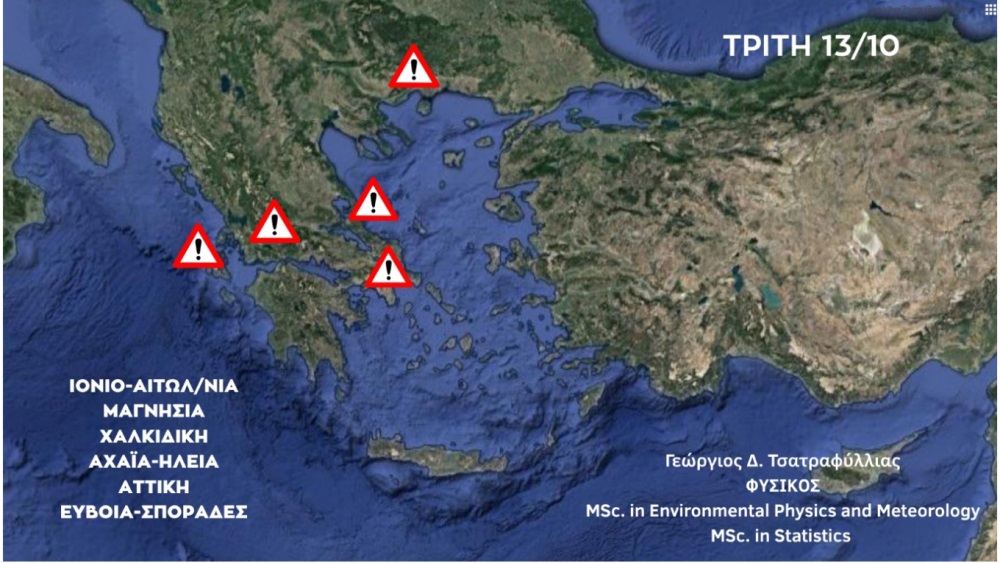
Severe conditions persist through Wednesday
Eastern Thessaly, the Sporades, and Euboea are expected to receive heavy rainfall through late Wednesday afternoon, with the prolonged duration increasing the risk of stream overflow, localized flooding, and landslides. In the Dodecanese islands, where conditions will deteriorate from late Tuesday night, intense weather is forecast to continue through Wednesday afternoon. In western Crete — particularly in Chania and Rethymno — thunderstorms may persist until late at night. Rainfall in several areas may be accompanied by hail, especially in coastal and island locations.
Gale-force winds and heightened emergency preparedness
From Tuesday evening, very strong northeasterly winds are expected across the northern and then central Aegean Sea, reaching 8 to 9 Beaufort through late Wednesday afternoon. Meteorologist Giannis Kallianos estimates that some gusts could reach as high as 10 Beaufort, which may cause disruptions to ferry services, route cancellations, sailing bans, and difficulties at island airports. Civil Protection authorities and the Fire Service have reinforced their operational readiness, urging citizens to stay away from streams and riverbeds, flooded roads, underground spaces, and to avoid unnecessary travel during periods of intense weather activity. A gradual improvement is expected from Thursday, October 15, although localized rainfall and strong winds may linger over the eastern and southern Aegean and Crete.