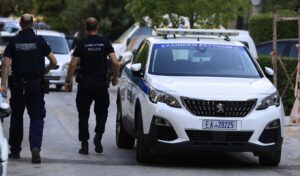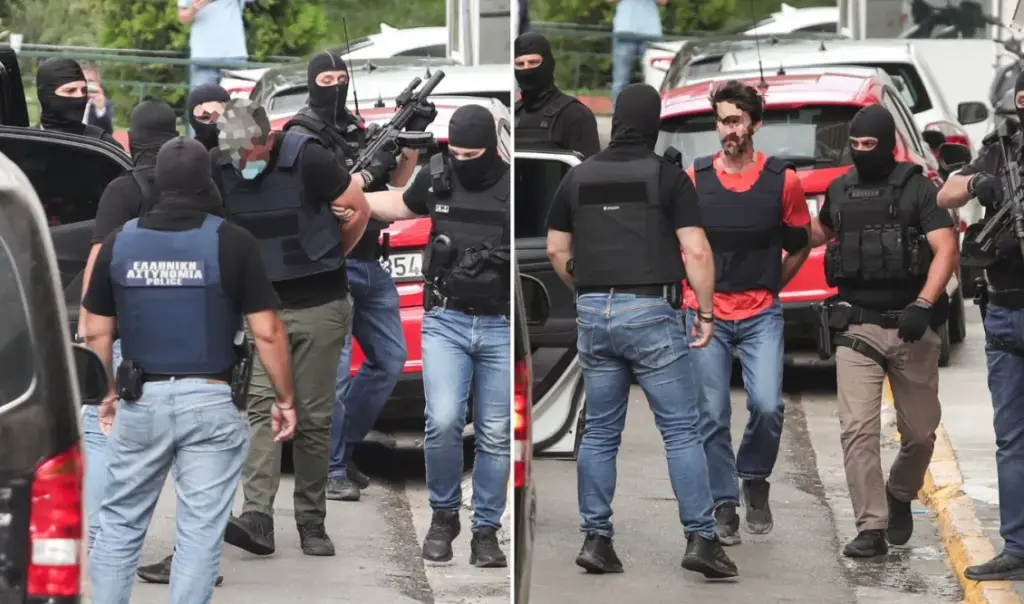
Greek Police (ELAS), under the leadership of Michalis Chrysochoidis, have put an end to the actions of ruthless neo-terrorists who had hoped to revive a climate of fear and undermine every principle of democracy. Authorities arrested the alleged killers of the three employees of Marfin Bank on Stadiou Street in 2010, as well as those responsible for the attack on Vagia Nestora, who fell victim to an arson attack just 11 days earlier in Thessaloniki. Closing the chapter on what had been an unpunished crime for 16 years, the Marfin case was described as a “matter of honor” for Greek Police and stands as the greatest success of the Organized Crime Division — specifically its Homicide Unit — since the dismantling of the “November 17” and “Revolutionary People’s Struggle” terrorist organizations.
Read also: Marfin: The two arrested suspects face charges of premeditated murder — set to appear before an investigative judge on Tuesday
In the days leading up to the arrests, authorities had established that the suspects in both the Nestora case and the bank arson were already defendants in other criminal proceedings. This reportedly prompted Justice Minister Giorgos Floridis to publicly suggest, following an anti-Zionist march by the anarchist group “Rouvikonas” in Thessaloniki, that “the time has come to consolidate criminal files from across Greece. The same was done with Golden Dawn: scattered, pending case files were merged, and that led to the prosecution of an entire criminal organization.” Angeliki Papathanasopoulou, 32 years old and four months pregnant, Epaminondas Tsakalis, 36, and Paraskevi Zoulia, 35, were burned alive on May 5, 2010 — the result, according to police, of actions carried out by two 42-year-old men arrested in the Athens suburbs of Chalandri and Liossia, as well as a 46-year-old woman who has been living in the United Kingdom for several years and is expected to be arrested following the issuance of an international warrant. The arrested suspects, however, deny all charges.
The anonymous tip that cracked the Marfin arson case
Approximately one year ago, just weeks after the establishment of the Organized Crime Division, an anonymous email arrived on investigators’ computers. It contained specific details about three of the perpetrators involved in the group that set the bank ablaze — anti-establishment activists who were already defendants in separate criminal proceedings related to other incidents and offenses. Officers re-examined the visual material collected in 2010, identifying the suspects moving through the area as members of the group that carried out the Molotov cocktail attack. Using artificial intelligence, their presence at the scene of the attack was confirmed, and the findings were forwarded to the competent investigative judge, who subsequently issued the arrest warrants. As reported by the Athens-Macedonian News Agency (ANA-MPA), the report produced by the Digital Evidence Unit of the Forensic Investigation Division contains irrefutable evidence against the three accused, presenting them “without their hoods.” Analysis of photographs and video footage — primarily recorded before and after the attack along the route of the demonstration — revealed the faces of the three defendants. The investigating judge was notified and the arrest warrants were issued.
The two 42-year-old men have no connection to other individuals who had previously been charged in the Marfin case. Until recently, both remained active members of the anarchist community. Notably, at the time of his arrest, one of the two suspects was wearing the same clothes he had worn on the day of the arson attack. As for the 46-year-old mother of two, she relocated permanently to the United Kingdom six years ago.
“Don’t pour the petrol — they were fully aware there were people inside the building,” says Marfin survivor
Maria Karagianni, a bank employee who was present on that fateful day, greeted the new arrests with cautious skepticism. “Past events have made us think carefully before reacting. When they smashed the glass, we were shouting at them, ‘Don’t pour the petrol.’ So they were fully aware there were people inside the building. It’s devastating to beg someone not to burn you alive, only to watch them set the fire without a second thought,” she said, visibly shaken, in an interview with Mega television.
Meanwhile, Thrasyvoulos Kontaxis, legal counsel for some of the victims’ families, told Action channel: “After all these years, we had all placed our hopes in God.” The arrested suspects were brought before the competent prosecutor the following day, from whom they requested and were granted additional time to prepare their defense statements.
The legal history of the Marfin case
The case has returned to the spotlight following the new arrests — a development that may finally lead to its resolution, as it introduces new evidence into the investigation and reignites the hopes of the victims’ families that, after sixteen years, justice may be able to assign responsibility and fully illuminate one of the most tragic cases in post-junta Greek history.
The criminal investigation has passed through many phases. In 2016, two defendants were referred to trial — one for the Marfin arson and another for an attack on the Ianos bookstore. Following a lengthy hearing process, the Athens Mixed Jury Court acquitted both defendants due to insufficient evidence, effectively closing the first phase of the investigation. In 2021, Greek Police requested a new preliminary inquiry, submitting fresh evidence to the Prosecutor’s Office with the aim of continuing the search for the actual perpetrators. However, that investigation had led nowhere — until just days ago, when new evidence was submitted to judicial authorities, ultimately leading to the reopening of the case and the issuance of arrest warrants. Separately, in parallel legal proceedings, bank executives were convicted of manslaughter by negligence due to serious failures in fire safety measures and staff training.
On the civil side, the victims’ families pursued compensation claims, and in 2024 the Supreme Court (Areios Pagos) overturned a previous appellate court ruling, finding that the acquittal of the bank and its board members regarding responsibility for building safety had not been sufficiently substantiated.
Originally published in the newspaper “Apogevmatini”