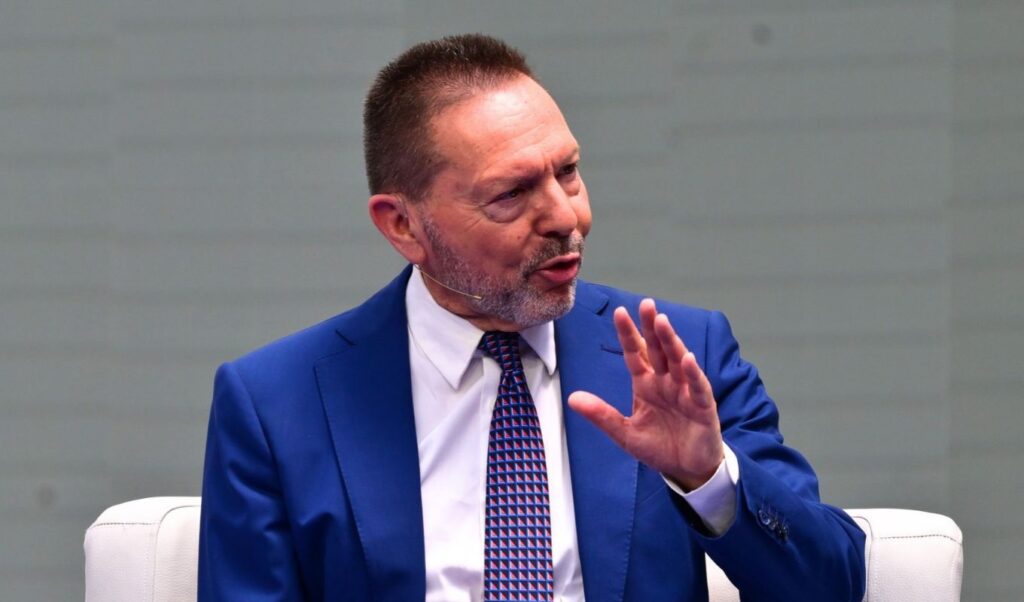
Bank of Greece Governor Yannis Stournaras spoke about the ongoing battle against inflation, warning that it remains the top priority of monetary policy. In an interview with the Hellenic Parliament Channel on the programme “Voulis Vima,” the central bank governor also stressed the need to avoid complacency following Greece’s return to investment-grade status, calling for continued fiscal responsibility, structural reforms, and sustained investment. Stournaras also sounded a note of caution as the European economy faces higher energy prices, geopolitical tensions, major fiscal pressures, and trillion-euro investments in artificial intelligence.
Read also: Eurostat: Inflation jumps to 5.1% in Greece in September — 3.8% in the Eurozone
Stournaras: The worst thing of all is to let inflation spiral out of control
Of particular interest was his reference to the European Central Bank’s stance. Stournaras said he has urged caution in interest rate decisions, as any new increase directly affects borrowing costs. At the same time, however, he underlined that keeping inflation close to the 2% target is the first line of defence for the most vulnerable citizens. “The worst thing of all is to let inflation spiral out of control. That is what will hit the vulnerable citizen the hardest,” he said emphatically.
The Bank of Greece governor explained that the current inflationary picture is driven not only by supply-side factors — such as energy pressures and geopolitical developments — but also by demand. At a global level, he said, fiscal expansion in several countries, combined with massive investments in artificial intelligence, is generating additional inflationary pressures.
📌 Ο Διοικητής Γιάννης Στουρνάρας μίλησε στο Κανάλι της Βουλής και στην εκπομπή «Βουλής Βήμα» με τη δημοσιογράφο Αλεξία Κουλούρη.
👉https://t.co/vCO9mZ4oWr pic.twitter.com/g0LH4Yle0H— Τράπεζα της Ελλάδος (@BankofGreece) October 2, 2026
In Greece specifically, there is an additional factor at play: robust domestic demand. Stournaras linked Greece’s persistently above-average inflation to excess demand relative to the economy’s productive capacity, citing the strength of the tourism sector as a prime example.
At this point, he also brought the fiscal dimension into the equation. Greece, he stressed, cannot afford to forget its past. The country may have significantly improved its position, but its high public debt still demands caution. “We must never repeat the mistakes we made back then,” he said, referring to the period of the debt crisis.
The “key” of investment-grade status
Stournaras placed particular emphasis on the benefits of Greece’s upgrade to investment-grade status. As he explained, the improvement in the country’s creditworthiness translates into lower borrowing costs — and not just for the government.
He estimated that the narrowing of the yield spread between Greek and German bonds is approaching one percentage point compared to the period before Greece regained investment-grade status. With public debt of around €340 billion, he explained, one percentage point theoretically corresponds to €3.4 billion in savings.
The next milestone, according to the Bank of Greece governor, is an A-category rating. To achieve it, Greece must sustain fiscal discipline, push forward with reforms, and improve its institutions — with particular emphasis on the justice system.
From non-performing loans to housing pressure
The discussion also extended to lending, with Stournaras acknowledging that higher interest rates make access to financing more difficult and can put additional strain on households already under financial pressure.
The link to non-performing loans is direct: every increase in the cost of servicing a loan adds to the burden on borrowers. Nevertheless, the governor identified the prevention of a new, broad-based inflationary crisis as the overriding priority, since such a crisis would hit lower-income households even harder.
He also noted that the Greek economy is growing faster than the rest of Europe and that real wages have risen, while acknowledging that there are households unable to cope with the high cost of living. For those, he said, targeted social welfare policies are essential.
What he said about the Recovery Fund completing its cycle
With the Recovery Fund drawing to a close, Stournaras described the period ahead as a “test of maturity.” The available funds do not simply stop producing results overnight. Projects are ongoing, residual ESPA (structural funds) allocations remain, and the Recovery Fund loans that have already been approved will continue to flow into the economy.
The real challenge, however, is ensuring that Greece does not revert to a growth model driven exclusively by consumption. Here lies perhaps one of the governor’s most significant observations: Greece’s productive model, he argued, has changed substantially. Greek exports have more than doubled as a share of GDP compared to the past, now approaching 50%, with Greek companies establishing a strong presence in pharmaceuticals, cement, chemicals, steel, and pipes.
He made special mention of pharmaceuticals, noting that Greece produces around 10% of Europe’s medicines, while its GDP accounts for less than 2% of the European total. The challenge, however, persists on the external balance front, as rising exports are accompanied by high imports. In this area, Stournaras sees the greatest potential in the energy sector: more grid infrastructure and energy storage could significantly reduce the need to import fuels.
Low private savings and the demographic challenge
The issue of low private savings fits into the same broader picture. The Bank of Greece governor argued that Greece continues to save less than it needs to, connecting this directly to the pension system and the country’s demographic outlook.
He made specific reference to occupational pension funds, describing recent reforms as one of the most significant structural changes that can boost savings and generate additional income for future retirees.
The demographic crisis, he said, represents one of Greece’s greatest long-term challenges, as the country faces a significant decline in population.
Europe in the crosshairs too
Stournaras also addressed European competitiveness, referencing the reports by Mario Draghi and Enrico Letta. Their proposals, he said, are not new to central banks, but the two reports brought Europe’s challenges together into a clear action plan: removing barriers to the single market, boosting investment, and completing the Capital Markets Union and the Banking Union.
The problem, in his view, is not a lack of proposals but the pace of implementation. Diverging national interests and the need for agreement among member states continue to slow the process of reform.
Digital euro, artificial intelligence, and the “new” money
The Bank of Greece governor also placed technological change at the top of the challenges facing central banks. The digital euro, he explained, will be central bank money in digital form — an electronic equivalent of cash — rather than simply another payment card.
According to Stournaras, its development is tied to the need to preserve the role of public money at a time when private digital payment instruments and cryptocurrencies are on the rise.
Meanwhile, the Bank of Greece has begun leveraging artificial intelligence and is investing in the security of its systems. The governor warned that cyberattacks represent a growing threat, as new technology can equally be exploited by malicious actors.
“We must reach an A-grade upgrade”
The message with which Stournaras effectively concluded his economic assessment was that Greece has changed, but has not yet completed its journey. He noted that Greece is now being called upon internationally to share its experience with countries seeking to understand how an economy that was at the epicentre of a deep crisis managed to return to investment-grade status and strengthen its exports and investment.
However, he set out a clear condition: progress must not lead to complacency. “We must reach an A-grade upgrade,” he said, identifying fiscal responsibility, financial stability, structural reforms, justice system reform, cutting red tape, and linking the private sector to education, research, and technology as the key pillars.
In an environment of heightened international uncertainty, the Bank of Greece governor’s message is clear: the next phase will not be decided solely by the trajectory of interest rates or inflation, but by whether Greece seizes this period of stability to permanently transform its productive model.