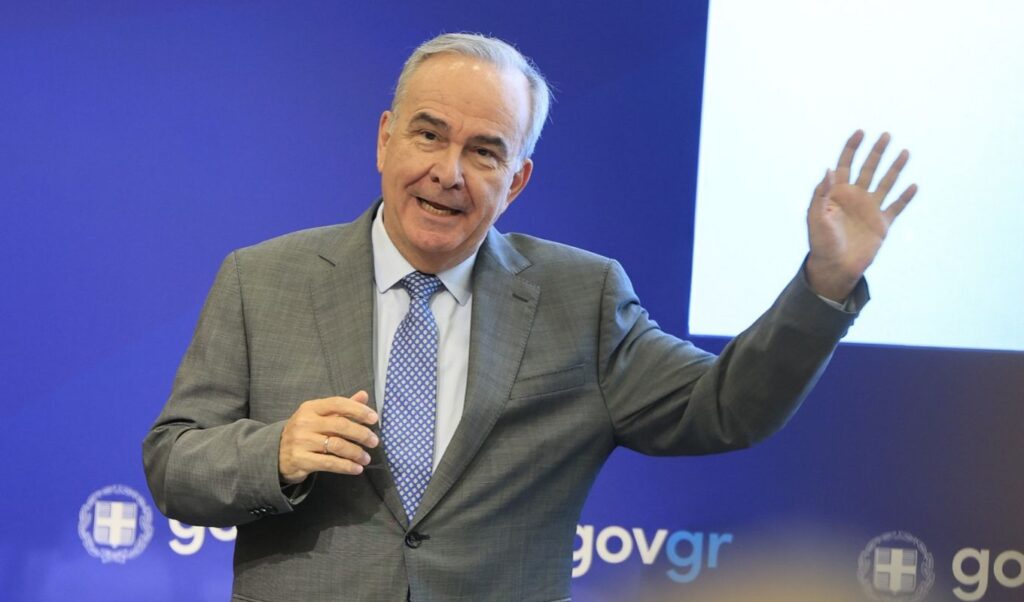
Deputy Minister Nikos Papathanasis spoke to ERT about the measures to be taken to support citizens, highlighting the slight drop in global oil prices — from $108 to $100 per barrel — and previewing government intervention on heating oil prices. Acknowledging market volatility with the phrase “we will wait and see how international markets develop,” he previewed the heating oil announcement: “The relevant announcements will be made by the end of the month, as the Prime Minister has already stated.” He also addressed broader fuel cost interventions, including pump-level support for diesel and refinery-level measures. “We have proven that we are on top of the problem,” he stated, noting that the government is fully aware of the difficulties citizens face and remains focused on their everyday needs.
Read more: Pierrakakis on the front line of the cost-of-living communication battle — The roles of Markopoulos and Papathanasis
Papathanasis: “Europeans cannot turn a blind eye”
Europe must step up and help, Nikos Papathanasis said, echoing the rhetoric that has been coming from government officials in recent days. He argued that the problem is fundamentally a European one, recalling that a previous EU decision allowed certain energy investments to be excluded from spending limits, thereby creating additional fiscal space. “Europeans cannot turn a blind eye to such a serious problem that affects the daily lives of our fellow citizens,” he stressed.
Should a new escape clause be activated, the government intends to make full use of the additional fiscal room it would create: “We will exhaust the margin of the escape clause. That is not even up for debate — it’s what we did this time around as well.” He clarified, however, that any such European decision would complement — not be a prerequisite for — the new measures the Prime Minister is set to announce. “Things are very fluid,” he noted, referring to the international environment.
His response to Tsipras on the special consumption tax
The deputy minister also addressed opposition leader Alexis Tsipras’s proposal to cut the Special Consumption Tax (excise duty) on fuels by 50%, focusing on the fiscal cost such a move would entail. “The Special Consumption Tax brings in 4 billion euros to state coffers. Fifty percent of that is 2 billion euros,” he said, posing the question: “Who is he going to tax to make up for that money?” He concluded that Tsipras would have no choice but to impose new taxes. “We’re back to his old rhetoric about raising taxes. There is no other way,” he declared.
He also referred to the increase in the excise tax during the SYRIZA government and commented on the former prime minister’s talk of “prioritizing” the measures he had presented in Thessaloniki. “Look at how the U-turn happens,” he said, arguing that “what he told the Greek people in Thessaloniki was not true.” He called for clarity on where the funding for any excise tax reduction would come from, and contrasted Tsipras’s proposals with the government’s own interventions, which, he said, would be fully reflected in the budget. “What we say, at any rate, comes with a price tag attached,” he noted.
On the question of additional taxation of windfall profits made by refineries, he pointed out that a similar measure had already been applied for the 2022 and 2023 fiscal years, while arguing that it does not directly reduce pump prices. “That is not, however, what brings fuel prices down,” he said.
The €1,000 minimum wage target
On the subject of tackling the cost of living, Papathanasis emphasized increasing disposable income through more jobs, lower tax rates, and higher wages in the private sector.
He noted that 600,000 new jobs have been created and reiterated the government’s target of a €1,000 minimum wage. He also commented that economic and labour market conditions are the primary drivers of private sector wages. “The market wants a strong economy. Greece has a strong economy, and that is what is pushing private sector wages higher,” he argued.
On the Recovery Fund
The deputy minister also addressed the funding of government initiatives through the Recovery Fund, citing examples such as preventive medical screenings, new buses, hospital and health centre renovations, and land registry improvements. “One tranche of the Recovery Fund — the €18 billion — does not have to be paid back by the country,” he clarified, referring to the non-repayable resources.
For the 2026–2030 period, the national component of the Public Investment Programme is projected at €23 billion, up from €10 billion previously. An additional €7 billion is linked to the Social Climate Fund and the Modernisation Fund, earmarked for, among other things, social housing, people with disabilities, and vulnerable social groups. For the new European programming period 2028–2034, Greece’s allocated resources are set at €49.5 billion, with the relevant agreement expected in the second half of 2027.
Raised age limit in the “My Home 3” housing programme
On housing, the “My Home 3” programme is designed to benefit approximately 15,000 families, while the previous “My Home 2” scheme helped around 14,000 citizens and families acquire a home. Under the new programme, the eligible age limit is raised to 55, the maximum property value increases from €250,000 to €400,000, and the maximum loan amount rises from €190,000 to €230,000. Properties with building permits issued up to 2007 — rather than 2005 — will be eligible, and income criteria will also be broadened. “This is therefore an expanded programme, with higher income thresholds,” he said.
Regarding the €500 million renovation programme, approximately 90,000 citizens have received eligibility approval, of whom around 14,000 involve closed or vacant properties that will be given priority. From 1 October, applications will be accepted, with subsidies of up to 95% and a maximum grant of €36,000. “Renovation means replacing your bathroom, your kitchen, your flooring — something that does not constitute an energy upgrade. That is the key difference,” he explained.
Overall, he estimated that the various housing initiatives cover approximately 25,000 homes. “The housing issue, which is extremely important, cannot be solved by a single decree or one decision. It requires many actions — and that is exactly what we are trying to do,” he underlined.
€5 billion financing programme for small and medium-sized enterprises
A new financing programme for small and medium-sized enterprises is planned to be launched towards the end of December, through the Hellenic Development Bank, using Recovery Fund resources, with discussions already underway with commercial banks. The programme will offer borrowing at an interest rate of 0.35%, or financing with an 80% government guarantee. “This will therefore effectively mobilise loans worth €5 billion,” he stated.
He also previewed new ESPA (structural funds) programmes targeting investments that strengthen European strategic autonomy and support the domestic production of goods currently imported from third countries. As an example, he cited an investment of €300,000 that could receive a subsidy of approximately €200,000 — a grant rate of nearly 67%.
Finally, on the subject of the 2027 budget, Papathanasis acknowledged the uncertain international environment. “This is not the first budget to be submitted in a climate of uncertainty,” he said, noting that Europe has been navigating similar conditions for years.
He noted that €800 million has already been allocated to address the current crisis and referred to the medium-term fiscal programme for planning in the years ahead. He also criticised the economic proposals put forward by Alexis Tsipras and Nikos Androulakis, insisting on the importance of costing measures properly and adhering to fiscal targets. “Greece cannot afford to make mistakes, and it cannot afford to go backwards,” he said.