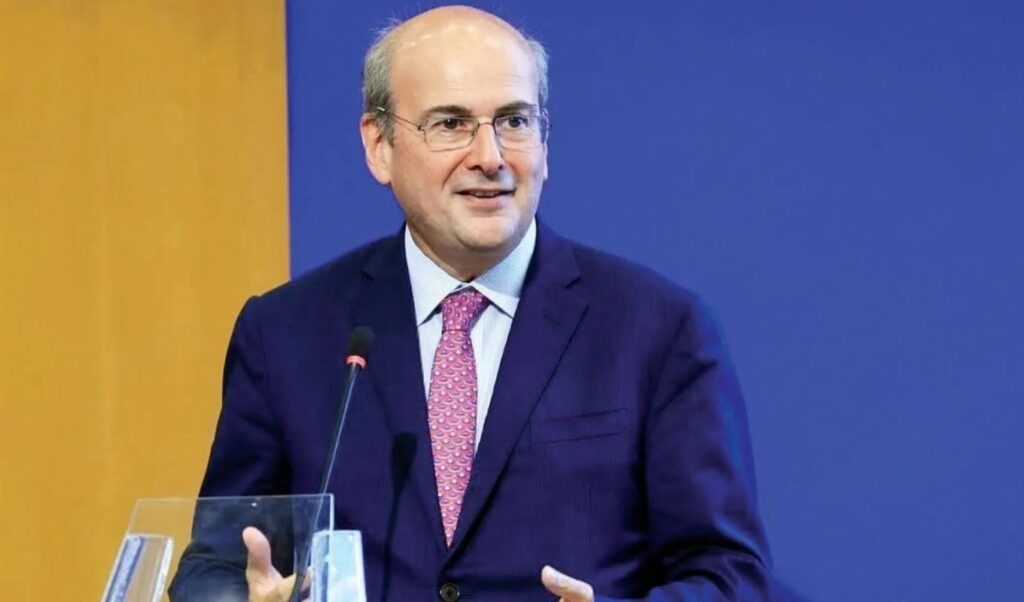
Boosting productivity, increasing productive investments, and strengthening competitiveness took center stage at today’s General Council meeting of the Hellenic Federation of Enterprises (SEV), which was attended by Deputy Prime Minister Kostis Hatzidakis. During the session, a wide-ranging discussion took place with the Deputy Prime Minister, focusing on current economic developments and the government’s priorities for the period ahead.
Read more: Hatzidakis: Upgrading the Athens Stock Exchange is a key lever for boosting investment
According to SEV’s briefing, the discussion covered a range of issues, including the strengthening of productive investments, energy costs and industrial competitiveness, the removal of barriers to investment implementation, and European priorities ahead of negotiations on the new Multiannual Financial Framework (MFF) for 2028–2034.
Hatzidakis: Our great challenge is a major development leap for the Greek economy, centered on improving productivity and competitiveness
In his address, Hatzidakis emphasized: “Having now left the crisis behind us and having restored the country’s credibility, our great challenge is to achieve a major development leap for the Greek economy, centered on improving productivity and competitiveness. This means a more business- and investment-friendly environment, faster adoption of Artificial Intelligence across all sectors, and strong incentives for the digital transformation of businesses, the completion of spatial planning, greater access for businesses to private capital, and the upskilling of our workforce.
For industry specifically, following a cycle of interventions in recent years — such as tax reductions, the simplification of the licensing framework, and the completion of the new Special Spatial Planning Framework — our plan for the next four years includes measures to improve the framework for industrial parks and the organized establishment of industrial activities. The aim is to ensure sufficient and suitable land, promote the connectivity of industrial zones with transport networks and infrastructure, further simplify and accelerate licensing procedures, and broaden access to capital for productive investments.
At the same time, with the new Multiannual Financial Framework 2028–2034 on the horizon, it is critical that we ensure Greece has meaningful participation in the new European instruments designed to strengthen competitiveness. In this direction, the timely mobilization of businesses, universities, and research centers to submit competitive proposals is essential. This is a significant opportunity to position our country in the EU’s fast lane on growth, productivity, and outward orientation — and we all have an obligation, both the state and the domestic productive and business community, to make the most of it.”
SEV General Council: New business productivity measurement guide unveiled
At the Council meeting, a new Business Productivity Measurement Guide was presented, developed by IOBE (Foundation for Economic and Industrial Research) in collaboration with SEV. As SEV notes, this is a practical tool that helps businesses — particularly small and medium-sized enterprises — systematically measure their productivity, benchmark their performance against companies in the same sector across Greece and the European Union, and identify opportunities for improvement.
The guide draws primarily on data that businesses already hold in their financial statements and information systems, organizing measurement around key metrics such as Value Added, employment, payroll, and fixed assets. It is also accompanied by a calculation tool through which a business can enter its data and automatically compute its value added and productivity per employee, as well as its deviation from the sector average in Greece and the EU-27. It is aimed at company boards, finance departments, human resources executives, business consultants, investors, and anyone seeking to understand and improve business productivity.
SEV Board Chairman Spyros Theodoropoulos stressed that increasing productivity is directly linked to accelerating productive investments and enhancing the competitiveness of the Greek economy. He noted that while significant progress has been made in recent years, the next phase calls for more ambitious interventions in the areas of productive investment, technological transformation, and tackling energy costs. He also emphasized that improving productivity is not only a matter of investment and policy, but also of business culture — systematic measurement, evaluation of results, and the continuous pursuit of better utilization of people, technology, and capital. He stated: “What is now required is not simply to continue on the same path. What is required is to move to the next phase — to translate the progress of recent years into consistently higher productivity, more productive investments, stronger international competitiveness, greater export dynamism, and ultimately, better wages and greater social prosperity.”
On behalf of IOBE, the Foundation’s Director General, Professor Nikos Vettas, said: “Productivity lies at the heart of every successful business and is an indicator of how effectively resources are being utilized. Measuring it at the firm level is a fundamental pillar for understanding competitiveness, ensuring the proper allocation of resources, building resilience, and assessing the capacity to efficiently convert available resources into high-value products and services.”