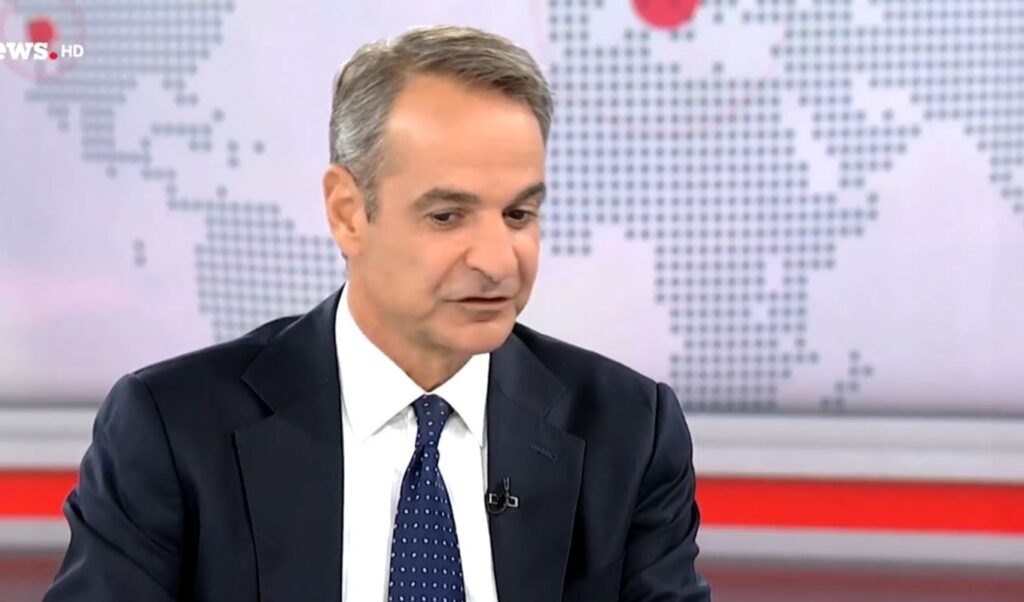
Government intervention aimed at bringing the starting price of heating oil below €1.75 per liter, along with an across-the-board increase in the heating allowance, was announced by Prime Minister Kyriakos Mitsotakis. Speaking in his first comprehensive interview since the Thessaloniki International Fair, on the ERTNews prime-time bulletin with Panagiotis Stathis, the Prime Minister outlined a series of support measures for households ahead of the winter season. He indicated that the government is leaning toward a universal increase in the heating allowance, while leaving open the possibility of intervening in profit margins and, if necessary, implementing a temporary emergency reduction in the Special Consumption Tax.
Read also: Mitsotakis escalates two-front offensive against PASOK and SYRIZA: Why he’s banking on the rivalry with Tsipras and how he’s building the case for a majority government
Announcements expected from relevant ministries
According to the Prime Minister, the relevant announcements will be made at the start of next week by the competent ministries. “We always make sure to keep some reserves in hand,” he noted, emphasizing that there will be significant support from both the government and the refineries. The goal, he clarified, is for the starting price of heating oil to come in below €1.75 per liter — the price at which it closed last October.
Measures extended to diesel as well
Kyriakos Mitsotakis also announced that the measures will be extended to diesel fuel in October, as part of broader efforts to keep fuel costs in check. Final details regarding the size of the heating allowance increase, the implementation of these measures, and any potential tax interventions are expected to be revealed in the official ministerial announcements.
Mitsotakis: “No meeting with Erdoğan is planned”
Greek-Turkish relations were also a central topic during the interview. Commenting on the Turkish president, Mitsotakis stated that no meeting is currently scheduled. “At this point, no meeting with Erdoğan is planned. It’s not certain that our schedules will align,” he said, though he did not rule out such a meeting if the opportunity arises.
On Greek-Turkish relations, he said: “We do not threaten anyone — Greece has been significantly strengthened in recent years, but our orientation is defensive. That said, we will not accept being threatened by anyone either. Turkey is our neighbor and that will not change. Our relations must be defined by geography. The Athens Declaration provided a framework for dialogue, ensuring that even during periods of tension, open channels of communication can be maintained.”
When asked about recent Turkish rhetoric, the Prime Minister acknowledged “a relative deterioration,” while noting that many of the positions voiced by Ankara are not new. “There has been a deterioration in Turkey’s rhetoric, but we should not forget that many of their positions have been expressed before. The waters are getting a little rough. We do not threaten anyone. Our position is one of defensive deterrence. We do not threaten anyone, and we will not accept being threatened.”
“Greece conducts its foreign policy through actions,” he stressed, highlighting that the country’s defense capabilities have been substantially reinforced in recent years. At the same time, he kept the door to dialogue open. “We are neighbors with Turkey — geography is a given,” he said, while also describing the Athens Declaration as a solid framework for structured dialogue. He further emphasized the importance of maintaining open communication channels whenever de-escalation is needed. On the issue of extending territorial waters to 12 nautical miles, he reiterated that this is a right enshrined in international law, which Greece may exercise when it deems the conditions appropriate. “The right to extend to 12 nautical miles is guaranteed by international law. We will use it whenever we see fit,” he said.
Mitsotakis also made special mention of his recent visit to Kastellorizo, speaking of the “emotion” and “positive energy” he received from the island’s residents. He underscored the importance of the measures he announced for the island, noting that “it is not easy to live on a small island” and that additional incentives are needed for those who choose to remain there.
On the electrical interconnection with Cyprus
Regarding the electricity interconnection project, the Prime Minister argued that the French side’s investment decision signals a genuine commitment to moving forward with the project, which he described as being of common European interest. He also sent a message to Turkey that in an interconnected Mediterranean, “artificial obstacles” should not be erected, while revealing that coordination with the French side is already underway regarding next steps.
“It will begin soon — it is a project also funded by Europe, and for Turkey to raise barriers is not the best response. There is coordination with the French side; the project is no longer solely Greek, but French as well,” he said.
“The only realistic governing proposal is a majority New Democracy government”
Mitsotakis went on to address the topic of a parliamentary majority, commenting on recent statements by Giorgos Floridis. He noted that “nobody — not even Floridis — posed an ultimatum,” but stressed that in an environment of international uncertainty, it is crucial for the country to have a stable government.
“We are entering uncharted waters,” he said, continuing: “Mr. Floridis expressed in his own way something I have also said. It is very important to have a government — and a stable one — after the elections. The only realistic governing proposal is a majority New Democracy government. All opposition parties have ruled out any possibility of cooperation.”
“This is not coercion — it is reality,” he noted, reiterating the “hope or adventure” dilemma and arguing that the other parties have not, in his view, presented a realistic alternative governing proposal.
On the economy
Mitsotakis also rejected, at least under current fiscal conditions, the prospect of a permanent reduction in the Special Consumption Tax. “The budget cannot sustain that at this moment,” he said, explaining that if a special European mechanism existed that would allow such an intervention to be excluded from expenditure ceilings, it could be applied on a temporary basis.
“Europe must do more about rising fuel costs. However, we cannot simply cut the special consumption tax. In extraordinary circumstances, we could temporarily reduce it for a limited period,” he said.
The Prime Minister reiterated that fiscal stability and the reduction of public debt remain core government priorities. “My obligation is to ensure that this country never faces a debt crisis again,” he stressed.
PASOK and SYRIZA announcements are “empty words”
The Prime Minister also raised the temperature against the opposition on economic matters, insisting that “the numbers have to add up.” He defended the costing of the government’s Thessaloniki Fair announcements, noting that they will be reflected in the budget and the Medium-Term Programme, and attributed the ability to deliver new measures to growth, surpluses, and the crackdown on tax evasion. He did acknowledge, however, that a significant portion of previous income increases has been eroded by accumulated inflation.
On wages, he said that Greece “is neither last in Europe nor experiencing an economic miracle,” while accusing the opposition of “absolute negativism.”
“Greece will not face a debt crisis again. Our programme is costed down to the last euro. At the Thessaloniki Fair I spoke about a four-year horizon. We have growth above the EU average, we have surpluses — and we need them. We have a prosperity surplus that must be returned to citizens. According to Eurostat: our wages are not at Bulgarian levels, but at Portuguese levels. This accurate picture from Eurostat shows that we are not living an economic miracle — we’re not first, we’re not last, we’re in the middle. The image of absolute negativism from the opposition is not helpful. It would be far more credible if it acknowledged the progress that has been made.”
On PASOK and SYRIZA’s announcements, he used even sharper language, calling them “empty words,” arguing that “the math simply doesn’t work out.”
Mitsotakis: “No unemployment benefit will be cut”
On the topic of unemployment benefits and comments made by government spokesman Pavlos Marinakis, Mitsotakis emphasized that no unemployment benefit will be cut: “It is an insurance-based, contributory right. We have carried out a significant reform — what matters is that people receive more at the beginning, when they need it most. We also have the employment benefit with the 50% subsidy. If someone is offered work and refuses it, then they should not receive the unemployment benefit. The framework is clear, but this discussion is taking place in a very different labor market. Unemployment is at 7.9%, not the 18% it once was.”
On Pavlos Marinakis, he noted: “We have an exceptional government spokesman. He is in a particularly demanding position because he expresses the government’s positions. I know it can sometimes be difficult to separate the government’s stance from a personal one. Pavlos Marinakis understood that, and I surround him with full confidence for the outstanding work he does.”
Polls, a parliamentary majority, and post-election scenarios
When asked what would happen if New Democracy fails to secure an outright majority, Mitsotakis avoided committing to specific post-election scenarios.
On the polls, he noted that it is unusual in Europe for a party that has governed for seven and a half years to maintain, as he put it, a significant lead over the opposition. He acknowledged the wear and tear of governing, adding that this demands greater effort “in both substance and tone.” “In post-dictatorship Greece, after nearly two full terms, no governing party has maintained such a large lead over the second-placed party. The second and third parties combined don’t match New Democracy’s share. The last thing we should be projecting is a sense of assured certainty that we are somehow irreplaceable,” he said, adding: “The Greek people are the boss — they will decide who governs.”
He also recalled that he has previously served as a minister in a coalition government with PASOK, while describing discussions about post-election coalitions as “premature and ungrateful.” “We have a difficult winter ahead of us,” he noted.
“I will not deal with elections before the pre-election period,” he added.
What he said about Samaras and Karamanlis
The Prime Minister was brief when asked about Antonis Samaras. “Whatever I had to say about Samaras, I’ve already said,” he replied, adding that if the former Prime Minister ultimately moves forward with forming a new party, then the question could be revisited.
On Kostas Karamanlis, he said: “I have a good relationship — I believe a good personal one as well. I respect the fact that he has chosen to distance himself from politics. Political cycles come to a close. I respect that he no longer wishes to intervene the way he did when he was an active politician. Mr. Karamanlis is deeply identified with New Democracy, and as I have said of all those who have served as Prime Minister.”
Mitsotakis: “I will not make Kasidiaris a dialogue partner of mine”
On the subject of Ilias Kasidiaris, Kyriakos Mitsotakis stated that the existing legal framework is sufficient and requires no further strengthening.
He acknowledged that extreme voices continue to find an audience and referenced the role of social media, as well as forces outside Greece that, he argued, may invest politically in such figures.
“The Prime Minister is the Prime Minister of all Greeks,” he said, stressing that government measures are not taken based on citizens’ party affiliations.
On Kasidiaris specifically, he was unequivocal: “We all know who he is and what his track record is. Personally, I will not make him a dialogue partner of mine.”
What he said about constitutional revision
Turning to constitutional revision and points of political convergence within the opposition, he launched a fresh offensive against the two main opponents of the government on the center-left and the left, saying that “Androulakis’s PASOK and SYRIZA are two sides of the same coin.”
Watch the full interview: