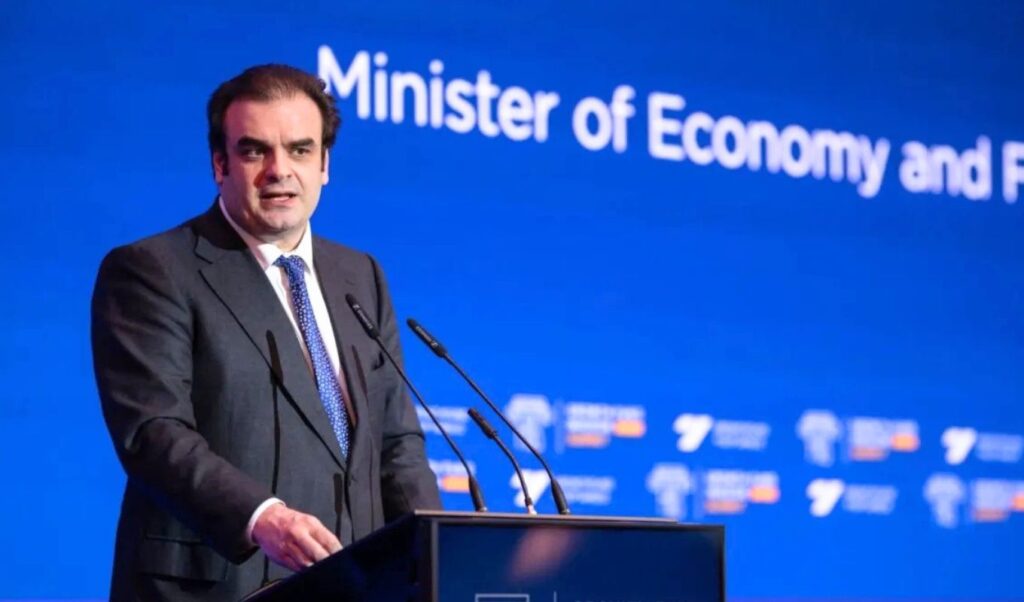
Greece’s Minister of National Economy and Finance and Eurogroup President, Kyriakos Pierrakakis, told German newspaper Handelsblatt in an interview that while Germany doesn’t need advice, Greece’s experience can serve as a source of inspiration.
Read also: Pierrakakis visits Germany for meetings with Chancellor Merz and counterpart Lars Klingbeil
Cooperation with Klingbeil and the Greek example
Kyriakos Pierrakakis referenced Germany’s Vice Chancellor, noting that reforms that work in one country are not necessarily guaranteed to succeed in another. “I work very closely with Lars Klingbeil. He is an outstanding colleague and doesn’t need advice from me.”
The Greek Finance Minister went on to stress that “I find it a source of inspiration that in my country we managed to overcome a decade of hardship. Greece faced an existential crisis, and today we are on the verge of a historically low unemployment rate. We are achieving primary budget surpluses, while our economic growth rates are double the eurozone average. The inspiration I believe Greece can offer in this context is that reforms may be painful at first, but they ultimately pay off — both politically and economically. Germany has always been an anchor of stability in the Monetary Union.”
Germany has enormous growth potential
When asked about the country’s prolonged period of sluggish growth, Kyriakos Pierrakakis noted that Germany is Europe’s industrial powerhouse, with enormous potential to generate growth — both domestically and across Europe as a whole. With its comparatively low level of debt, he added, Germany is in a very strong position. He expressed confidence that the German government will push ahead with the reforms it has set as goals and which the economy needs.
Reforms and risks for Europe
The Eurogroup President emphasized that “if we continue to advance reforms at the European level as well, we will all benefit together.” On the current situation in international markets, he noted that rising yields do not pose a problem for the eurozone. Higher energy prices, rising inflation expectations, and strong global demand for capital — driven largely by investment in artificial intelligence — are affecting all markets.
Eurozone fundamentals remain strong
“The eurozone’s fundamentals remain strong. Member states are borrowing at lower interest rates compared to the United States or the United Kingdom. The spreads in risk premiums between eurozone countries, which in the past had caused uncertainty, also remain contained…” said Kyriakos Pierrakakis, who noted that rising interest rates are increasing pressure on public budgets.
Three priorities
As Eurogroup President, Kyriakos Pierrakakis outlined three key priorities:
– States must ensure the sustainability of their public finances and adhere to agreed spending paths
– Public spending must contribute more to growth
– Advancing the Savings and Investments Union, as the necessary investments cannot be financed through public budgets alone