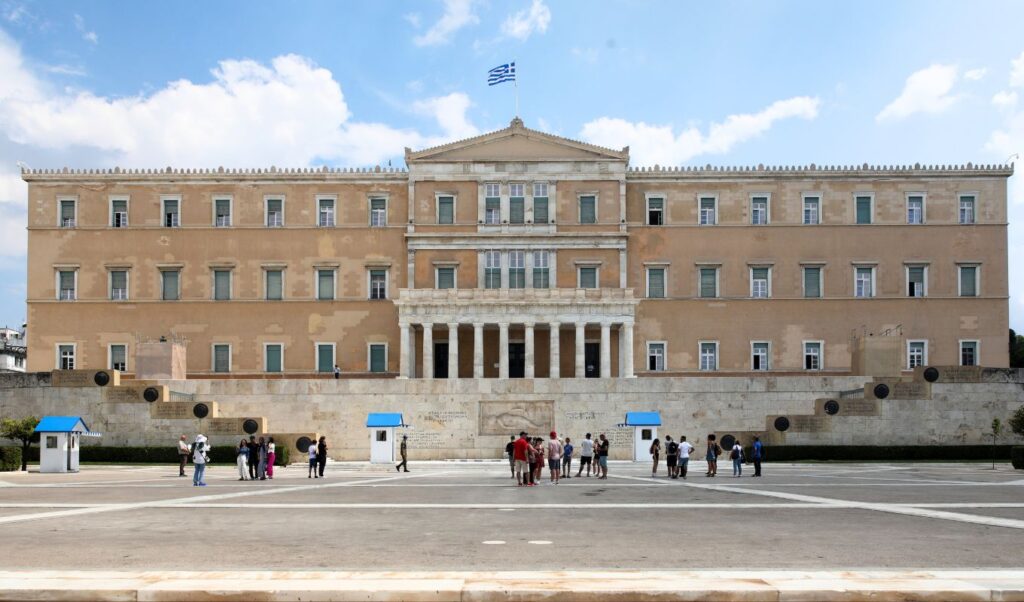
A new study by the State Budget Office at the Hellenic Parliament underscores that maintaining primary surpluses and reducing public debt as a percentage of GDP — alongside growth-enhancing reforms — are essential prerequisites for keeping Greek sovereign borrowing costs low and limiting the impact of global shocks on the national economy.
An unprecedented fiscal adjustment
Greek sovereign bond yields have undergone a remarkable transformation over the past decade: from levels above 7% in 2016 — the highest in the eurozone and a legacy of the debt crisis — they fell by 2024 to levels comparable to those of Italy and Portugal, reflecting an unprecedented fiscal adjustment. Greece has thus managed to transition from being the eurozone’s most vulnerable sovereign borrower in times of global turbulence to a country that has ranked in the middle of the eurozone table over the past four years.
What the State Budget Office study finds
This achievement is not the result of any structural peculiarity in the Greek debt market, but rather of the country’s fiscal performance, which has earned investor confidence, as emphasized in the second research note published by the State Budget Office at the Hellenic Parliament. At the same time, however, the report warns that this improvement should not be interpreted as the end of fiscal effort, since “it is conditional, not permanent: it reflects a credibility that has been earned and must be preserved.”
The research note is titled “Greek Sovereign Yield Sensitivity to Global Uncertainty Shocks: Evidence from Daily Data, 2016–2026.” Its authors are Alexandros Kontonikas, Professor of Economics at the Business School of the University of Essex, and Yannis Tsoukalas, coordinator of the State Budget Office at the Hellenic Parliament and Professor of Economics at the Adam Smith Business School of the University of Glasgow. The authors analyzed daily 10-year sovereign bond yields for ten eurozone countries — Belgium, France, Germany, Greece, Ireland, Spain, Italy, the Netherlands, Portugal and Finland — from 2016 to 2026, comparing how each country’s bonds responded during the most turbulent trading days before and after the COVID-19 pandemic.
Key findings of the study
The study’s key findings can be summarized as follows:
- Greek sovereign bonds have significantly strengthened their resilience to global shocks in the post-pandemic period. During the COVID-19 crisis (Q3 2019 – Q1 2022), Greek government bonds exhibited greater volatility on days of market turbulence than those of any other eurozone country — with a reaction more than twice that of the next most vulnerable sovereign — and showed a high degree of dependence on European Central Bank (ECB) support measures. In the post-pandemic period, from Q2 2022 to Q2 2026, this extreme sensitivity has weakened considerably: Greece now broadly tracks countries such as Italy and Portugal, and according to some indicators, reacts less sharply than Italy.
- Fiscal consolidation — not financial engineering — was the key to Greece’s success. Greece’s debt-to-GDP ratio fell by approximately 34 percentage points between the two periods, the largest reduction of any country in the study. At the same time, the state budget consistently achieved primary surpluses. The calmer market behavior reflects this hard-won fiscal credibility: investors demand a lower risk premium from a borrower they have begun to trust.
- The same pattern holds across the eurozone. Examining all ten countries included in the study, those that reduced their debt the most saw their bond markets stabilize to a greater extent. Greece achieved the largest reduction in public debt and the greatest reduction in its bonds’ sensitivity to global shocks, while countries where public debt increased over the period — such as France and Finland — showed no such improvement.
- The findings are robust. The same result emerges from three independent indicators of market stress and economic uncertainty: the VIX index (stock market volatility), the CISS index (financial stress in the eurozone), and the EPU index (economic policy uncertainty in the United States).
A call for continued fiscal discipline and pro-growth reforms
The central message of the State Budget Office analysis is that “the calm in the Greek bond market is not guaranteed: it is contingent on continued adherence to the fiscal framework that attracted investor confidence.” The improvement would not have materialized without sustained fiscal discipline, and would evaporate if that discipline were to loosen. As Greek debt gradually passes from the hands of official-sector creditors to private investors, markets will become increasingly sensitive to the country’s fiscal choices.
Fiscal discipline is essential — but, as the research note points out, it is not sufficient on its own. “The credibility that has compressed the uncertainty risk premium ultimately rests on the trajectory of the debt-to-GDP ratio, the denominator of which depends on growth. Ongoing primary surpluses must therefore be accompanied by an acceleration of structural reforms that enhance growth — the investment and productivity agenda of the Recovery and Resilience Facility, combined with reforms to the tax system, public administration, and labour and product markets,” the State Budget Office observes. It concludes that “maintaining fiscal stability, combined with accelerating reforms that strengthen the economy’s growth potential, remains the most powerful defense against a shifting and uncertain global environment.”