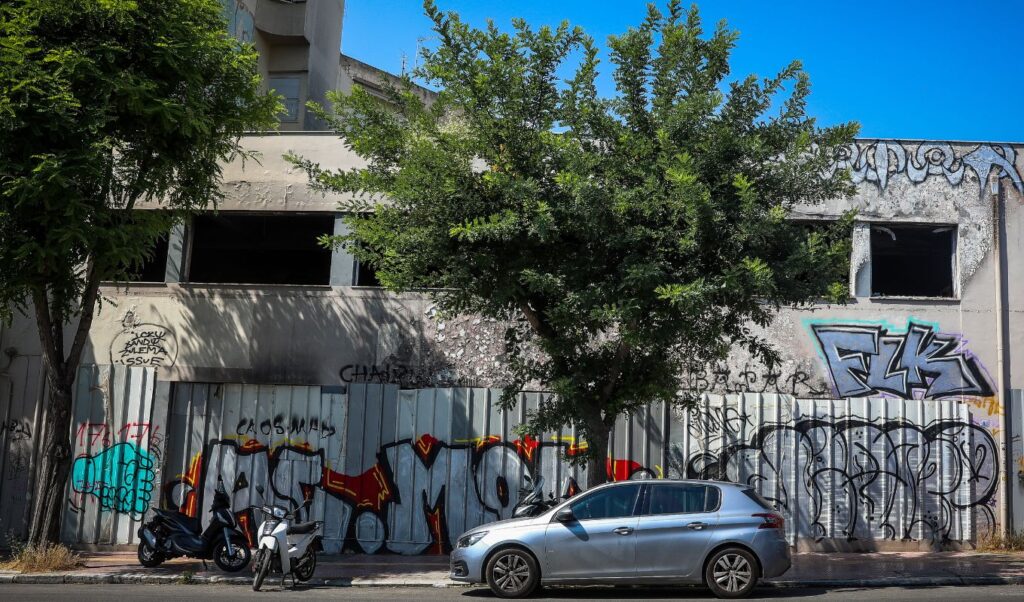
Investigations by the Crimes Against Life Division are in full swing regarding the case of a woman found dead inside a suitcase in an abandoned building in Kypseli, Athens. New forensic findings have provided some answers, but leave open the most critical question: how she died.
The body was discovered on the afternoon of Saturday, July 18, at an abandoned building on the corner of Evelpidon and Mystakidou streets, after a homeless person alerted authorities that something resembling a human limb was visible inside a suitcase. Officers who arrived at the scene confirmed that the suitcase contained the body of a woman in an advanced state of decomposition. The Crimes Against Life Division took over the case immediately and is currently investigating all possible scenarios.
The autopsy was performed by the head of the Athens Forensic Medicine Service, Nikos Ntilernis. However, the advanced decomposition of the body prevented a definitive conclusion regarding the cause of death, which remains undetermined.
According to sources, the forensic examination revealed no visible injuries on the body, and the possibility of death by strangulation has been ruled out. At the same time, neither asphyxiation nor other causes could be confirmed or excluded, as the condition of the remains did not allow for a reliable assessment.
Read also: Kypseli: Woman’s body found wrapped in a garment bag inside suitcase — new forensic findings, identity mystery, and French clothing label (Video)
First details about the victim found in Kypseli
The autopsy did, however, yield several details that may prove decisive in identifying the victim. The woman is estimated to have been between 30 and 35 years old, stood approximately 1.61 meters tall, and wore a size 36 shoe. Furthermore, according to the same sources, she appears to have eaten food roughly one hour before her death — a detail that may help investigators reconstruct the final hours of her life. Fingerprint analysis revealed that the victim had no prior criminal record, which is currently complicating the identification process.
The authorities’ next steps
Police are now awaiting the results of toxicological tests, which may provide crucial answers regarding the cause of death.
A DNA sample has also been taken from the woman’s fingernails to determine whether there is any evidence suggesting she fought back or attempted to defend herself before she died. Investigators continue to collect and analyze footage from security cameras in the area, while cross-referencing data with open missing persons cases in an effort to identify the woman and piece together her final movements.
The case of You Ting
Among the scenarios being examined is the case of 40-year-old You Ting, a woman who disappeared from the Artemida area last May. Greek police have informed her husband and have requested personal items — such as a toothbrush and hairbrush — in order to compare her DNA with that of the deceased woman found in Kypseli. The identification of the victim through laboratory testing is expected to provide definitive answers and determine the next course of the investigation.