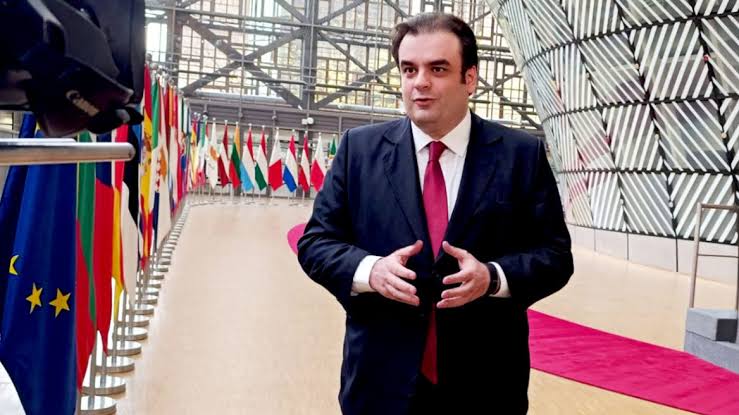
A Greek initiative with a European dimension is now at the center of negotiations for the next European Union budget. The proposal by Minister of National Economy and Finance and Eurogroup President, Kyriakos Pierrakakis, for the establishment of a European Spectrum Union, has now been incorporated into specific provisions of the revised negotiating framework (“Nego-box”) for the Multiannual Financial Framework for the period 2028–2034. The framework was presented by European Council President António Costa following the conclusion of consultations with EU member states.
According to European Commission sources, this development marks the transition of a Greek initiative from the level of a policy proposal to the arena of European negotiation.
At its core lies a fundamental shift in thinking: Europe can generate new financial resources, rather than limiting itself to negotiating the distribution of already available funds.
The Greek proposal on 6G spectrum frequencies
The Greek proposal, which Kyriakos Pierrakakis first presented in July and elaborated in September 2026, provides for pan-European coordination of future 6G spectrum auctions. A portion of the resulting revenues could boost the European budget, while another portion could fund strategic technology investments.
The initial estimated funding scale of the Greek proposal reaches €12–15 billion, not counting potentially additional revenues from future 5G license renewals.
What the new European framework provides for
Of particular significance is that the revised negotiating framework explicitly provides for the inclusion of revenues from spectrum usage rights in the band above 6 GHz — designated for 6G services — in the EU budget.
These revenues will constitute an additional source of EU budget funding, correspondingly reducing the national contributions of member states.
At the same time, the framework opens the door to leveraging revenues from other spectrum bands already auctioned by member states, once the relevant usage rights expire or are renewed.
This represents a significant broadening of the discussion, as it creates the prospect of a continuous source of European revenues from spectrum utilization.
The European Commission is expected to incorporate the relevant proposal into the corresponding sectoral legislation during the first half of 2028.
From resource distribution to creating new revenues
According to the same sources, the Greek approach seeks to address one of the European Union’s greatest challenges: funding its growing strategic needs without ongoing conflicts among member states.
Europe needs greater investment in defense, competitiveness, technology, and infrastructure, while simultaneously maintaining strong cohesion policies.
The Greek proposal changes the starting point of the conversation. Rather than focusing solely on who will contribute more and who will receive less, it raises the question of leveraging shared European assets to generate additional revenues and strengthen the Union’s investment capacity.
This is also the broader political significance of the inclusion of key elements of the Greek initiative in António Costa’s negotiating framework.
The Greek model proposed for Europe
The proposal is based on a model already implemented in Greece during Kyriakos Pierrakakis’s tenure at the Ministry of Digital Governance.
During the 5G spectrum auction, 25% of revenues were directed to the Phaistos Fund, an investment fund created to finance innovative businesses and fifth-generation technologies.
This Greek model is now being proposed for replication at a European scale, leveraging the transition to 6G to generate new resources and strengthen the unified telecommunications market.
Additionally, through the European Investment Bank and the participation of private capital, a portion of the revenues could mobilize investments of far greater value in next-generation networks, artificial intelligence infrastructure, and critical digital technologies.
The inclusion of the relevant provisions in the revised “Nego-box” represents a significant step, though it does not prejudge the final agreement of member states, Commission sources note. The special European Council of November 26–27 and the Summit of December 17–18, 2026 are critical milestones in the negotiations over the new European budget.
Greece is participating in this discussion with a concrete proposal that could change the way Europe funds its priorities.