
Auditors from the Special Tax Fraud Squad (DEOS) of Greece’s Independent Authority for Public Revenue (AADE) have uncovered yet another major network of individuals and businesses that amassed enormous profits at taxpayers’ expense — through a well-organized tax evasion ring built on fictitious invoices, companies that went bankrupt or ceased operations in record time, and vanishing traders.
Investigators compiled and cross-referenced data from:
- their own audits,
- AADE’s digital platforms (myDATA),
- the business registry,
- corporate shareholding records,
- the management and representation details of the businesses involved,
and found themselves facing an extensive and highly interconnected network of individuals and legal entities, all sharing common characteristics in terms of:
- their operating methods,
- their administrative structure, and
- their transactional behavior.
Tax evasion ring: “Single-use” shell companies, 32,000 counterfeit products, and lucrative fictitious transactions
Specifically, the same individuals repeatedly appear as participants in different businesses — either as managers, general partners, or limited partners. Moreover, new companies were successively incorporated immediately after the shutdown of previous businesses or following changes in their shareholding structure.
In addition, all of these individuals and businesses shared:
- common business premises,
- common telephone numbers,
- common registered business addresses,
- common corporate structures.
These elements clearly indicate that the businesses under investigation are significantly interconnected.
More specifically, direct or indirect links have emerged between foreign nationals who appear to be participating in a series of businesses with similar lines of activity and a shared corporate structure.
These connections stem, among other things, from:
- shared participation of the same individuals in multiple companies,
- use of common telephone numbers,
- use of common business premises and addresses,
- overlapping business activities, primarily in the wholesale trade of clothing, footwear, and related goods,
- repeated involvement of the same individuals in different corporate schemes.
Furthermore, it was established that most of these businesses were used exclusively or primarily for the issuance or receipt of fictitious invoices of particularly high value.
Among the cases identified to date — representing only a portion of the overall network — the following stand out:
- Sole trader: Fictitious transactions worth €25,000,000
- Online store (general partnership): Fictitious transactions worth €15,000,000
- Sole trader: Fictitious transactions worth €25,000,000
- Physical retail store (limited partnership): Fictitious transactions worth €2,500,000
- Sole trader: Fictitious transactions worth €28,000,000
- Import company (general partnership): Fictitious transactions worth €3,250,000
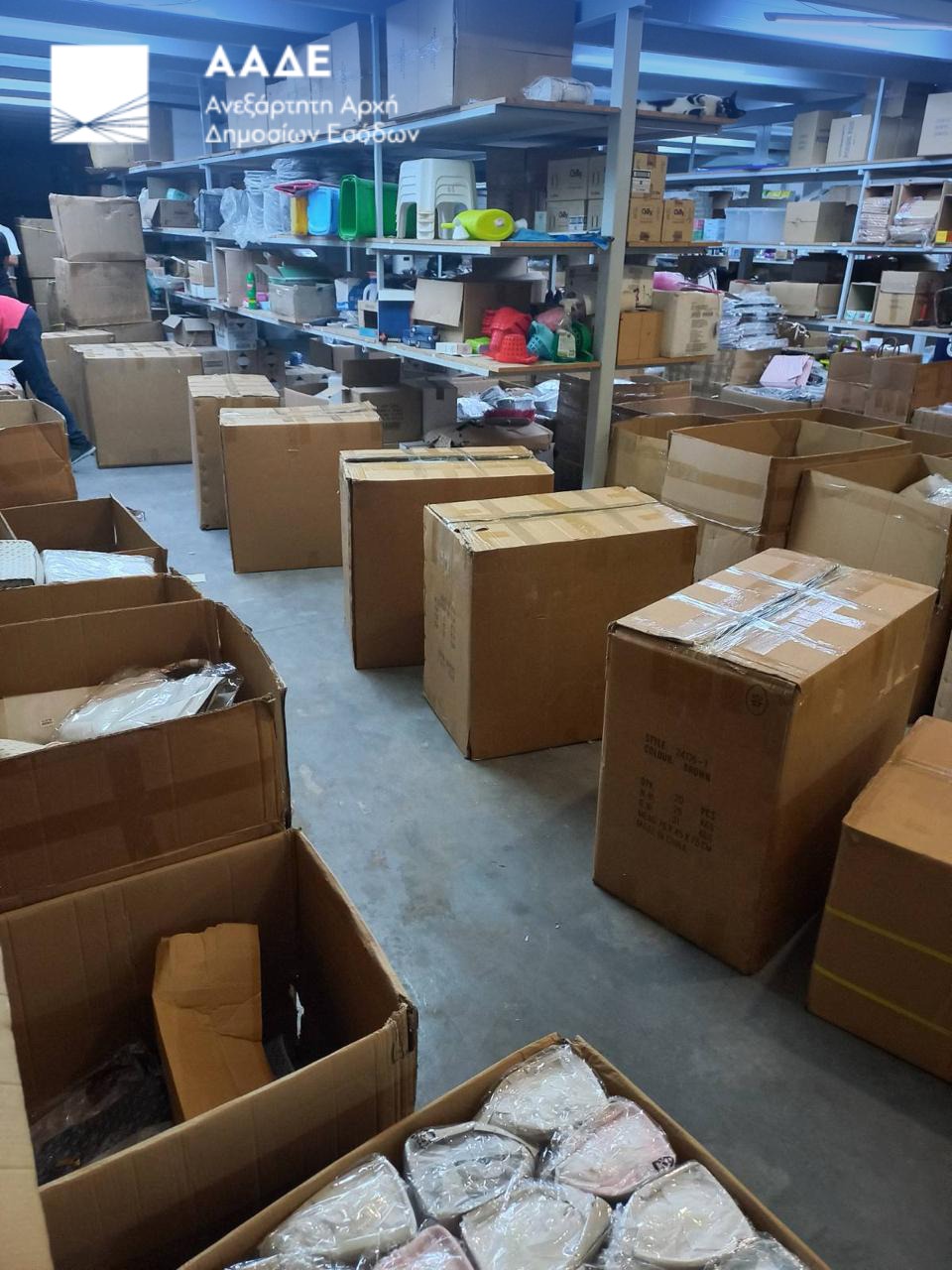

Analysis of tax records and supporting documents used in the declared intra-community transactions revealed that different Greek businesses within the above network appear to have transacted with the same foreign companies, repeatedly using identical corporate stamps, identification details, and other commercial identifiers.
Tax evasion ring: She claimed to be homeless — but was living in a villa with a pool
To date, three individuals have been arrested, one of whom is a foreign woman believed to be the manager and owner of one of the network’s key businesses. Despite declaring herself homeless, she was found to be living in a 280 sq.m. villa in the northern suburbs of Athens — complete with a swimming pool.

The ring also involves foreign “missing traders” who appear to have purchased goods worth more than €40 million. To date, tax evasion of €9.6 million in VAT and €8.3 million in income tax has been confirmed. Steps have been initiated to freeze bank accounts and other assets, and more than 32,000 counterfeit products have been seized. The investigation is ongoing and continuing in depth.
Watch the video: