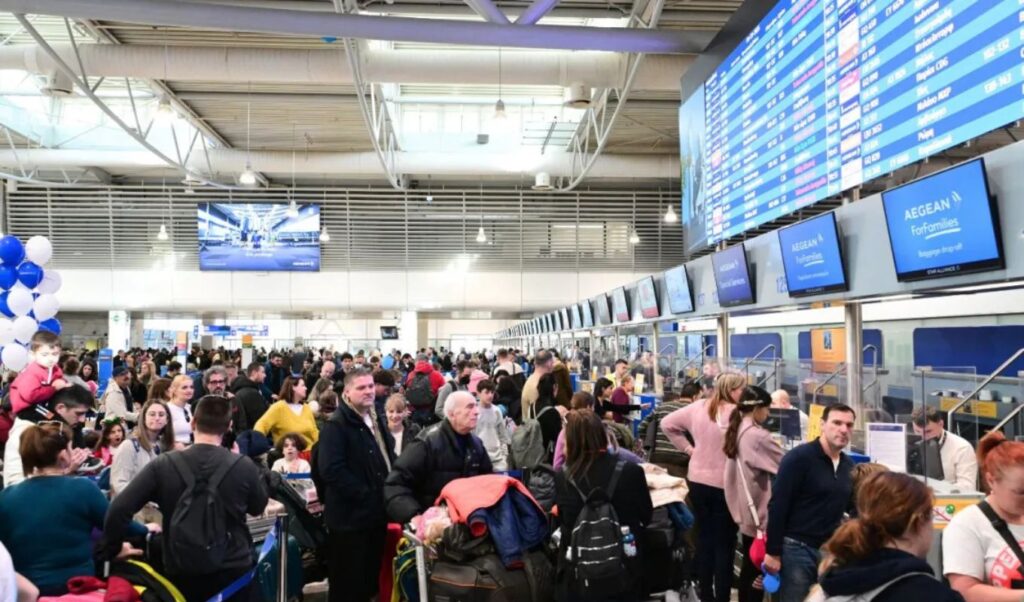
A new era is beginning for families traveling by air across Europe. The European Parliament has approved a sweeping overhaul of passenger rights regulations, putting an end to practices that have long placed an unfair financial burden on parents traveling with children. The new legislation requires airlines to guarantee adjacent seating for passengers accompanying minors under the age of 14, at no additional charge.
Read also: Airport employee warns travelers: Why you should never tie ribbons to your luggage
An end to family separation on flights
This long-awaited reform — more than a decade in the making — brings fundamental changes to the way airlines treat families. Parents traveling with children under 14 will no longer have to pay extra to sit next to their kids. The new obligation effectively dismantles a well-established tactic used by low-cost carriers, which would deliberately separate families during seat assignment, forcing them to pay additional fees to sit together.
The right extends beyond parents with young children. Passengers with disabilities or reduced mobility, as well as pregnant women, will be guaranteed access to appropriate seating at no extra cost. The overarching goal is the removal of financial barriers that make air travel unnecessarily difficult for the most vulnerable groups of passengers.
Transparent ticket pricing from the very first search
One of the most significant innovations in the new rules is the requirement for airlines to include the cost of one carry-on bag in the base fare displayed on search engines and comparison websites. This change will allow consumers to compare ticket prices across different airlines in a genuinely meaningful way, putting an end to the practice of advertising artificially low fares that then increase substantially through a series of add-on charges.
Consumers will still have the option to secure a lower fare if they choose to travel without a carry-on bag. The intention of European legislators is not to impose obligations on travelers, but to ensure genuine price comparability from the very start of the booking process, giving passengers real transparency before they commit to a purchase.
Compensation rights for delays and cancellations preserved
The agreement preserves the existing right to financial compensation when a flight is delayed by more than three hours. The amounts payable will range from €250 to €600, depending on the distance of the affected journey. This consumer victory was under serious threat during negotiations, as a number of EU member states had initially pushed to extend the compensation threshold to four hours and reduce the amounts payable.
In the event of a cancellation, passengers will retain the right to a full refund or an alternative routing. However, airlines will be permitted to halve the compensation amount on longer routes if the arrival delay is less than four hours — a limited concession designed to strike a balance between consumer protection and the operational realities faced by carriers.
Airlines must inform passengers of their rights within 96 hours
Airlines will be required to inform passengers of their rights and how to exercise them in the event of a cancellation or delay within a maximum window of 96 hours from the end of the journey. This measure directly addresses widespread complaints from travelers who were unaware of their entitlements or did not know how to claim them effectively from airlines.
The reform also eliminates another common abusive practice: passengers can no longer be denied boarding on a return flight simply because they did not take their outbound flight. This rule will put an end to so-called “no-show” clauses in ticket terms and conditions, which automatically cancelled an entire booking if the first leg of the journey was not used.
What the changes mean for families flying in Europe
Virginijus Sinkevicius of Lithuania, the European Parliament’s lead negotiator on the reform, highlighted the scope of the new agreement in an official statement: “We worked hard to make sure passengers don’t lose rights they already had, and to secure better protection for families, people with reduced mobility, and those who need it most.” His words underscore that the agreement not only preserves hard-won protections for European consumers, but also extends them to groups that are particularly vulnerable in the context of air travel.
The key changes affecting parents and children
Among the regulation’s most important innovations are several elements that will meaningfully transform the flying experience for millions of travelers. First, ticket price transparency from the moment of searching, with carry-on bag costs included in the base fare displayed by comparison websites. Second, the prohibition on separating families with children under 14 without additional charges represents a fundamental shift that will benefit millions of European families every year.
Third, the preservation of financial compensation for delays exceeding three hours — a right that had been under serious threat throughout the negotiation process. Finally, the new obligation to provide passengers with information within 96 hours of an incident will ensure travelers are aware of their rights and can exercise them effectively, closing a loophole that many airlines had exploited to obstruct legitimate consumer claims.
Low-cost carriers, whose business models rely on offering very low base fares supplemented by numerous ancillary charges, will need to adapt their commercial strategies to comply with the new regulations. For parents flying with children, this means air travel will become more financially predictable and considerably less stressful — no more worrying about unexpected fees or the prospect of being separated from their kids during a flight.