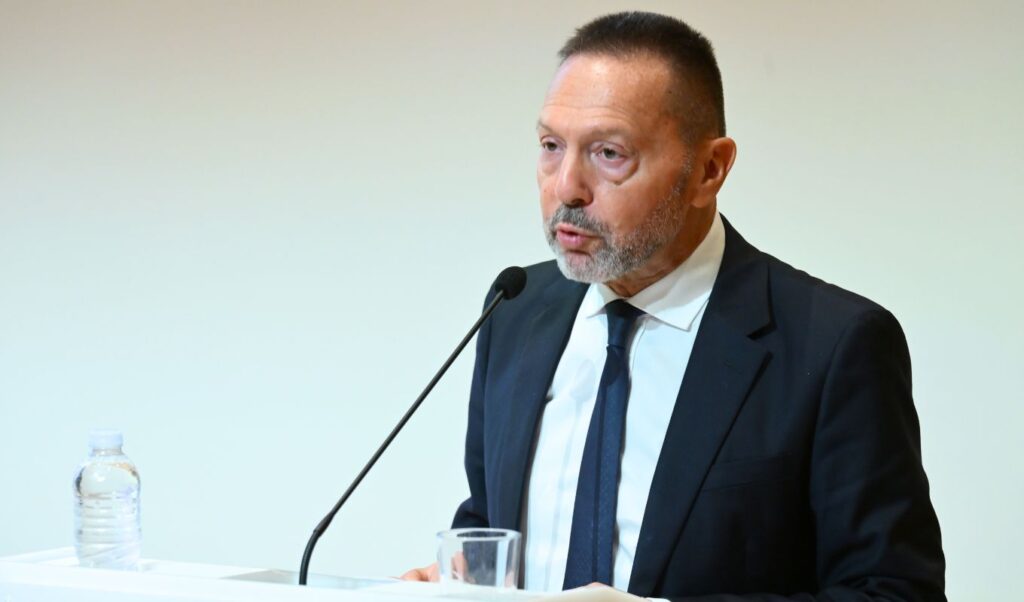
The Governor of the Bank of Greece, Yannis Stournaras, characterized concerns about a potential recession in the eurozone as real and justified, in an interview published in Cyprus’s Phileleftheros newspaper. As he noted, “the concern about a potential recession in the eurozone is real and justified, given the new negative supply-side disruption caused by the escalation of the conflict in the Middle East. Rising energy prices and intensifying uncertainty directly affect growth and inflation, given the eurozone’s high energy dependence.”
Unlike in 2022, the rise in inflation is manifesting in an environment of already weaker growth, tighter financial conditions and reduced fiscal space, which limits policy margins and makes economies more vulnerable. Although the eurozone economy has shown resilience, its momentum remains subdued, with growth slowing from approximately 1.4% in 2025 to 0.9% in 2026, according to the ECB’s March projections.
Alternative scenarios developed by the ECB highlight the prevalence of downside risks for growth. At present, however, we are not in the adverse scenario, as relative geopolitical de-escalation has contained the most extreme developments. Nevertheless, in case of negotiation failure and resumption of military conflicts, the risk of recession remains possible, without being the baseline scenario.
Yannis Stournaras: What are the potential impacts of current geopolitical uncertainty
Regarding the impacts that current geopolitical uncertainty may have on both financing costs and the quality of banks’ loan portfolios, Mr. Stournaras estimated that we are likely to see an increase in the flow of new non-performing loans, particularly from “vulnerable” households or from businesses in sectors sensitive to energy price changes.
He did not rule out that in an adverse scenario, there could be an increase in financing costs due to market volatility and revision of banks’ business plans due to lower demand for new loans. However, he emphasized that Greek and Cypriot banks, as well as European banks, are entering this period of increased uncertainty with strong fundamentals.
Regarding the functioning of institutions in Greece, he maintained that despite clear progress, strengthening citizens’ trust in the state requires faster and more effective administration of justice, stronger accountability, full implementation of transparency rules, and consistent addressing of corruption and administrative inefficiency phenomena.