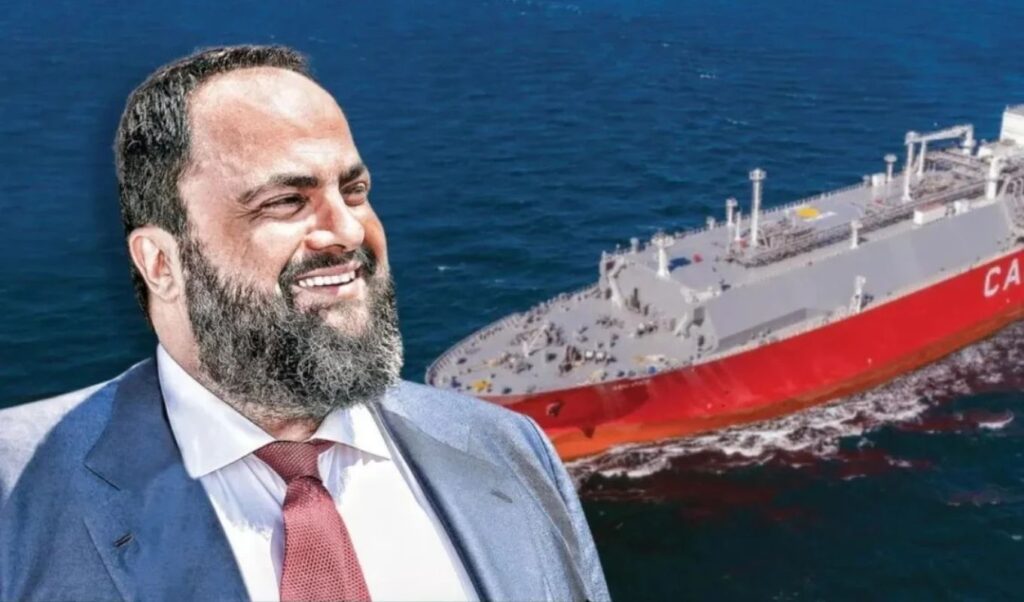
Capital Maritime Finance (CMF), owned by shipping magnate Evangelos Marinakis, is making a landmark move for the Greek capital market by proceeding with an initial public offering (IPO) and listing all of its shares exclusively on Euronext Athens. This marks the first time a shipping company has chosen to list its entire share capital on the Greek market through an IPO — a development that strengthens Athens’ ambition to claim a greater role on the global maritime finance map. According to available information, CMF aims to raise up to €200 million through the public offering. The funds are primarily intended to finance the company’s extensive shipbuilding program, as well as to cover working capital needs. The Euronext Athens listing comes at a time when Greek shipping remains one of the economy’s most powerful outward-facing sectors, while the Greek capital market is actively working to broaden its listed company base and attract larger enterprises.
Read also: Capital (CMF) sets course for the stock exchange: A milestone as the first shipping company to list exclusively on the Greek capital market
Revenue visibility
Today, the company’s entire available fleet capacity is under charter, with operational day coverage extending through 2034. The contracted revenue backlog stands at approximately $3.9 billion, while the average remaining charter duration reaches 9.5 years. These characteristics offer significant revenue visibility — a particularly valuable asset in a sector where freight rates can fluctuate sharply depending on global trade cycles.
A substantial portion of these contracts involves leading international liner shipping companies, structured as long-term take-or-pay agreements. Key charterers include CMA CGM — one of the world’s largest container liner operators — with contracts totaling nearly $3 billion, as well as Unifeeder, a subsidiary of DP World, with agreements approaching $1 billion. At the heart of CMF’s investment strategy is a notably young fleet. Upon completion of its shipbuilding program, CMF will operate 36 vessels, of which 13 are already in service and 23 are currently under construction. The fleet’s weighted average age at full delivery is expected to be just two years, placing the company among the youngest fleets in the market.
The fleet consists of 26 feeder containerships with a capacity of 1,800 to 2,900 TEU, and 10 Neo-Panamax vessels with a capacity of 8,800 TEU. Particular emphasis has been placed on energy efficiency, as the ten largest vessels are equipped with dual-fuel LNG capability. The use of LNG — along with the ability to utilize bio-LNG and e-LNG — reduces emissions and enables adaptation to the increasingly stringent environmental regulations governing the shipping industry.
These investments carry additional significance as IMO and European Union requirements for emissions and energy efficiency continue to tighten. The EEXI and CII regulations, combined with the EU Emissions Trading System (EU ETS) and FuelEU Maritime, are raising operational costs for older vessels and strengthening incentives for global fleet renewal. CMF believes its younger, technologically advanced fleet significantly limits its exposure to these rising compliance costs.
Financial foundation
The company also asserts that it has a strong financial foundation to complete its investment program. The remaining capital expenditure program amounts to $1.9 billion through 2028, of which approximately $1.6 billion is covered through bank financing. The remainder is expected to be funded through operating cash flows and the net proceeds from the public offering.
In parallel, management has designed a dividend distribution policy aimed at delivering quarterly distributions to shareholders, linked to adjusted net earnings. The commencement of distributions is currently planned for the first quarter of 2027. CMF’s investment case is further supported by broader trends in the containership market. By 2029, approximately 50% of the global fleet of vessels below 3,000 TEU is expected to be over 20 years old, while in the 8,000–12,000 TEU segment, the corresponding figure is estimated at 32%. The aging of the existing global fleet, combined with rising energy efficiency requirements, is creating mounting pressure to replace older vessels. At the same time, the realignment of global supply chains and businesses’ efforts to reduce their dependence on specific production hubs are boosting regional trade routes. This trend is increasing demand for small and mid-size vessels, which can serve regional transport networks with greater operational flexibility.
Originally published in “MoneyPro,” the financial supplement of the “Parapolitika” newspaper