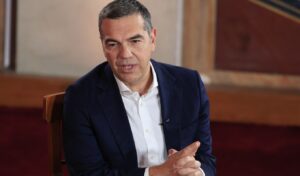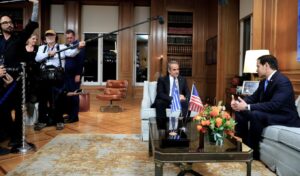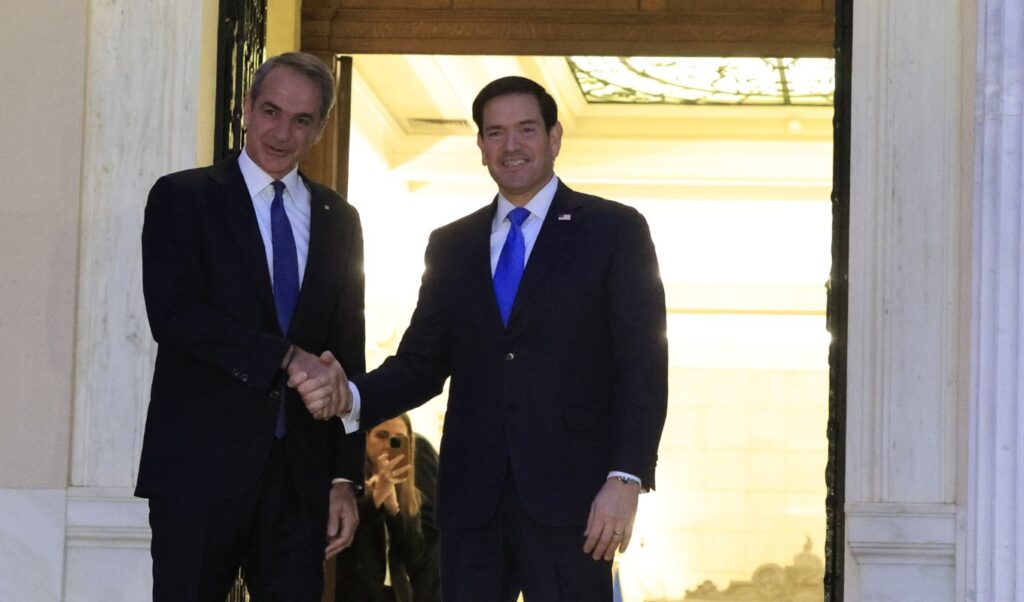
The Greek government is counting multiple gains from the visit of U.S. Secretary of State Marco Rubio, who traveled to Athens for the first time since taking the helm of the State Department in January 2025. On the level of public rhetoric, Rubio spoke at the Greek Foreign Ministry of a “historic alliance” between Greece and the United States — one that “serves as a source of stability” — and underscored that “we are grateful that Greece is a great ally.” He added that Greece and the U.S. are not merely strong allies, but share a common understanding regarding “the threats our countries face, the threats our societies face, and we share a common vision on how to address them.” He also described Greece as a very close strategic partner in border security and in combating mass migration, transnational criminal organizations, and terrorism. In a post on X, he noted among other things that “the bond between the U.S. and Greece is deep, and our cooperation is stronger than ever.”
The vertical corridor: American support for Greece as Europe’s energy hub
Rubio delivered strong backing for the Vertical Gas Corridor — a highly competitive market for natural gas transit into Europe, in which Alexandroupolis is vying to play a pivotal role. “One area where we have close cooperation and want to take action is the energy relationship — it has risen to a higher level and we want to expand it, to talk about the Vertical Corridor and to position Greece as an energy and security hub, in order to increase American gas exports to Europe,” the U.S. Secretary of State emphasized.
Greece – U.S.: $4 billion defense agreements and a stronger military partnership
Following the conclusion of the Strategic Dialogue, “Greece and the United States announced military sales through the Foreign Military Sales (FMS) program worth $4 billion, in support of Greece’s long-term defense planning,” according to the joint communiqué. Of particular significance was the public reference made by Greek Foreign Minister Giorgos Gerapetritis, in the presence of his American counterpart, to the issue of Cyprus: “Cyprus is an integral part of the security architecture of the Eastern Mediterranean. A solution must be found for the reunification of the island in accordance with the decisions and resolutions of the United Nations Security Council, calling for an end to the illegal occupation,” the Foreign Minister stated before Greek and American media.
Rubio at the Pnyx: Greece as a “model ally” and the message to Europe
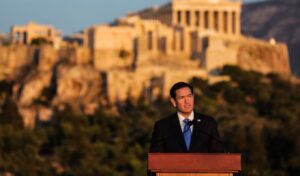
Marco Rubio’s speech at the Pnyx — delivered against the backdrop of the Acropolis and the Parthenon — carried its own distinct weight. In it, he praised ancient Greek thought, valor, and civilization in a variety of ways, with the key points of his address circling the globe through international media. At one moment in the speech, Rubio made the following remarks: “The people of this country have proven once again that they are an indispensable friend both to Europe and to the United States, in every field — from energy and migration to defense, where Greece has been a model ally. It is our sincere hope that all of Europe will follow your example.” Shortly afterward, the U.S. Secretary of State met with Prime Minister Kyriakos Mitsotakis at the Maximos Mansion — a meeting that confirmed the historically high level of Greek-American relations, as well as the mutual desire to further deepen and broaden bilateral cooperation across defense and security, energy security, trade, investment, technology, shipping, education, and culture.
Three Greece – U.S. agreements: Defense, culture, and maritime cooperation in a new framework
At the level of individual agreements, the day’s proceedings unfolded in three distinct areas:
A letter of intent co-signed by Defense Minister Nikos Dendias and Secretary Rubio on cooperation between the Greek Armed Forces and the Florida National Guard, envisaged to develop across areas of mutual interest — including joint training and exercises, interoperability, command and control, combined fires and tactical maneuvers, logistics support, air defense and air operations, disaster response, space, and cyber operations.
The renewal of a Memorandum of Understanding signed by Culture Minister Lina Mendoni and U.S. Under Secretary of State Catherine Dillon, extending import restrictions on categories of Greek archaeological and ethnological material for another five years, through 2031. As Minister Mendoni emphasized, “this is a particularly successful partnership, which has contributed decisively to the repatriation of numerous and significant cultural artifacts to Greece, as well as to strengthening cooperation between the competent authorities of both countries.” Also noteworthy was the intervention of U.S. Ambassador Kimberly Guilfoyle: “Our cultural ties have never been stronger, and with this renewal we are sending traffickers a very clear message: ‘Greek history is not for sale,'” the Ambassador said.
In the maritime sector, Greece and the United States signed a Memorandum of Understanding on the mutual recognition of seafarers’ certificates of competency. The agreement facilitates the crewing and employment of Greek and American sailors aboard vessels of both countries, while also strengthening cooperation in the field of maritime education and training.