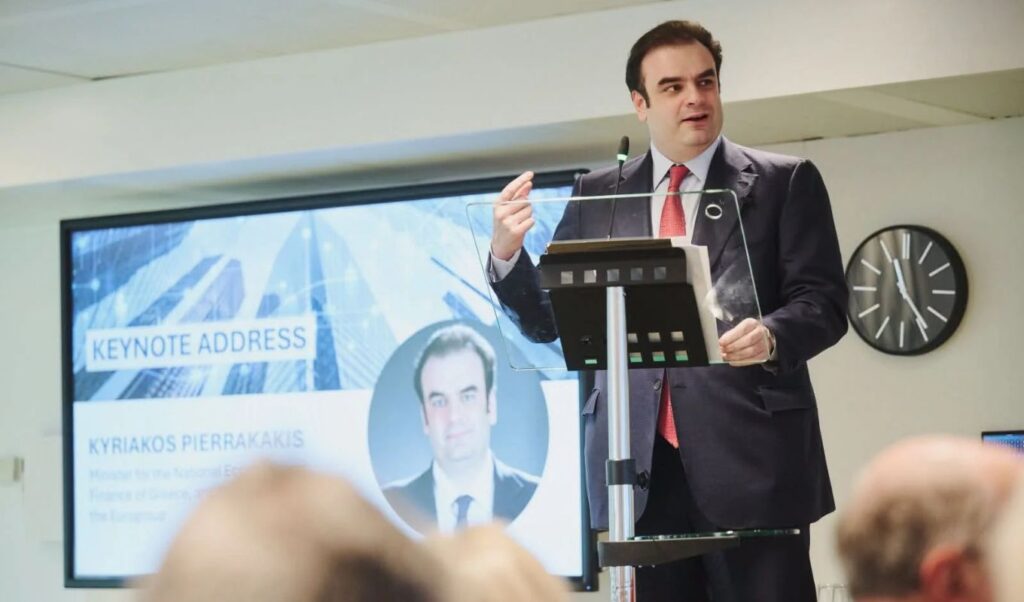
Greek Finance Minister Kyriakos Pierrakakis zeroed in on the core challenges facing Europe’s single economy at a high-profile event held on Wednesday, October 7, in Brussels, organized by BusinessEurope and the European Banking Federation (EBF). The event, titled “Banking Competitiveness: The EU Agenda for a More Integrated, Efficient and Competitive Banking Sector,” drew key figures from across the European financial landscape. As president of the Eurogroup, Pierrakakis was among the most closely watched speakers, delivering the keynote address and taking part in a discussion with EU Commissioner for Financial Services and the Savings and Investments Union, Maria Luís Albuquerque, moderated by BusinessEurope’s Chief Economist and Director of Economic Affairs, Lucio Vinhas de Sousa. Greece’s Finance Minister made clear that he is increasingly convinced of the need for a new financial architecture in Europe — one that could help the continent break free from the structural rigidity and latent conservatism that appears to be holding back its unified economy.
Kyriakos Pierrakakis: The importance of savings
Completing the Banking Union is a top priority for Pierrakakis, who emphasized the urgent need to transform savings into productive investments and to mobilize significantly larger volumes of private capital across Europe. The Greek Finance Minister stressed that boosting productivity and driving growth requires not only greater private investment, but also a more deeply integrated European financial system — one capable of channeling savings effectively into the real economy. He underscored that completing the Banking Union is essential both for the success of the Savings and Investments Union and for the overall competitiveness of the European economy.
“Allow me to start with a simple fact. Europe is not growing fast enough. We remain one of the most prosperous and successful economic regions in the world. We have world-class companies, highly skilled people, a single market of 450 million consumers and, as we often remind ourselves, enormous private savings. Yet we are not converting these advantages into growth at the rate we should,” the minister said.
The geopolitical dimension
As Pierrakakis explained, growth translates into better jobs, higher wages and improved living standards, while also enabling businesses to invest more in technology, energy and artificial intelligence.
He also highlighted the growing geopolitical significance of economic strength, pointing out that Europe urgently needs increased investment in defense, energy security, artificial intelligence, critical technologies and strategic infrastructure. He then posed a stark question: “We need around €800 billion in additional investment every year. And that leads us to yet another question: Who is going to fund it?” This followed his assertion that productivity gains depend on substantial investment in skills, technology, energy, innovation and artificial intelligence.
Pierrakakis made clear that this level of investment, necessary for Europe’s transformation, cannot realistically come from public budgets alone — it requires private investment at a far greater scale. In his view, the core problem is not a lack of money in Europe, but the absence of a financial system that efficiently channels available savings into the European economy.
He was explicit: “Banks still cover around 70% of financing for the European economy, playing a particularly vital role for small and medium-sized enterprises. Yet, despite a common currency and common European supervision, the banking market remains largely organized along national lines. Only about 16% of corporate lending in the Eurozone is cross-border, and barriers to the transfer of capital and liquidity within banking groups persist. This is why I increasingly see fragmentation as a strategic tax. A tax on scale. A tax on investment. A tax on innovation. And, ultimately, a tax on European growth,” he noted.
By way of comparison, he pointed out that the largest American banks invest more than two and a half times as much in information technology, relative to their assets, as their European counterparts.
The three “magic words”
The Eurogroup president outlined three core pillars for the future of the European banking system: integration, trust and competitiveness. As a first step, he called for the removal of unnecessary barriers to cross-border activity, so that “a euro saved in one part of Europe” can be channeled into productive investments in another. His second priority was strengthening trust in common European safety nets — through effective crisis management, liquidity support and progress on deposit insurance. The third pillar was competitiveness, with Pierrakakis calling for “better regulation, not less regulation,” with greater proportionality and a reduction in unnecessary complexity.
In the discussion that followed, he agreed with Commissioner Albuquerque that the most significant obstacles to deeper European integration are political rather than technical. He spoke of the substantial opportunity cost of “non-Europe” and non-integration, arguing that parallel progress across all fronts is needed to complete the Single Market. “It has all already been written down in the Draghi and Letta reports. So right now, the debate is not about strategy. It is about implementation,” he stressed.
“Resilience is a necessary prerequisite for a strategy”
On the European Commission’s proposals regarding banking competitiveness, the minister said he fully shares their ambition. “If I had to sum it up in one sentence: resilience is not a strategy. Resilience is a necessary prerequisite for a strategy. It is the oxygen in the room. You build on top of it,” he said. He added that the goal must be to unlock the maximum possible growth potential while managing risks appropriately.
In closing, he turned to the pace of technological change and the need for European institutions and regulatory frameworks to adapt continuously. He made specific reference to artificial intelligence, the digital euro, the MiCA regulation, stablecoins and cybersecurity, noting that Europe must harness the opportunities of digitalization without creating new instability in the financial system. “Our institutions will need to adapt. The point is that they will need to adapt constantly, just like code,” he said, warning that cybersecurity will emerge as a major challenge far sooner than expected.