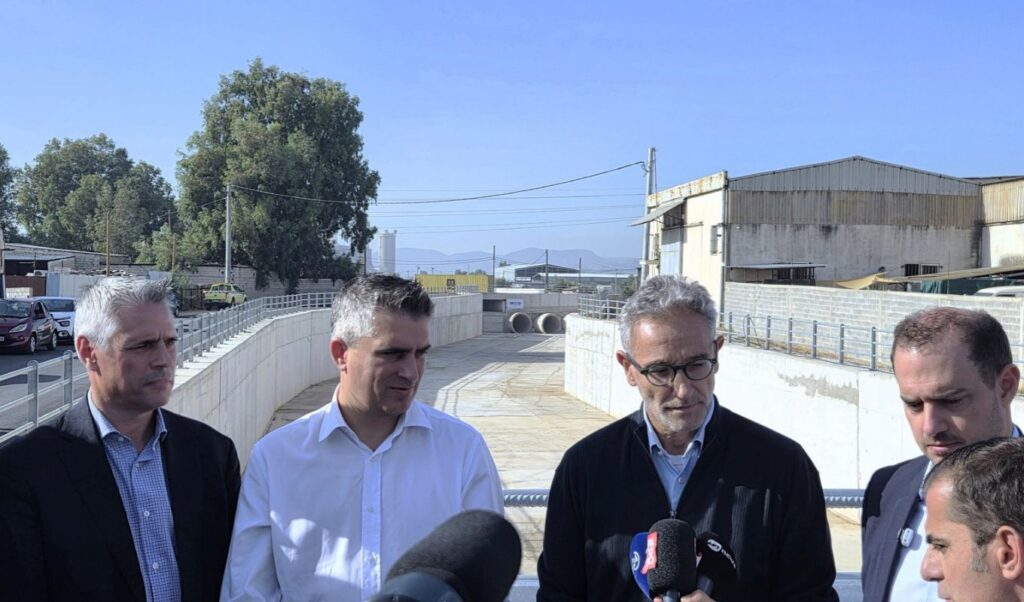
AKTOR Group has completed and delivered a major flood protection project for the local community of Western Attica, designed to better safeguard the region against severe flooding — at a time when the climate crisis is increasingly testing the resilience of infrastructure across Greece.
The project, officially titled “Regulation of the Agios Georgios (Giannoulas) Torrent — Eastern Thriasio Plain, Attica, from Station 1+835.60 to Station 9+335.00 (Mornos Siphon),” had a budget of €10.3 million and was formally handed over to the Ministry of Infrastructure and Transport.
Read also: AKTOR’s Exarchou at the Dendias event in Alimos — A one-on-one with the Defense Minister (Photos)
The second most important torrent in the Thriasio Plain
The Agios Georgios torrent, stretching a total length of 7.5 km, is the second most significant waterway in the Thriasio Plain — after the Sarantapotamos torrent — with a drainage basin of approximately 110 km², which also incorporates the Mavri Ora and Distillery torrents. The waterway originates from Mount Parnitha and enters its lowland channel near the Mornos aqueduct siphon at an elevation of approximately 150 metres, which marks the upstream section of this project. It then flows east of Aspropyrgos, where it is diverted to run parallel to the railway line. At the level of the oil refineries, the diversion channel runs parallel to the western boundary of the refinery installations before crossing the new Athens–Corinth National Highway and ultimately discharging into the sea.
The primary goal of the project was to strengthen flood protection across the broader area by improving the waterway’s discharge capacity, stabilizing and defining the riverbed, protecting neighboring infrastructure, and enhancing the environmental and aesthetic character of the watercourse.
The techniques applied
A range of engineering techniques were deployed throughout the project, tailored to local hydraulic, geotechnical, and morphological conditions. These included gabion structures, reinforced concrete constructions, check dams, retaining walls, and erosion and undermining protection works. Special attention was given to points where the watercourse intersects with roads, bridges, and utility networks, with the aim of ensuring the safe passage of flood flows and protecting existing infrastructure.
Key works carried out as part of the project included:
- Lining of the riverbed with gabions of trapezoidal cross-section, 0.50 m thick and either 3.0 m or 5.0 m wide, depending on the location.
- Construction of rectangular reinforced concrete cross-sections, 15 m wide.
- Construction of four new bridges (B2, B3, B5, and B6).
- Construction of a bypass for Bridge B6, incorporating twelve culverts.
- A flow distribution structure to safely channel the design flood discharge.
Additional works included riverbed clearing and shaping, sediment retention structures, road construction, and the creation of eight access zones for ongoing maintenance of the waterway. At specific locations, bored piles and other retaining structures were constructed to protect neighboring buildings and ensure slope stability. Landscaping interventions and vegetation restoration were also planned to achieve the environmental and visual integration of the project into its surroundings.
The project is considered especially significant for the Thriasio Plain — an area experiencing considerable development, characterized by a mixed-use landscape of residential properties, agricultural and grassland areas, and scattered industrial facilities.