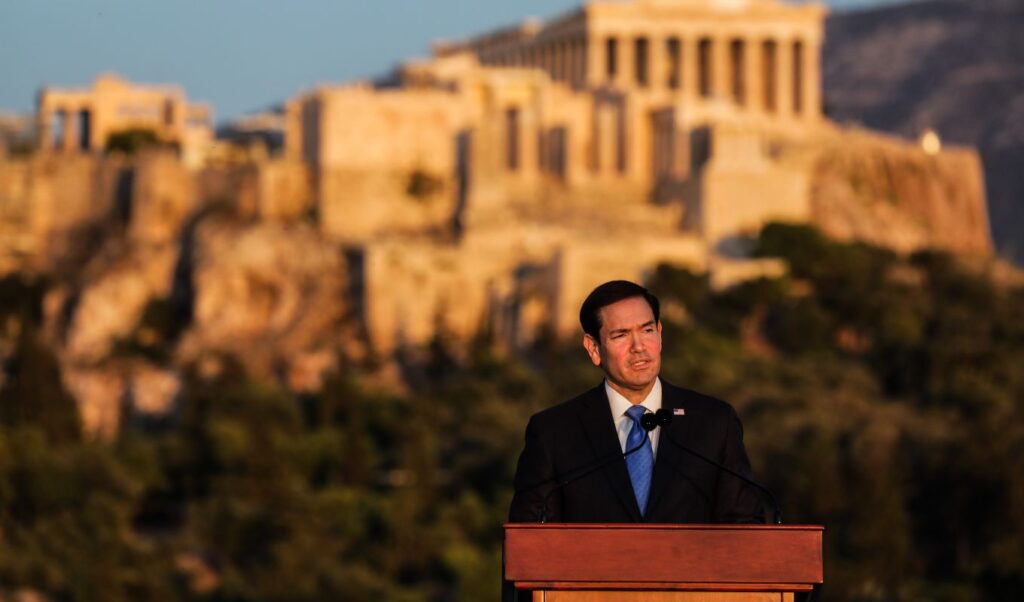
In a speech rich with symbolism and a clear political message, U.S. Secretary of State Marco Rubio chose the Pnyx — the historic cradle of Athenian democracy — to lay out his vision for the future of the West. With Greek President Konstantinos Tasoulas, Archbishop of Athens and All Greece Ieronymos, Foreign Minister Giorgos Gerapetritis, and a host of ministers and dignitaries in attendance, the top American diplomat spoke against the backdrop of the Acropolis about the need for the West to rediscover its confidence and draw strength from the values it inherited from Greece.
Speaking from the very site where the ancient Athenian Assembly once convened, Rubio presented ancient Greece not merely as a glorious chapter in history, but as the very foundation upon which much of the modern Western world was built. He also drew a direct line between the values of ancient Greece and contemporary American policy, arguing that President Donald Trump is working to restore power, confidence, ambition, and national sovereignty to the forefront.
Rubio: “America’s history is covered with the fingerprints of antiquity”
With the Acropolis towering in the background, Marco Rubio spoke of the enduring influence of Greek civilization on the West. He noted that the Acropolis has long held a unique fascination for the Western world, with generations of politicians, artists, and philosophers gazing upon it in admiration and drawing inspiration from it.
He also reflected on his own personal journey, noting that some 250 years after the founding of the American Republic, he stands in Athens as U.S. Secretary of State and as the great-grandson of settlers who arrived in the New World from Spain. “America’s history — my country’s history — is covered with the fingerprints of antiquity,” he said. He explained that the Greek heritage is literally etched into the architecture of American government, in the imposing columns, domes, and monuments of Washington, D.C., the city where the U.S. Constitution was born.
From Athens to the West: democracy, philosophy, and politics
The U.S. Secretary of State spoke at length about the legacy of Athens, Plato, and Aristotle. “Athens gave us democracy; Plato and Aristotle gave us Western philosophy,” he declared, noting that Western concepts of law, virtue, citizenship, and democratic governance were all shaped in the Greek city-states.
Even the political vocabulary of the West, he said, has its roots in ancient Greece — words like “democracy” and “tyranny,” and even the very concept of politics itself, were born in this land.
Yet Rubio was quick to point out that Greece’s legacy runs far deeper than institutions and words. It encompasses, he said, an entire way of thinking and a particular character: individualism, ambition, curiosity, exploration, the pursuit of knowledge, the willingness to take risks, and above all, the striving for excellence.
“Man must constantly push beyond his limits”
According to Rubio, the ancient Greeks held a fundamental belief that human beings must constantly strive to push beyond their limits and become better. It was from this philosophy, he said, that philosophy, art, science, politics, and the broader Western pursuit of knowledge were born. And it was precisely at this point that his historical reflection turned into a contemporary political message. Rubio argued that today’s West has drifted away from many of the foundational values upon which it was built.
A critique of the modern West
He argued that the West has become overly fearful of risk and failure, has begun to feel ashamed of its own achievements, and treats nationalism as something inherently negative. He further contended that the West is rejecting or deconstructing elements of its own history, has weakened its industrial and military base, and has transferred a portion of its sovereignty to international bureaucracies. In his view, this trajectory has created a power vacuum that other forces are now seeking to fill. Rubio’s message was unambiguous: the West must reclaim its confidence, invest in its own capabilities, and defend its interests and values with far greater resolve.
“Trump is reversing this course”
In this context, Marco Rubio framed Donald Trump’s policies as a deliberate effort to reverse this trajectory. He argued that the American government is working to strengthen U.S. national power, bring back industrial production, secure critical supply chains, and invest in defense, technology, and energy independence.
In the same vein, he referenced the development of artificial intelligence, drones, semiconductors, and other strategic technologies, as well as space exploration and America’s return to the Moon. For Rubio, technological, economic, and military power are not merely tools of competition — they are prerequisites for effective foreign policy.
“Peace requires real power”
He placed particular emphasis on the relationship between power, peace, and diplomacy. The U.S. Secretary of State stressed that peace and diplomacy require real power behind them — a reality, he noted, that the ancient Greeks already understood. This observation served as the bridge between ancient Athens and today’s geopolitical reality, with Rubio arguing that a strong West is an essential precondition for securing peace and stability.
Greece – U.S. – Europe: “Europe must wake up”
A central theme of the speech was the relationship between Greece, the United States, and Europe. Rubio described Greece as an important and reliable ally of the United States, with particular significance in the areas of defense, energy, and migration. He also sent a clear message to Europe, calling on it to “wake up” and strengthen its defense capabilities.
He argued that the transatlantic alliance should not be seen as a zero-sum game. On the contrary, the U.S. and Europe — working together — can be stronger than the sum of their individual capabilities. What is needed, according to the American Secretary of State, is a West that does not fear its own power but uses it strategically to uphold peace, security, and its own interests.
From Athens to Rome, Christianity, and America
Closing his speech at the Pnyx, Marco Rubio presented Western history as one great chain of cultural continuity: from Athens and Rome, through Christianity and medieval Europe, to England, and ultimately to America. In doing so, ancient Greece served Rubio not only as the backdrop for his speech, but as the starting point for a broader political argument — an argument in favor of a more dynamic, ambitious, nationally oriented, and strategically powerful West, one that invests in its own strengths and faces modern challenges with confidence.
Who was in attendance
Marco Rubio’s speech at the Pnyx was attended by, among others, Greek President Konstantinos Tasoulas, Foreign Minister Giorgos Gerapetritis, and U.S. Ambassador to Athens Kimberly Guilfoyle. Also present were Culture Minister Lina Mendoni, National Defense Minister Nikos Dendias, Health Minister Adonis Georgiadis, Education and Religious Affairs Minister Sofia Zacharaki, Development Minister Takis Theodorikakos, and Shipping and Island Policy Minister Vassilis Kikilias. Further attendees included Deputy Minister to the Prime Minister and government spokesman Pavlos Marinakis, Deputy Labor and Social Development Minister Kostas Karagkounis, Deputy Foreign Ministers Tasos Chatzivasileiou and Charis Theocharis, Secretary General for Communication and Information Dimitris Kirmikiroglou, New Democracy Political Committee Secretary K. Kyranakis, and New Democracy candidate Afroditi Nestora.
The speech was also attended by the ambassadors of Germany, Israel, and France — a diplomatic presence that lent even greater international weight to the U.S. Secretary of State’s address from the Pnyx.