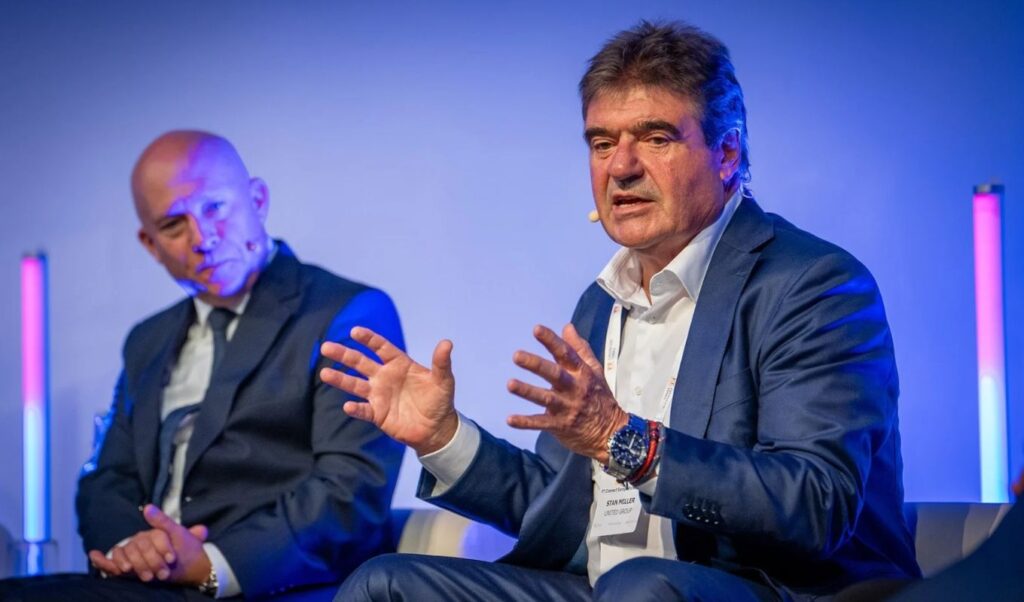
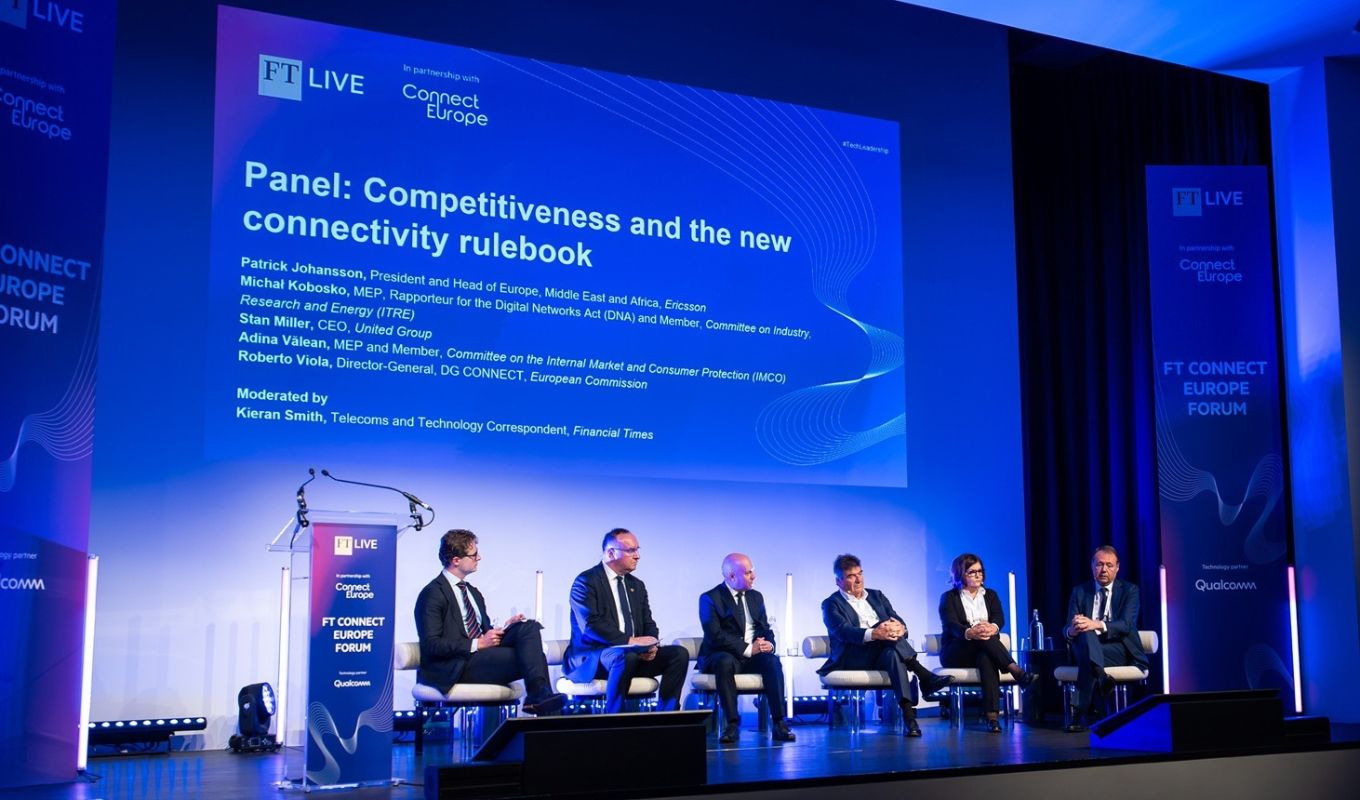
United Group CEO Stan Miller participated in the “FT Connect Europe Forum 2026” alongside senior European officials and leading industry executives, taking part in the opening panel titled “Competitiveness and the new connectivity rulebook.”
The annual Forum, organized by the Financial Times in partnership with Connect Europe, brought together top representatives from the telecommunications and technology sectors, focusing on Europe’s digital future, investment, innovation, and competitiveness.
With negotiations between the European Parliament and the Council currently underway, the discussion centered on the proposed Digital Networks Act and the responses it has generated — examining whether the new framework adequately addresses the need to boost investment in Europe’s digital infrastructure, as well as progress toward reducing single market fragmentation. The issue of investment also featured prominently in closed-door meetings with officials in Brussels.
Stan Miller highlighted four key priorities for the Act:
- Spectrum: Spectrum licenses should be granted without time limitations, giving providers the certainty they need to invest in infrastructure and coverage and to ensure a return on their investments. Spectrum is a finite public resource whose value is only truly realized when it is put to use. Europe should therefore reward those who invest in network rollout and discourage spectrum hoarding by operators who hold frequencies without deploying them.
- Technology neutrality: Connectivity targets should be defined by the quality of service consumers need, giving providers the flexibility to choose the most cost-effective way to achieve them. Covering an entire country almost always requires a combination of different technologies, with solutions such as fixed wireless access or satellite connectivity often being the most appropriate choice for remote rural areas.
- Consolidation: The telecommunications sector essentially comprises two distinct activities. The first concerns infrastructure — a capital-intensive domain where investments have a long-term horizon that mirrors the duration of licenses, and are influenced by technological developments, regulatory changes, and even natural disasters. The key metric here is return on equity over time. Ensuring stability and predictability in controllable factors — such as long-term spectrum licenses and technology neutrality — creates more favorable conditions for investment. The second concerns commercial operations, evaluated through metrics such as return per subscriber and average revenue per user. Effective network investment, combined with market consolidation, can further strengthen the conditions for investment. Consolidation at the national market level falls under merger guidelines, which are currently under review. For this reason, the Digital Networks Act and merger guidelines should work in a complementary manner.
- Simplicity and flexibility: Providers should have the freedom to deploy network slicing in ways that allow for the most efficient use of technology, without regulatory constraints that hinder this capability. Such an approach can stimulate the necessary investments in networks like 5G Standalone, which support security systems, defense applications, and drone detection technologies. The same approach should apply to specialized services such as connected vehicles, smart grids, digital health, and railway signaling. In these cases, a unified European framework could replace case-by-case national assessments, giving providers the predictability they need to invest. A simple and predictable regulatory framework — applied consistently across the single market and minimizing the need for subsequent delegated and implementing acts — will strengthen Europe’s digital economy, contribute to its security and resilience, and facilitate the faster deployment of new technologies to market.
Stan Miller, CEO of United Group — of which Nova is a member — stated: “The markets we operate in differ significantly from one another, ranging from urban areas to coastal and mountainous regions. I had the opportunity to highlight to policymakers the need for providers to have the freedom to choose how they ensure connectivity for citizens, within a framework of rules applied consistently across the entire European Union. To deliver effective and cost-efficient connectivity to all Europeans, providers need clarity, predictability, and a fair return on invested capital.”
The panel also featured Patrick Johansson, President and Head of Europe, Middle East and Africa at Ericsson; Michał Kobosko, Member of the European Parliament and rapporteur on Digital Networks; Adina Vălean, Member of the European Parliament and former EU Commissioner for Transport; and Roberto Viola, Director-General of DG CONNECT at the European Commission. The discussion was moderated by Kieran Smith, Financial Times correspondent for telecommunications and technology.
Following the Forum, the Brussels-based European news outlet “Rapporteur” published an op-ed by Stan Miller titled “Europe’s digital future requires investment security for its networks.” In the article, Miller highlights the pivotal role the European Digital Networks Act can play in creating a stable and predictable investment framework for providers — giving them the confidence to continue investing in Europe’s digital infrastructure and contributing to the development of cost-effective and efficient connectivity networks.