
Public health policy priorities regarding the protection of young people from smoking were the focus of an online discussion held as part of the 9th Tobacco Harm Reduction Summit. At the center of the discussion were two large, long-term studies on tobacco product use among young people in the United States. Participants included: Ignatios Oikonomidis, Professor of Cardiology at the Medical School of the National and Kapodistrian University of Athens (NKUA) and Director of the Laboratory of Preventive Cardiology and Echocardiography; Ray Niaura, Professor of Social and Behavioral Sciences at the School of Global Public Health, New York University; Brad Rodu, Professor Emeritus at the School of Medicine, University of Louisville; and David T. Sweanor J.D., Chair of the Advisory Board, Centre for Health Law, Policy & Ethics, University of Ottawa.
Young people are moving away from smoking
The speakers highlighted a remarkable demographic shift in smoking patterns across the US and Canada, showing that the 15–19 age group has overwhelmingly stopped smoking, while the 20–29 age group — which previously recorded some of the highest smoking rates — now shows very low rates. The highest smoking rates have now shifted to significantly older age groups. This represents a striking social transition that, as the speakers emphasized, is receiving far less attention than it deserves.
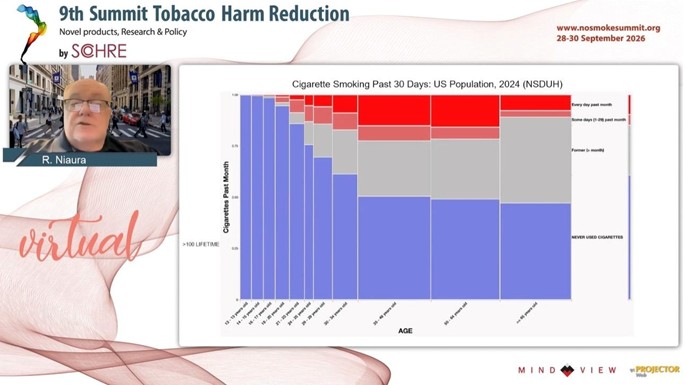
The discussion also examined the data used by the Centers for Disease Control and Prevention (CDC) to compile annual statistics on smoking and vaping. Speakers pointed out that federal authorities do not present the two behaviors — smoking and vaping — in combination, which would allow for a clearer picture of how they interact.
By presenting them separately, the data creates the impression that vaping is an out-of-control “epidemic.” Looking at the two behaviors together, however, reveals the significant role that vaping has played in helping people quit smoking.
Results were presented from two major US surveys — the National Health Interview Survey (NHIS, 2014–2025) and the National Youth Tobacco Survey (NYTS) — examining vaping and its relationship with smoking. The NHIS data shows a clear inverse relationship: as the number of people who vape increases, the number of people who smoke decreases — as does the proportion of so-called “dual users,” meaning individuals who use both vaping products and cigarettes simultaneously. The data also records a notable and steadily growing percentage of vapers who now identify as former smokers. While this does not necessarily mean they quit smoking through vaping, it is certainly indicative that vaping played a role in their decision to quit.
Among 18–20-year-olds, since the NHIS began collecting vaping data in 2014, the trend is clear: following the rise of vaping, smoking rates in this age group dropped sharply. It is also noteworthy that, while in the early days of vaping there was a measurable proportion of dual users, that proportion has declined significantly year over year, reaching below 1% in 2024 and 2025.
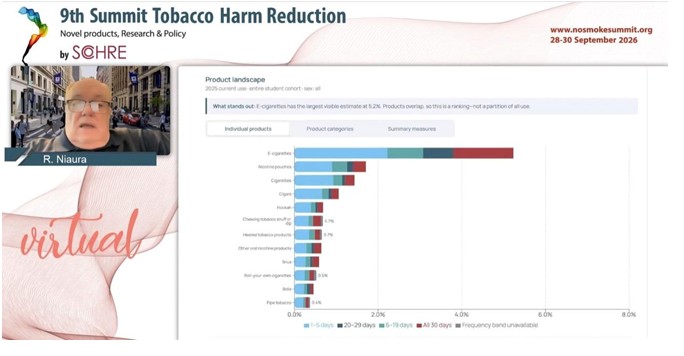
Tobacco product use among college students
As part of the National Health Interview Survey, 2025 data on the use of different tobacco products among college students was presented. E-cigarettes top the list of preferred products, followed by nicotine pouches and conventional cigarettes. Heated tobacco products and snus account for a smaller share, while roll-your-own cigarettes and pipe tobacco rank very low on the list.
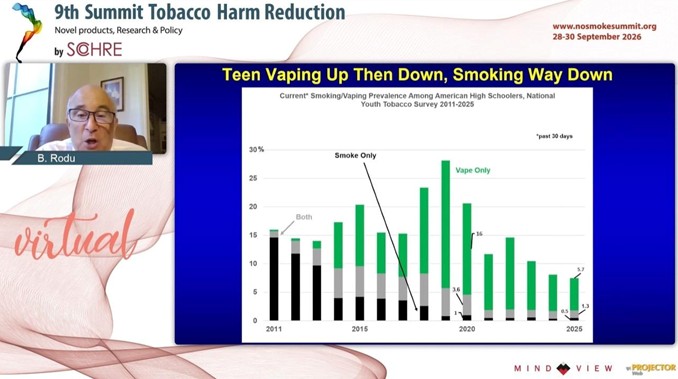
The NYTS, covering the period from 2011 to 2025, shows that while smoking rates were very high before 2011, they dropped sharply as high school students began vaping, and today are barely statistically visible. The data also records a rise in vaping that peaked in 2019, followed by a steady and continuous decline over the past six years.
The risk is shifting to adults over 35
Particularly compelling were the statistics presented on smoking among older age groups. According to 2025 National Health Interview Survey data, while smoking rates in the 18–20 age group have fallen below 1%, they rise to 2.6% among 21–24-year-olds, 4.9% among 25–34-year-olds, 8.7% among 35–44-year-olds, 10.8% among 45–54-year-olds, and peak at 11.4% among 55–64-year-olds. Rates then begin to decline, though they never approach the very low levels seen among young people — despite the fact that older individuals would be expected, and in many cases medically advised, to quit smoking for health reasons.
In the 75–84 age group, smoking is recorded at 6.2%, while even individuals aged 85 and over continue to smoke, albeit at a much lower rate of 1.2%. The speakers drew attention to these findings, stressing that greater focus needs to be placed on older smokers, who are at risk from a range of smoking-related diseases — while of course maintaining focus on young people, who must be kept away from the harmful habit of smoking.
The search for regulations that actually work
The speakers went on to discuss various regulatory approaches aimed at reducing smoking in the general population and among young people in particular. Measures presented included cigarette price increases, higher tobacco taxation, flavor bans and restrictions on tobacco products, school and university interventions, and legislative initiatives establishing minimum age requirements for the purchase of cigarettes and other tobacco products by minors.
These measures were examined both in terms of their scientific basis and their actual effectiveness — and the speakers questioned both. When it comes to young people in particular, it was emphasized that a policy built on prohibition and fear does not produce the desired results, and often has the opposite effect. More effective approaches are considered to be clear, evidence-based communication about the risks — communicated in a way that is accessible and relatable to young audiences. It was also stressed that not all nicotine products should be presented as carrying the same risk profile, since this is not accurate and tends to provoke backlash.
The speakers noted that in recent years, significant changes have taken place in young people’s lifestyle patterns, with social media playing a dominant role — shaping ideals around appearance, body image, physical fitness, and quality of life. Communication strategies aimed at reducing smoking among young people should align with these habits and make greater use of social media platforms to effectively deliver their messages to younger audiences.