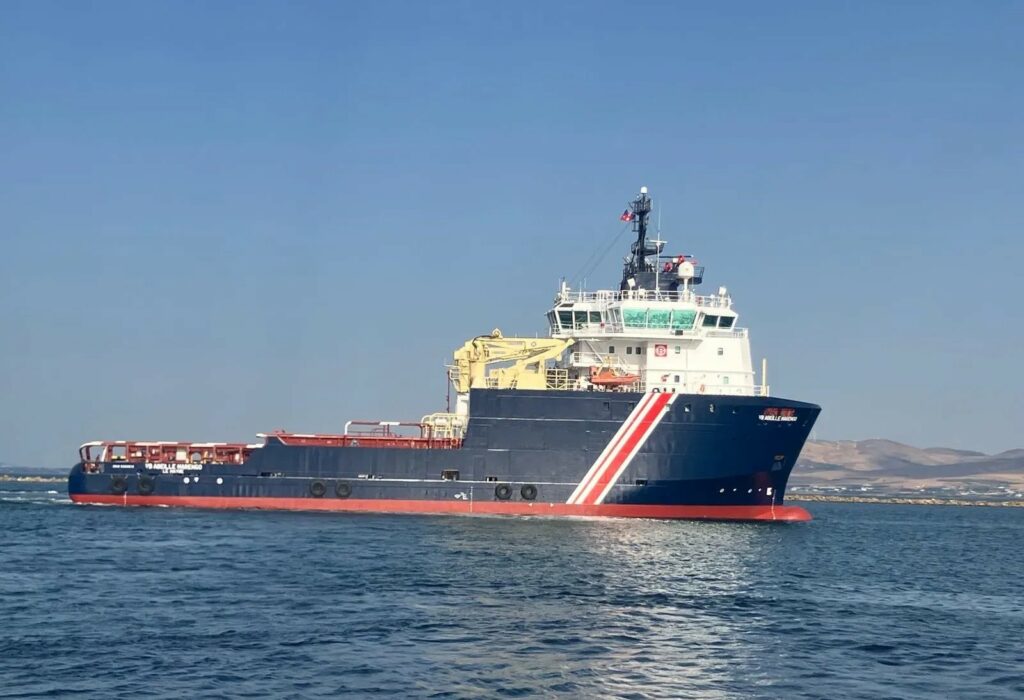
Ahead of the resumption of surveys for the Great Sea Interconnector (GSI) — the electrical interconnection between Greece and Cyprus — the French vessel Abeille Marengo has arrived at the port of Heraklion, Crete, sailing from Naples, Italy. According to ERTnews, the vessel is expected to proceed to the designated survey area as soon as the relevant NAVTEX notice is issued. The necessary applications for operational licensing have already been submitted to the Hellenic Coast Guard, along with the formal request for NAVTEX issuance. The exact start date of operations will be confirmed once all required procedures have been completed.
Of particular significance is the mandatory briefing process for the relevant military and naval authorities prior to the commencement of survey operations. As explicitly stated in the submitted request, the Abeille Marengo will notify the Hellenic Navy’s Hydrographic Service, Submarine Command, and Naval Aviation Command (NAC) at least 72 hours before operations begin, as well as on a daily basis throughout the entire duration of the work.
The notifications will include precise coordinates, a detailed description of the operations, required safety exclusion zones, and any other information necessary to ensure the safe conduct of the surveys.
Additionally, the submitted documentation requests that local port authorities and passing vessels be duly informed, with all ships required to maintain a safety distance of at least one nautical mile from the survey vessels.
According to available information, the vessel is expected to operate under the discreet supervision of Hellenic Coast Guard patrol craft, as well as Hellenic Navy units, as part of broader surveillance and security measures in the area.
Great Sea Interconnector: How the surveys will be conducted
The underwater survey operations have been entrusted to Italian company Next Geosolutions Europe SpA, a member of the Marnavi maritime group and a specialist in geophysical and geotechnical surveys for offshore energy infrastructure. The contract was awarded by French cable manufacturer Nexans, which is responsible for the construction and installation of the Greece-Cyprus electrical interconnection cable.
The surveys will be conducted along the planned cable route, spanning the sea area between Korakias, in the Heraklion regional unit, and Cyprus.
The primary objective is to produce detailed seabed mapping and to document the geological and morphological characteristics of the seafloor, in order to identify the most suitable route for the safe laying and protection of the electrical cables.
To achieve this, a range of specialized systems will be deployed, including multibeam echo sounders, side-scan sonar, magnetometers, and underwater video imaging systems.
In addition, geotechnical sampling is planned at depths of up to 700 metres below the sea surface, along with penetration testing and seabed drilling operations.
The primary challenge of the work is linked to the considerable depths of the Eastern Mediterranean and the presence of steep underwater gradients and complex geomorphological formations.
The licensing process
It is worth noting that the deployment of the Abeille Marengo, which sails under a French flag, required an additional exceptional authorization from the competent departments of the Ministry of Shipping and the Hellenic Coast Guard.
As highlighted in the documentation, the use of this particular vessel was deemed necessary due to the high technical requirements of the survey operations and the unavailability of comparable Greek-flagged vessels for the relevant period.
The Abeille Marengo, measuring 73.2 metres in length, was built in Norway in 2009 and is equipped with specialized technology for offshore operations.