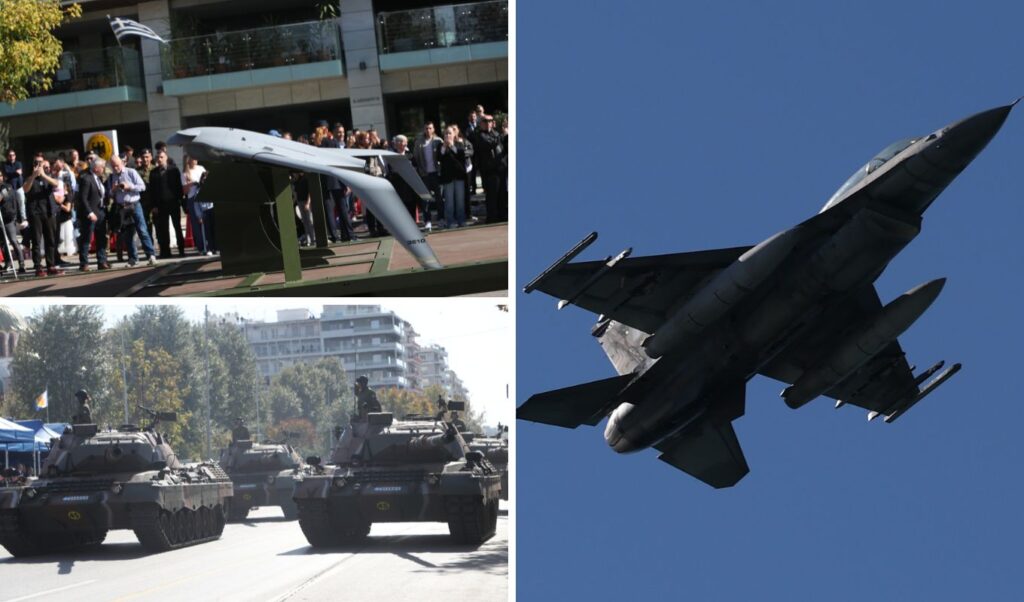
This year’s military parade marking October 28 in Thessaloniki will feature new weapons systems, unmanned aerial vehicles, advanced air defense capabilities, and military contingents from Greece and abroad. At the forefront are the “Achilles Shield” integrated defense system, Greek counter-drone systems, Rafale and F-16 Viper fighter jets, as well as international participation including Portugal’s KC-390 Millennium transport aircraft and military contingents from Cyprus and Egypt.
According to reports, the parade will open with military units, followed by civilian contingents — a departure from the usual order of events.
Military parade in Thessaloniki: The “Achilles Shield” and air defense systems
A central highlight of the parade will be the systems associated with Greece’s plans to develop a multi-layered anti-aircraft and anti-ballistic protection network, known as the “Achilles Shield.” As part of this showcase, components of advanced systems such as David’s Sling and Spyder are expected to be on display, both of which are integral to the strategy of reinforcing the protection of Greek airspace.
Drones and Greek counter-drone systems
Unmanned systems will have a prominent presence at this year’s event. Among those featured are the Greek-designed “Archytas,” the French Patroller, the VBAT vertical take-off and landing drone, and the Orbiter 3, which is used in surveillance and targeting missions.
Naval unmanned systems include the Schiebel Camcopter S-100, expected to operate from the Belharra frigates, as well as the ALTUS LSA A900.
Also drawing attention are the Greek electronic warfare and counter-drone systems “Centaurus” and “Hyperion,” developed by the Hellenic Aerospace Industry as part of efforts to strengthen domestic defense technology. According to information presented on the new systems, this year’s parade is also expected to showcase unmanned logistics vehicles capable of transporting ammunition, food, and other supplies to front-line units. Some of these vehicles can carry payloads of up to 600 kilograms, reducing the need to expose soldiers to hazardous areas.
The systems on display will also include Greek-made loitering munitions — also known as “kamikaze” drones — as well as unmanned aerial vehicles designed for reconnaissance and surveillance missions.
“Centaurus”: Greek technology against drones
The “Centaurus” system is one of Greece’s most significant counter-unmanned aerial vehicle platforms. It has been deployed in operations in the Red Sea and has attracted considerable international interest.
Its operation is based, among other things, on jamming GPS signals and disrupting communications between a drone and its operator, with the aim of neutralizing its functionality. Plans are also underway to deploy it aboard frigates and other Hellenic Navy vessels, while its use at land-based installations is also under consideration.
Missiles, battle tanks, and artillery systems
Along Megalou Alexandrou Avenue, the parade is also expected to feature “Pyrpolitis” and Corsair unmanned surface vessels, SeaHake mod4 torpedoes, and Exocet anti-ship missiles. The ground segment includes Leopard battle tanks, Marder and M1117 armored vehicles, M109 self-propelled howitzers, M270 multiple launch rocket systems, and vehicles equipped with Spike NLOS missiles.
The weapons systems showcase will also include Meteor, SCALP, Rampage, and HARM precision missiles, reflecting the full breadth of the Hellenic Armed Forces’ capabilities.
Rafale, F-16 Viper, and the Portuguese KC-390
The aerial segment is expected to generate particular excitement, with flypasts by Rafale fighters and upgraded F-16 Viper jets. The skies over Thessaloniki are also set to see Apache, Chinook, NH-90, and Kiowa Warrior helicopters, with the program concluding with a display by the “Zeus” aerobatic team.
An international dimension is added by the participation of a KC-390 Millennium transport aircraft from the Portuguese Air Force. Its presence carries additional significance, as Greece is planning to acquire three aircraft of this type as part of the renewal of its airlift and aerial refueling capabilities.
The frigate “Kimon” and military contingents
The frigate “Kimon,” Greece’s first Belharra-class vessel, generated considerable public interest in the days leading up to the parade, having arrived in Thessaloniki on Friday. The public was given the opportunity to visit the ship, with turnout proving exceptionally high.
The parade will include infantry units from the Hellenic Army, Navy, and Air Force, as well as contingents from Special Forces and elite units. Personnel from border and island region units will also participate, equipped with operational gear and field uniforms.
Also present will be the Presidential Guard, the Hellenic Military Academy, the Hellenic Naval Academy, the Hellenic Air Force Academy, and other military schools. Units from the Hellenic Police, the Fire Service, and the Hellenic Coast Guard will also take part in the event.
An international character is lent by the participation of military contingents from Cyprus and Egypt. From Cyprus, Raider commandos of the National Guard and reserve frogmen are expected to take part.
This year’s parade goes beyond its commemorative significance — it also highlights the priorities of the “Agenda 2030,” with an emphasis on technological modernization, the development of indigenous defense capabilities, and the adaptation of the Armed Forces to the demands of modern warfare.