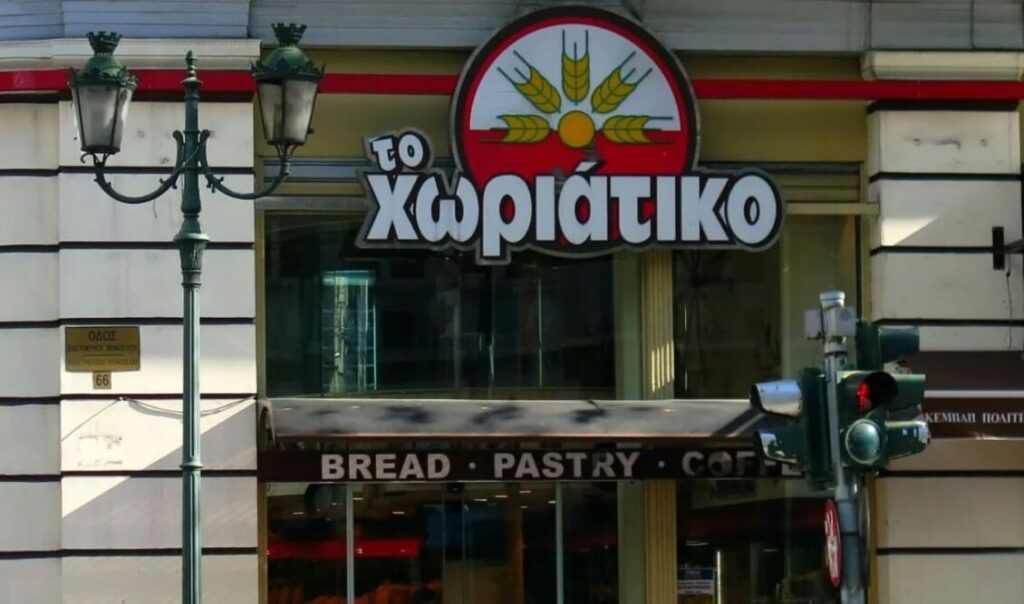
Can a company list as its legal representative a person who never actually existed? And how can a store continue operating normally — with the same sign, the same staff, and the same suppliers — while the company that ran it has been abandoned, leaving behind millions of euros in debt?
Read also: Mr. Horiatiko: Allegations of women forced into striptease and police officers covering for the criminal network
These are two of the central questions raised by the evidence contained in the massive case file compiled by the Organized Crime Division regarding the alleged criminal network linked to the “To Horiatiko” bakery chain and businessman Angelos Giannakopoulos. According to the 850-page case file, investigators identified 13 non-existent individuals whose details were allegedly used to establish companies, as well as six managers who died between 2023 and May 2026.
Behind these findings, authorities describe a labyrinthine mechanism through which businesses with significant turnover allegedly passed successively from one company to another, without anything fundamentally changing in their day-to-day operations. What changed was the legal entity appearing as responsible for running them, while the financial liabilities remained with the previous companies.
“To Horiatiko”: The 13 ghost identities that never existed
One of the most striking findings of the police investigation concerns the use of non-existent individuals as company managers. According to the case file, investigators identified at least 13 instances in which forged identity cards and passports from European countries were used to obtain Tax Registration Numbers from the relevant tax authorities. The alleged managers appeared as nationals of countries including Germany, France, Spain, Italy, and Cyprus. However, the investigation reportedly established that these individuals had no real existence. Using these fabricated details, corporate structures were created with registered legal representatives who, in reality, did not exist.
This practice, as described in the case file, raises serious questions about how corporate registration procedures were carried out, as well as about the individuals who actually stood behind the financial transactions of these businesses.
The six managers who died and the debts they left behind
A separate chapter of the case file concerns six individuals who had been installed as managers in companies belonging to the network under investigation and who died between 2023 and May 2026. According to the police investigation, these individuals appeared in the management of dozens of companies that had accumulated significant financial liabilities. Following their deaths, they were allegedly replaced by new proxy managers, as part of the continuous rotation of figureheads described throughout the case file.
At the same time, authorities identified dozens of additional Greek and foreign nationals — with no substantial financial means — who appeared as sole partners or legal representatives of companies in exchange for modest payments. These are the so-called “straw men”: individuals who appeared in official documents as responsible for running businesses, while, according to the police investigation, actual decisions were allegedly made by other members of the network.
How a store could change companies within a single day
Particularly noteworthy is the succession mechanism described in detail in the case file. According to the police investigation, each store operated under a specific trade name, regardless of which company appeared as its operator at any given time.
That company would have a proxy manager as its legal representative and, according to what is attributed to the alleged network, would systematically stop paying taxes and social security contributions. When the debts owed to the Tax Administration and the e-EFKA social security fund grew large and enforcement measures were imminent, the company in question was allegedly abandoned or pushed into dissolution and liquidation.
At that point — sometimes on the very same day — a new company would take over the store’s operation, with a different “straw man” in the manager’s seat. The change, however, was imperceptible to customers. The store continued operating with the same sign, the same equipment, the same suppliers, and the same staff. In this way, according to the authorities’ assessment, business activity continued uninterrupted while the previous financial obligations remained attached to the abandoned company. In essence, what changed was the company name on official documents — not the business that customers saw in front of them.
The “command center” on Kifisou Avenue and the mass liquidations
The case file also describes the location from which the multi-company network was allegedly coordinated. This is a two-story building complex of over 3,000 square meters on Kifisou Avenue in Peristeri, which police characterize as the central office of the alleged organization. The property had been leased by one company and was subsequently sub-leased to dozens of other companies connected to the case.
Particular significance is attached to the fact that, according to the case file, in May and June 2026, mass and simultaneous lease terminations and company liquidations took place for entities based at this building. These actions are being examined by authorities as part of their investigation into the continuous corporate changes and the potential attempt to evade financial obligations.
The role of the accounting apparatus
According to the case file, a critical role in the alleged mechanism was played by the network’s accounting arm. Police describe an accounting firm based on Heyden Street in Athens, with a branch on Kifisou Avenue, which allegedly handled the formation and dissolution of companies, changes in their management, property leases and sub-leases, as well as hiring and termination procedures through the “ERGANI” employment registry system.
This particular activity takes on special significance, as the successive corporate changes represent — according to the police investigation — a core element of the alleged network’s operating model.
In this context, authorities are examining who was responsible for creating new companies, appointing managers, and transferring the operation of stores from one corporate structure to another.
The €95.5 million question and the issue of real accountability
The financial footprint of the alleged mechanism is considerable. Specifically, the primary overdue debts owed to the state and e-EFKA amount to €76,960,295.42, not including surcharges and penalties. Of this total, €38,177,451.83 relates to obligations owed to the Tax Administration and other public bodies, while €38,782,843.59 corresponds to unpaid social security contributions. Including surcharges and penalties, the total claims reach €95,557,335.09.
At the center of the investigation is businessman Angelos Giannakopoulos, to whom authorities attribute a directing role in the network under investigation — despite his name not officially appearing in the management of the companies that accumulated the debts.
The critical question emerging from the case file is not only the scale of the debts, but also who truly controlled these businesses. This is because, according to police findings, behind companies with significant business activity there appeared even non-existent individuals, managers who subsequently died, and people with no financial capacity to meet the obligations being accumulated.
Meanwhile, the stores allegedly continued operating as normal — with a different company appearing on official documents each time, and the previous debts remaining unpaid.