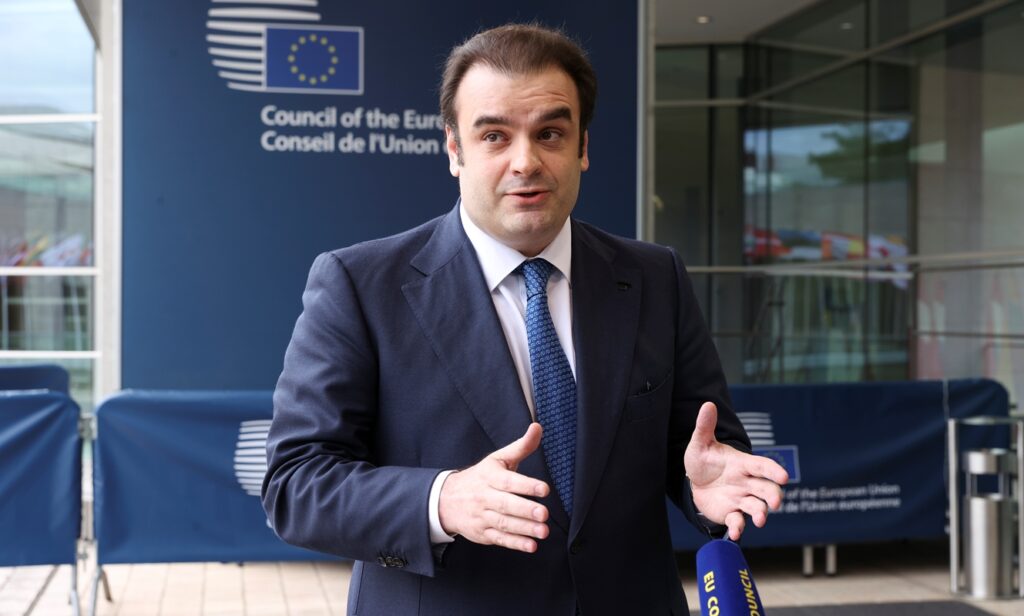
The need to protect European households and businesses from rising energy costs without jeopardizing Europe’s fiscal credibility was underscored by Eurogroup President Kyriakos Pierrakakis as he arrived at the Finance Ministers’ meeting in Luxembourg. He described the current situation as a “difficult equation,” as the European economy faces two simultaneous challenges: soaring energy prices and inflation weighing on citizens and businesses, alongside bond market pressures that reinforce the need to maintain fiscal stability. According to Pierrakakis, Europe’s response must be grounded in two core objectives — protection and preservation — in order to address the economic consequences of the energy shock within the existing fiscal framework.
Read also: Pierrakakis in Luxembourg for Eurogroup and ECOFIN meeting — Energy, investment, and competitiveness in focus
Pierrakakis: The double challenge from the energy shock
The Eurogroup President explained that the first side of the challenge concerns the immediate economic burden caused by rising energy prices. High energy costs and accelerating inflation are creating additional hardship for households and businesses, making it necessary to find ways to provide support. As he stated, the key priority is to protect “households and businesses and every European who is feeling the cost of the energy shock.” At the same time, however, he stressed that Europe must also uphold “the credibility of our fiscal rules,” since tackling the energy crisis cannot be separated from the pressures being recorded in financial markets. This approach, he noted, requires achieving both objectives simultaneously, without sidelining either side of the economic challenge.
Greece and Italy’s calls for greater flexibility
Kyriakos Pierrakakis made specific reference to requests from southern European countries for greater flexibility in addressing the consequences of the energy crisis. Responding to a relevant question, he mentioned the letters sent by the Greek and Italian prime ministers, noting that other member states have also taken their own initiatives and positions on the matter. As he explained, individual approaches differ, with some countries placing greater emphasis on protecting citizens and businesses, while others focus more on fiscal stability. Despite these differing priorities, the Eurogroup President stressed that there is a shared understanding of the need to combine both objectives. “We are all aware of the fact that we need to do both,” he stated, clarifying that the relevant decisions must be made “within the framework of the rules we have before us” and in accordance with the existing European fiscal framework.
Bond market pressures and the European balance
Commenting on developments in bond markets, Pierrakakis pointed out that the pressures being recorded are not exclusively a European phenomenon, but are linked to broader shifts in the global economic environment. Among the factors influencing the situation, he cited increased demand for private debt, noting that developments are “global in nature” and that all relevant data is “taken into account as a whole.” He also assured that market movements are being closely monitored, and that the need to combine citizen protection with the preservation of fiscal credibility is a central topic of discussions within the Eurogroup.
Finally, the Eurogroup President acknowledged that the economic impact is not uniform across all member states. Some European countries are facing more intense pressure from the energy shock, while others are more concerned about their fiscal headroom and government bond yields. Despite these differences, he argued that addressing the challenges must remain a common European effort, expressing confidence that “we can achieve the right balance,” as has been the case during previous periods of difficulty.