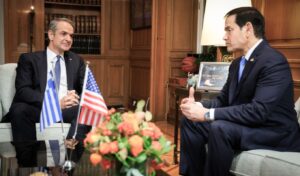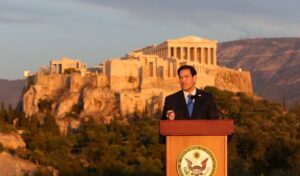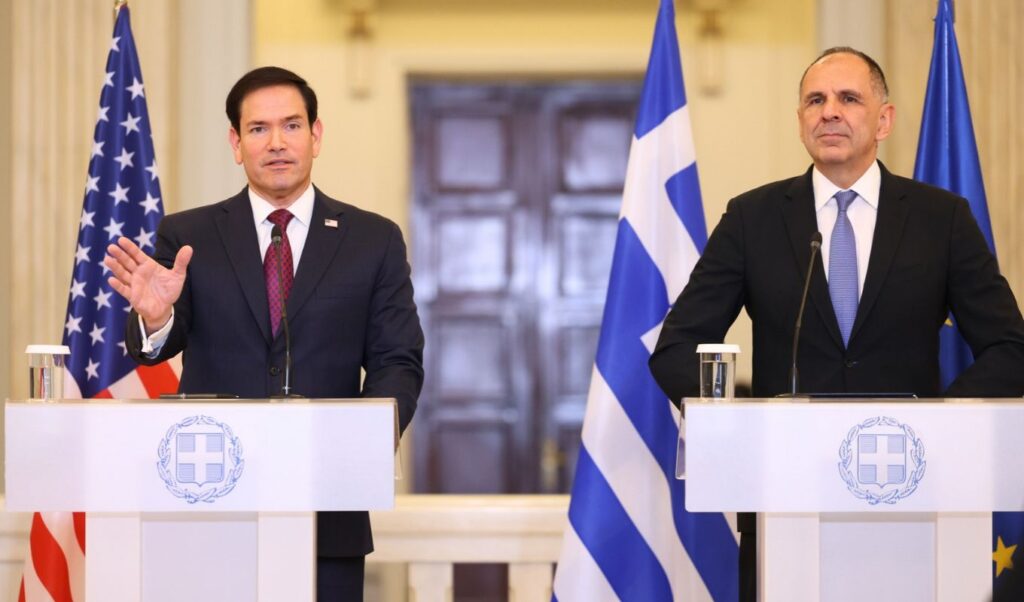
Greece and the United States are moving toward an even closer partnership, expanding their strategic relationship across a range of areas with significant geopolitical and economic implications. The direction for the next chapter was set in Athens during the sixth round of the Greece-US Strategic Dialogue, co-chaired by Greek Foreign Minister Giorgos Gerapetritis and his American counterpart, Marco Rubio. In the joint statement that followed, both sides reaffirmed the “steadfast, enduring, and deep character” of Greek-American relations, while expressing their intent to further broaden bilateral cooperation. Special emphasis was placed on defense and security, economy and investment, emerging technologies and innovation, as well as energy and shipping. The agenda also included strengthening cultural ties, extending the footprint of bilateral cooperation beyond traditional sectors. This new round of the Strategic Dialogue confirms the shared commitment of Athens and Washington to maintaining open and stable channels of communication at a time when geopolitical and energy developments across the broader region are taking on increasing significance.
$4 billion defense agreements
The defense component of the Strategic Dialogue carries particular weight. Greece and the United States announced military equipment sales through the American Foreign Military Sales (FMS) program, totaling $4 billion. According to the joint statement, the agreements are embedded within Greece’s long-term defense planning and aim to enhance interoperability between Greek and American armed forces. The deal also provides for exploring new cooperation opportunities between the defense industries of both countries, with special focus on cutting-edge technologies.
Stryker vehicles for Greece and cooperation with the Florida National Guard
The joint statement also records the transfer of Stryker armored vehicles to Greece, representing another step toward strengthening operational interoperability. The two countries also finalized Greece’s participation in the State Partnership Program of the US National Guard Bureau with the State of Florida. Athens and Washington reaffirmed the strategic value of their defense cooperation for both bilateral security objectives and NATO goals. Within the same framework, an expansion of cooperation in law enforcement and counterterrorism was agreed upon, while both sides reiterated their commitment to addressing illegal migration.
Energy, the Vertical Corridor, and hydrocarbons
Significant attention was also given to energy cooperation. Both sides agreed to capitalize on the momentum generated following the Ministerial Meeting of the Partnership for Transatlantic Energy Cooperation (P-TEC) in November 2025. At the center of discussions were the Vertical Gas Corridor and hydrocarbon exploration — two areas directly linked to Greece’s enhanced role in the energy planning of Southeastern Europe.
Investment, critical infrastructure, and economic security
On the economic front, Greece and the United States committed to working toward increasing bilateral trade and investment. Special mention was made of economic security, as both countries intend to strengthen cooperation on investment screening and the protection of procurement processes related to critical infrastructure. This particular commitment takes on added significance at a time when the US is placing increased emphasis on controlling strategic investments and safeguarding technological, energy, and digital infrastructure.
Cooperation on superintelligence, supercomputing, and cybersecurity
A substantial portion of the joint statement addresses advanced technologies. Given Greece’s participation in the Pax Silica initiative, Athens and Washington agreed to strengthen cooperation in the fields of superintelligence, high-performance computing, cybersecurity, and advanced technologies. Technological cooperation is now formally established as one of the core pillars of the two countries’ strategic relationship, alongside defense and energy.
Agreement on American seafarers aboard Greek ships
Shipping also received notable attention. Greece and the United States highlighted the importance of bilateral cooperation in the maritime sector and signed an agreement on the certification of American seafarers aboard Greek-flagged vessels. The agreement adds a new institutional dimension to Greek-American relations in a sector where Greek shipping plays a central role in global maritime transport.
New memorandum on cultural heritage
The two governments also signed the renewal of the Memorandum of Cooperation on Cultural Heritage, aimed at protecting cultural property and combating illegal trafficking networks dealing in antiquities and other culturally significant objects. Additionally, the first project in Greece to be included in the US Ambassadors Fund for Cultural Preservation (AFCP) was announced, with the goal — as stated in the joint declaration — of highlighting the shared democratic traditions of Greece and the United States.
The sixth meeting of the Strategic Dialogue confirms the broadening of the Greek-American agenda. Defense cooperation remains at the core of the relationship, while technology, energy, investment, critical infrastructure, and shipping are all gaining greater prominence in the strategic planning of both Athens and Washington.
The full text of the joint statement of the Hellenic Republic and the United States of America on the sixth Greece-US Strategic Dialogue:
“On October 7, 2026, Greek Foreign Minister Giorgos Gerapetritis and US Secretary of State Marco Rubio co-chaired the 6th Round of the Greece-US Strategic Dialogue and exchanged views on a wide range of international issues. Both sides reaffirmed the steadfast, enduring, and deep character of the bilateral relationship, grounded in shared democratic values and Greece’s role as an active NATO Ally. Guided by their shared priorities, both sides committed to deepening defense ties, strengthening trade and investment, and advancing cultural bonds.
DEFENSE AND SECURITY
Greece and the United States reaffirmed their commitment to further strengthening their longstanding cooperation in defense and security. Greece and the United States announced $4 billion in Foreign Military Sales (FMS) to support Greece’s long-term defense planning, with the aim of further enhancing interoperability and exploring future cooperation opportunities between defense industries, including in the area of innovative technologies.
Both sides finalized Greece’s participation in the State Partnership Program of the US National Guard Bureau with the State of Florida and enhanced interoperability through the transfer of Stryker armored vehicles to Greece. Both sides reaffirmed the strategic value of their defense cooperation in achieving both bilateral security objectives and those of NATO. They expanded cooperation in the areas of law enforcement and counterterrorism and reiterated their commitment to addressing illegal migration.
ECONOMIC AND TRADE COOPERATION
Greece and the United States reaffirmed their commitment to strengthening bilateral trade and investment. They recognized the importance of economic security and intend to cooperate on strengthening investment screening and securing procurement processes related to critical infrastructure.
Given Greece’s participation in the Pax Silica initiative, both sides welcomed the strengthening of cooperation in the fields of superintelligence, high-performance computing, cybersecurity, and advanced technologies.
They highlighted the further deepening of energy relations, building on the momentum of the November 2025 Partnership for Transatlantic Energy Cooperation (P-TEC) Ministerial, the Vertical Gas Corridor, and hydrocarbon exploration. They underscored the importance of cooperation in the maritime sector and signed an agreement on the certification of American seafarers aboard Greek-flagged vessels.
CULTURAL TIES
The two governments also signed the renewal of the Memorandum of Cooperation on Cultural Heritage, reaffirming their commitment to protecting cultural heritage and combating illegal cultural property trafficking networks. They also announced the first project in Greece under the US Ambassadors Fund for Cultural Preservation (AFCP), aimed at highlighting the shared democratic traditions of both nations.”