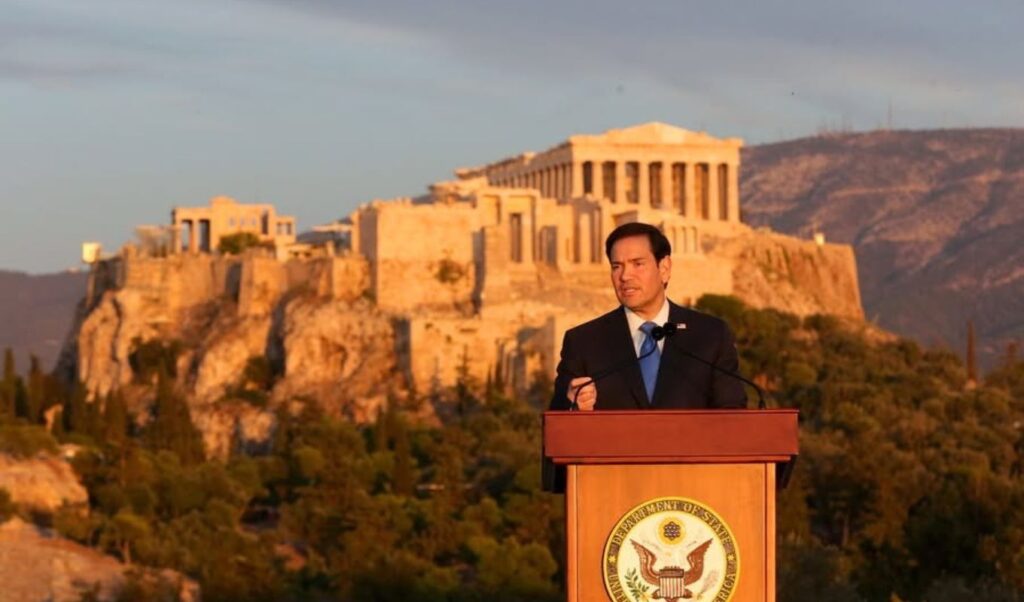
US Secretary of State Marco Rubio spoke about the influence of ancient Greece on the formation of Western civilization — and the United States in particular — during his address at the Pnyx. “There are great ruins all over the world. In many cases, they are places where history seems to have exhausted itself — remnants of distant civilizations long lost from living memory. But the Acropolis is different,” he said.
Rubio at the Pnyx: “The ancient Greeks seem to exert an almost mystical power over our memory”
As he noted, the civilization that created what still stands on the Acropolis “has captivated the imagination of the Western world for thousands of years,” while generations of political leaders, artists, and philosophers have turned to it “with admiration and awe.” “The ancient Greeks seem to exert an almost mystical power over our memory. They call us back to them again and again,” he added.
The destruction of the Acropolis and the construction of the Parthenon
Marco Rubio made extensive reference to the events of 480 BC. As he described, the Athenians put up resistance, managing to hold back “the greatest empire of that era.” Ultimately, the Persians razed the Acropolis to the ground.
Under Pericles, however, the Athenians raised the Parthenon. “For 25 centuries the Parthenon has stood. Empires have risen and fallen in its shadow,” said Rubio, adding that the descendants of those who built it — “the sons of Athens and Rome” — carried their civilization to the ends of the earth.
“A debt”
Marco Rubio connected ancient Greek heritage to the history of the United States. “Two and a half centuries after the founding of the American Republic, on the other side of the world from where I stand today, I stand here as Secretary of State of that Republic — and as the great-grandson of settlers who arrived in the New World from Spain,” he said. He added: “I stand here to bear witness to a debt that no passage of time and no geographical distance can ever erase.”
According to Rubio, “the history of America, the history of my country, is filled with the imprints of antiquity.” Greek influence, he said, is etched into the architecture of American institutions. He also highlighted Philadelphia — the city where the US Constitution was born — noting that its very name is Greek.
Plutarch and the founding fathers of America
Marco Rubio pointed out that many people are surprised to learn that the most frequently cited author in the Federalist Papers was Plutarch — “the Greek biographer of the great men of Greece and Rome.”
Rubio then spoke about the influence of ancient Greece on the ideas of America’s founding fathers, as well as on philosophers and statesmen across the Western world more broadly. “Athens gave us democracy; Plato and Aristotle gave us Western philosophy,” he said, noting that concepts of law, virtue, citizenship, and democratic governance were shaped in the Greek city-states. Even much of the modern political vocabulary, he added — words like “democracy,” “tyranny,” and the word “politics” itself — has its roots in Greece.
“To know them is to know ourselves”
The US Secretary of State emphasized that America’s debt — and the West’s debt as a whole — to ancient Greece runs far deeper than the institutions and political ideas it bequeathed. “What we owe to this place, as Americans and as people of the West, is in reality much, much deeper,” he said.
Those institutions and ideas, he explained, were the outward expression of deeper qualities belonging to the ancient Greeks: the way they perceived the world, their imagination, the virtues they demanded of their citizens, and the things they were willing to defend. These were, as he put it, “the things they lived for, fought for, and died for.”
“To know them is to know ourselves,” Marco Rubio declared. He went on to say that “what flourished here, in this place, was the Western desire to discover…” The Secretary of State also stressed that Greece has proven to be a model ally in cooperation with US armed forces. “Together, we must strengthen an alliance capable of confronting the threats of our time,” he added.