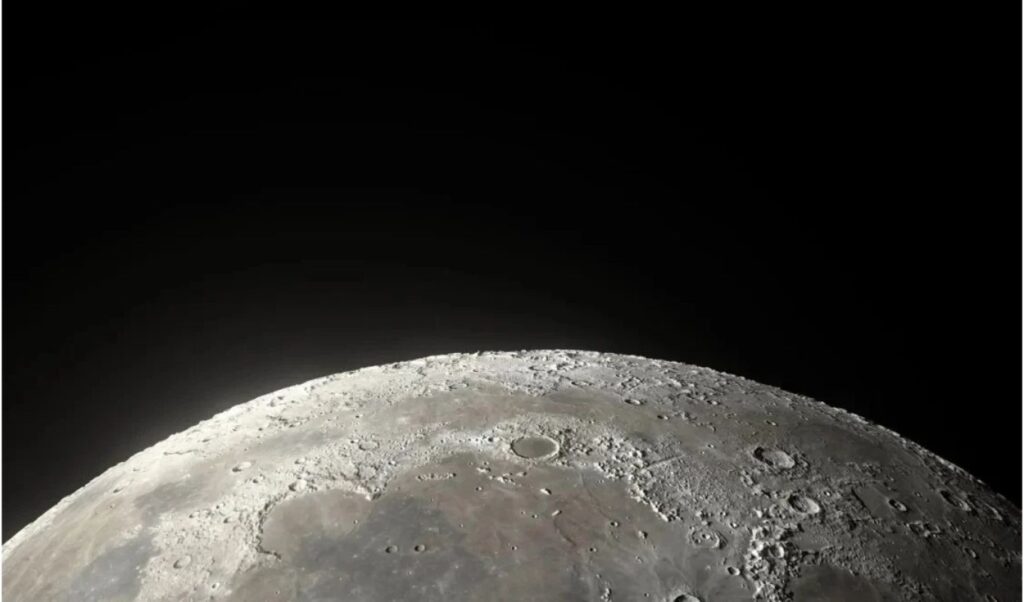
The new space race is no longer just about who will return to the Moon first. The next great challenge is who will successfully establish the infrastructure needed to support a permanent human presence there. And at the heart of that battle is nuclear power. NASA is accelerating its plans to deploy a nuclear reactor on the Moon, with a target launch readiness date of December 2030. Standing on the other side are Russia and China, which are advancing their own joint plan for powering future lunar installations. The race has already begun — and the stakes are far greater than yet another display of technological might.
NASA picks up the pace
The American space agency has asked partner companies to prepare for the development of a reactor that can be safely transported to the Moon and operate autonomously, without continuous human maintenance. The design calls for it to be installed near the lunar south pole — a region of enormous scientific and strategic interest.
Washington wants the system ready by the end of 2030, as Russia plans to deploy its own lunar nuclear reactor by 2036 as part of its collaboration with China. The time pressure is therefore immense. The nation that first achieves stable, long-term electricity generation on the Moon will have taken a decisive step toward establishing permanent lunar facilities.
Why the lunar south pole matters so much
The Moon’s south pole has become the primary target of the world’s major space powers. One of the most important reasons is the presence of frozen water in regions that lie in permanent shadow. That water could be used not only to sustain astronauts, but also — with appropriate processing — to produce oxygen and fuel components.
This could transform the Moon from a destination for short missions into a base for longer-duration human presence and, in the long term, a staging point for missions to Mars and beyond. But making that happen requires energy — and far more of it than today’s robotic missions demand.
The major problem with solar power
Solar panels are an obvious solution for early lunar installations, but they come with significant limitations. The lunar night can last more than two Earth weeks. A permanent base cannot rely solely on sunlight to power its critical systems.
Nuclear reactors, by contrast, can generate electricity regardless of solar radiation and operate for years with minimal human intervention. That is why nuclear power is now regarded as one of the key technologies for the transition from short-duration missions to permanent lunar outposts.
What the United States is planning
The American reactor is being designed to produce approximately 20 kilowatts of electrical power and operate for years without human intervention.
The United States is not starting from scratch. In 1965, it launched a nuclear reactor into space — though it was shut down following a malfunction aboard the spacecraft.
In the decades that followed, significant sums were invested in space nuclear power programs, yet no other operational reactor was ever deployed. NASA is now working to change that.
Russia’s significant advantage
Russia holds one crucial advantage: experience. The Soviet Union placed more than 30 nuclear reactors in orbit, primarily during the 1970s and 1980s, as part of Cold War-era space programs.
That accumulated expertise carries particular weight today, as Moscow and Beijing work together on the development of future lunar infrastructure.
Their plans include the Russian lunar reactor “Selena,” targeted for operational deployment by 2036. The system is expected to generate up to 10 kilowatts of electrical power and operate autonomously for approximately a decade.
The looming fear: what if something goes wrong?
The accelerating pace of these programs is raising serious concerns among scientists and nuclear safety experts. The first critical moment is launch.
Both NASA and Russia plan to keep their reactors inactive during transit, activating them only after a safe arrival on the Moon.
This significantly reduces the risk in the event of a launch failure — but it does not eliminate it entirely. A serious accident could destroy the system and scatter nuclear material across a wide area.
And there is already a historical precedent that serves as a stark warning.
Kosmos 954: when a nuclear satellite fell to Earth
In 1978, the Soviet satellite Kosmos 954, which carried a nuclear reactor, re-entered Earth’s atmosphere in an uncontrolled descent.
Radioactive debris was scattered across a vast area of northern Canada, triggering an extensive search and cleanup operation.
The incident remains one of the most striking examples of the dangers that can accompany the use of nuclear power in space.
On the Moon, the risks would be different in nature. A serious accident could contaminate a region of exceptional scientific or strategic value and severely complicate access for future missions.
How do you cool a nuclear reactor on the Moon?
Beyond safety, there are enormous technical challenges to overcome. A reactor on the Moon would need to operate for years without regular human maintenance, withstand extreme temperature swings, and shield surrounding equipment — and people — from radiation.
Heat management is particularly difficult. In the vacuum of space, there is no atmosphere to dissipate heat the way many Earth-based systems rely on. That means specialized thermal management technologies are essential.
And all of this must be packaged into a system compact and light enough to be launched from Earth and land safely on the Moon.
When the reactor grows old
One more question remains without a straightforward answer: what happens when a lunar reactor reaches the end of its operational life?
On Earth, decommissioning a nuclear facility is a complex process that can take years and cost enormous sums.
Transporting a spent reactor back to Earth would be extraordinarily difficult and almost certainly prohibitively expensive.
One likely scenario, therefore, is that the reactor would simply remain on the Moon after it stops functioning.
That, however, raises new questions about the long-term management of radioactive material — particularly if those areas eventually host large-scale human settlements.
Nuclear fuel is a headache of its own
NASA is exploring the use of HALEU — High-Assay Low-Enriched Uranium — a form of enriched uranium considered essential for several advanced reactor designs.
Its availability, however, presents a significant challenge for the United States. Russia holds a prominent position in the international nuclear fuel supply chain, and restrictions on American imports of Russian uranium have intensified the push to build greater domestic production capacity.
The space nuclear race is therefore directly tied to a broader battle for energy and technological independence.
Private companies are entering the race
Interest in this arena is not confined to governments. Private companies see small nuclear reactors as an emerging market — one that could extend from terrestrial applications all the way to the Moon and beyond.
The US Department of Defense has already turned its attention to developing micro-reactors for space applications, and the technologies involved could eventually be used for both military and civilian programs.
The battle isn’t about who gets there first
The true significance of this new race becomes clear when you look beyond 2030. The question is not simply which country will be first to install a nuclear reactor on the Moon.
It is who will be first to master the technology needed to stay there.
Reliable power generation means larger bases, scientific laboratories, resource extraction and processing, the ability to support more astronauts and, potentially, the infrastructure to launch missions toward Mars.
The Moon is thus being transformed from a destination for exploration into a potential strategic hub.
And nuclear power may well be one of the keys to determining who gains the upper hand in this new era of space exploration.
The greatest risk, however, is that the pressure to be first could become pressure to cut corners on safety.
Because in the new race to the Moon, the critical question is not only who gets there first — but who can afford to stay.