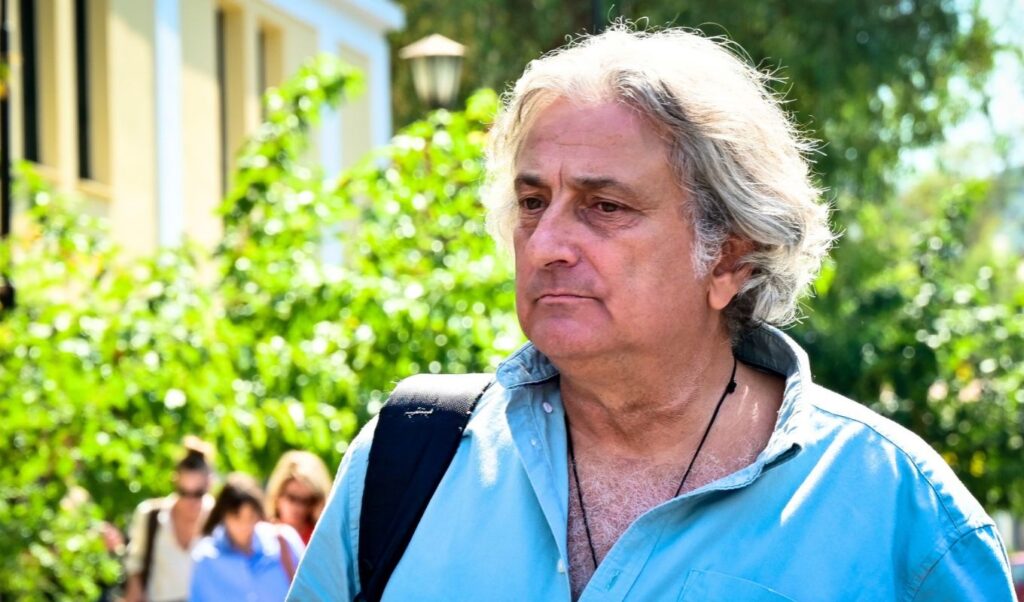
The testimony given by hypnotherapist Nasos Komianou to the examining magistrate contains significant details about the final days of Giorgos Mazonakis. In his statement, he describes in detail how he first met the singer, the conversations they had, his contact with the doctor who took on Mazonakis as a patient, and the events of the day the singer was taken away by ambulance.
Read also: Giorgos Mazonakis: “Mydriasis” and “propofol” were searched by a person present at the clinic while the singer had already collapsed — what the privacy waiver revealed (Video)
According to his statement, the first contact came through a woman who, as he understood it, was acting as the singer’s manager. She told him that Mazonakis had seen one of his videos and wanted to undergo therapy with him. The hypnotherapist asked that the necessary medical history be completed beforehand — something which, as he states, never happened. The woman insisted he take on the singer as a client, but he requested to speak with Mazonakis directly. She preferred to continue communicating on his behalf, and a meeting was eventually arranged at a restaurant in Neo Psychiko.
Death of Mazonakis: “I could tell he was in a great deal of emotional pain”
According to the testimony, at the September 7th meeting, Mazonakis arrived at approximately 5:40 p.m. and initially spoke in the presence of others. He then asked the others to leave so the two of them could talk privately. The hypnotherapist describes the singer as “very warm-hearted” and says Mazonakis expressed his happiness at meeting him. During their conversation, he states, Mazonakis spoke at length about his personal life. “I could tell he was in a great deal of emotional pain, that he felt everyone was taking advantage of him,” he says in his testimony. The witness also notes that Mazonakis made no mention of the incident that had taken place a few days earlier at a restaurant in the northern suburbs — something he says he only learned about later through the news. During that same conversation, Mazonakis told him that he had previously undergone hydrotherapy and that he had been visiting a particular doctor for years.
Contact with the doctor and the proposed treatment
The hypnotherapist states that, at Mazonakis’s suggestion, he called the doctor in the singer’s presence. He told her that Mazonakis was willing to do whatever was needed and asked what treatment she might recommend. According to his testimony, she asked him to come and see her the following day so they could discuss the way forward.
He further states that on the same evening he shared his concerns about Mazonakis’s mental state with the doctor. She reportedly responded that he “needs help” and that she recalled him being “cyclothymic,” meaning he experienced frequent mood swings. The following day, according to his testimony, the doctor told him that Mazonakis had already visited the clinic and would be returning on Wednesday for plasmapheresis.
“She sent me a photo of Mazonakis during the treatment”
The hypnotherapist also refers to the messages he exchanged with the doctor on Wednesday. He states that he contacted her at around 12:50 p.m. to find out whether Mazonakis had arrived and whether their scheduled 5:00 p.m. appointment would still go ahead. Later, he says he received a message saying “all is well,” followed by a photograph showing Mazonakis apparently undergoing treatment. “I was actually taken aback that she sent me a photo of the patient, with no indication that the patient had consented to it,” he states. He also notes that in the photograph, Mazonakis had his eyes closed and “his leg appeared to be hanging limply.”
Being informed of the collapse
Shortly before his scheduled appointment with Mazonakis, the hypnotherapist sent a message to the doctor. When he received no reply, he called her. According to his testimony, she told him that an ambulance had arrived and taken Mazonakis away, saying that “his blood pressure had dropped.” He asked why she had not accompanied Mazonakis to the hospital, and she reportedly replied that she had another client. The witness urged her to go to the hospital immediately and offered to help, as he says he still believed at that point that Mazonakis was alive.
“I was in shock”
The hypnotherapist goes on to say that at around 6:00 p.m. he received an alert from a news website reporting that Giorgos Mazonakis had died at Elpis Hospital. “I was in shock,” he states in his testimony. A series of messages with the doctor followed, in which he expressed his grief and distress. He explains that he felt particularly devastated because he believed he had played a role in bringing Mazonakis and the doctor back into contact with one another.
The plasmapheresis treatment and the cost
In his testimony, the hypnotherapist also addresses the treatment that the doctor had presented to him as “detoxification.” He states that when he asked about the cost, she told him it amounted to €6,000 for two sessions, which were to be carried out at least 48 hours apart.
The hypnotherapist maintains that he never made the completion of this treatment a precondition for beginning hypnotherapy sessions with Mazonakis. On the contrary, as he states, he had assumed they would simply continue their conversation about the singer’s personal life. According to his testimony, Mazonakis had initially agreed to the treatment and its cost. However, on Tuesday the doctor forwarded him a message from the singer indicating that he had changed his mind due to the cost and would only be coming in for the standard treatment. The hypnotherapist also clarifies that he was not to receive any commission from any treatment Mazonakis underwent at the clinic.
The hypnotherapist’s relationship with the doctor
In his testimony, he also describes his long-standing professional relationship with the doctor, which began in 2013. He states that she had been among his first hypnotherapy clients and that he subsequently became an external associate at her practice. He notes that in recent years the sessions had become less frequent, as he had opened his own office.
He also mentions that he had signed a cooperation agreement in 2025, which nominally listed a fee of €40 per patient, though in practice, he states, he initially received €80 and later €100 per session.
Regarding the other doctor at the practice, he states that he was aware the doctor used bioresonance machines as diagnostic tools. He also describes a new space on Patriarchou Ioakeim Street where, he says, hypnotherapy sessions were conducted and which contained numerous individual offices.
“I was the one who brought them back into contact”
One of the most striking parts of the testimony is the hypnotherapist’s personal reflection on the role he believes he played in this case. Following the news of Mazonakis’s death, he states that he sent the doctor messages expressing his grief and distress. “I felt terrible, because it was essentially me who had brought them back into contact,” he states pointedly.
The witness maintains, however, that he had no knowledge of the specifics of the treatment that was to be carried out, beyond it being described as a therapy that “cleanses the blood,” and that he had not been informed of any developments in Mazonakis’s condition prior to the arrival of the ambulance.