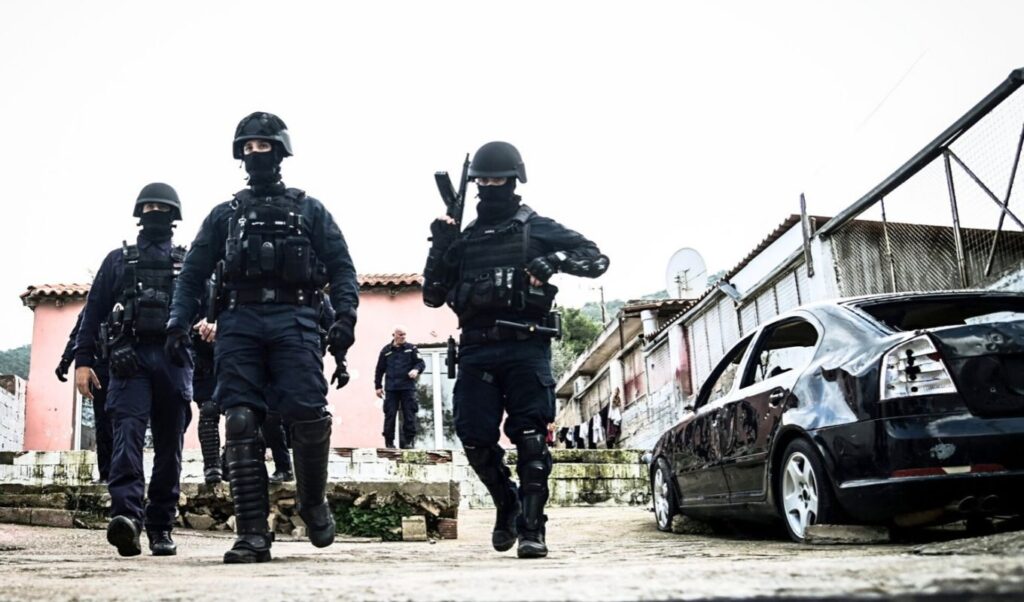
Police officers are seeking non-lethal alternatives for immobilizing suspects in order to reduce the risk of fatalities during arrests. The recent incident at the Mandra Police Station — where a man with psychological problems broke into the station armed with a knife, injured an officer, and was shot in order to be subdued — served as yet another stark example of the gap in police equipment. Between a baton and a firearm, Greek police officers currently have no other means of restraint, with tasers and rubber bullet pistols emerging as the most widely discussed tools that could potentially offer a solution to this pressing issue.
How a taser works
The use of electric stun devices — commonly known as “tasers” — is widespread in the United States, while in Europe, an increasing number of countries are adopting them one after another. France, the Netherlands, and Belgium make extensive use of tasers; in Germany, several federal states include them as standard equipment; and they are equally prevalent in the United Kingdom. In Greece, the Panhellenic Federation of Police Officers and several other police unions appear to support — under certain conditions — the use of tasers as well as rubber bullet weapons.
A taser is a device shaped like a pistol — or in some cases a rectangular unit — that, when activated, rapidly fires two prongs connected by thin wires. When the prongs hit their target, they deliver electric pulses, effectively an electric current, causing neuromuscular paralysis. The intensity of the current is such that it does not damage the target’s heart, insist the manufacturers of such deterrent systems. However, if a person has pre-existing cardiac conditions and is struck by the prongs, they may suffer cardiac arrest or even die.
Modern challenges require a reassessment of the regulatory framework, equipment modernization, training, and the adoption of technology such as electric stun devices, states Thomas Kakionis, secretary of the Lefkada Police Officers’ Union and member of the Communications Team of the Panhellenic Federation of Police Officers: “There clearly needs to be a dialogue on re-evaluating the use-of-force continuum, but more importantly on the broader protection of officers — operationally, institutionally, and legally. Every new tool, such as tasers and rubber bullet weapons, must be assessed individually, based on effectiveness, risks, and the impact of its use, along with the necessary training and the regulatory framework that must govern it. Citizens must understand that police officers face situations every single day where, within a matter of seconds, they must make decisions aimed at protecting the lives and physical safety of the public, their colleagues, and even the suspects themselves.”
“A comprehensive strategy for operational safety is needed”
Speaking to “A,” the secretary general of the Lefkada Union made it clear that it is not enough to simply decide to introduce, for example, rubber bullet weapons, without first providing specialized training and regular ongoing retraining: “A comprehensive strategy for operational safety is needed — one that combines equipment, training, technology, and clear rules of engagement. Tools like the ones mentioned are not a ‘magic solution’ on their own. The use of devices such as tasers and rubber/plastic bullets requires particular caution, rigorous risk assessment, and high-level training. While these tools have indeed been adopted in some countries abroad, in others they are either not used at all or their use is strictly limited to specially trained personnel. This shows that there is no single international model that can simply be transplanted wholesale into Greece.”
“Full implementation of the body camera system”
The Panhellenic Federation of Police Officers has a clear position on the renewal of the Hellenic Police’s equipment, which includes body-worn cameras (bodycams) and vehicle-mounted cameras: “Full implementation of the camera system on officers’ uniforms and in service vehicles, in accordance with current legislation and Presidential Decree 75/2020.” For police officers, Kakionis emphasizes, “cameras are tools for deterring unlawful behavior, ensuring transparency, and providing objective documentation.”
Senior Hellenic Police officials maintain that the introduction of new technological tools would prevent incidents such as the one that occurred on July 12 in Argos, when a 20-year-old was shot and killed by officers during a pursuit. On the issue of police pursuits, the secretary general of the Lefkada Union told “A”: “We would say that the need to better equip and protect officers becomes even more apparent and urgent in these cases. Handling a pursuit cannot be reduced to the mindset of ‘stop the vehicle by any means necessary.’ Clear rules are needed, and an appropriate fleet of service vehicles is required — vehicles built to specifications that meet real operational needs and ensure officer safety. The patrol cars used in everyday policing are not necessarily specialized pursuit vehicles and do not provide officers with adequate protection in the event of a ramming, something we frequently see from suspects attempting to flee arrest or avoid a checkpoint.”
By Giorgos Sombolos, Published in Apogevmatini