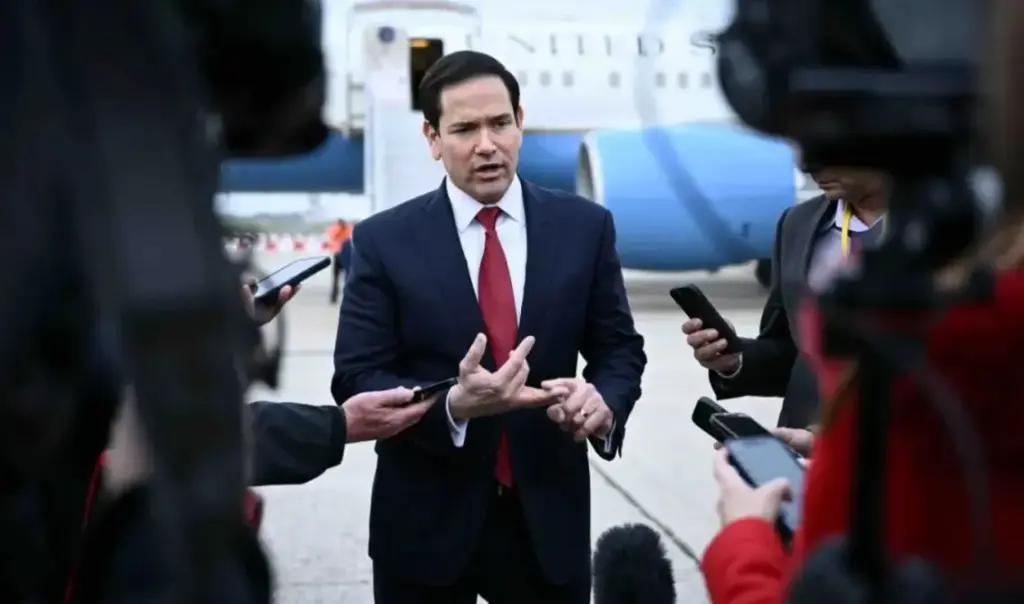
U.S. Secretary of State Marco Rubio is expected in Athens on Tuesday for a wide-ranging visit covering everything from defense and energy cooperation to developments in the Eastern Mediterranean and shifting regional dynamics. The centerpiece of the visit will be the 6th round of the Greece-U.S. Strategic Dialogue, with Athens and Washington placing the full scope of their bilateral relationship on the table. Defense, energy, and regional security are expected to top the agenda, while discussions will extend to major international crises, from Ukraine to the Middle East. The defense component is expected to carry particular weight, focusing on the Mutual Defense Cooperation Agreement (MDCA) and the facilities Greece provides to U.S. forces.
Read also: Marco Rubio expresses strong support for Gilfoyle and the Vertical Corridor — “President Trump and I deeply value the Ambassador’s pivotal work in the region”
Marco Rubio: MDCA and the U.S. military presence in Greece take center stage
Behind the scenes, discussions have been underway for some time regarding a further expansion of the U.S. military footprint in Greece, through amendments to the facilities covered by the agreement. Among the locations under consideration are Petrochori in Xanthi and the Dalip Camp in Thessaloniki, while the continued upgrade of Souda Bay remains a priority. It remains to be seen whether Rubio’s visit and the 6th Strategic Dialogue will produce concrete next steps on the MDCA, as no new amendment to the agreement has been announced to date.
Defense cooperation, however, extends well beyond the facilities Greece provides to U.S. forces. Athens and Washington have invested heavily in recent years in strengthening the interoperability of their armed forces through joint exercises and training programs, while major U.S.-origin defense procurement programs — most notably the acquisition of the F-35 — form a key pillar of the broader strategic relationship.
A significant portion of the talks is also expected to focus on the Eastern Mediterranean. Athens is anticipated to raise Turkey’s latest moves and its ongoing provocative behavior with the American side, reiterating Greece’s longstanding position in favor of respect for international law and the Law of the Sea.
The discussion takes on added significance at a time when Washington is seeking to maintain stability on NATO’s southeastern flank and prevent a new escalation in Greek-Turkish tensions. The “3+1” framework — the cooperation between Greece, Cyprus, and Israel with U.S. participation — also factors into this equation. The “3+1” format has been an integral part of the Athens-Washington Strategic Dialogue, with both sides having agreed on the need to deepen cooperation further and link it to other regional initiatives. For Greece, it serves as one of the key tools of engagement in the Eastern Mediterranean, within a broader framework encompassing energy, economic ties, and regional security.
It is worth noting that Marco Rubio, as a senator, was a co-sponsor — alongside Bob Menendez — of the Eastern Mediterranean Security and Energy Partnership Act (EastMed Act) in 2019. That legislation laid the groundwork for upgrading the “3+1” framework and institutionalizing defense and energy cooperation among the U.S., Greece, Cyprus, and Israel. His presence in Athens therefore carries particular significance, as he has an in-depth understanding of Eastern Mediterranean affairs. This is also where the second major chapter of Rubio’s visit intersects: energy cooperation.
Greece’s strategic objective
Greece is seeking to further solidify its role as a natural gas gateway to Southeastern and Central Europe, at a time when the United States is focused on expanding American LNG exports and reducing Europe’s energy dependence on Russia. Central to this strategy is the Vertical Corridor, through which natural gas volumes can flow from Greece to Bulgaria and onward to countries in Central and Eastern Europe.
Also part of this energy puzzle are the Revythoussa LNG terminal, the Alexandroupolis FSRU, and the Greece-Bulgaria interconnector (IGB) — infrastructure assets that reinforce Greece’s position on the region’s energy map. Also on the table is the broader question of energy connectivity between the Eastern Mediterranean and Europe, an area where Athens is actively working to align its energy strategy with regional cooperation efforts and the “3+1” framework.
Finally, Rubio’s meetings are expected to include discussions on the war in Ukraine, developments in the Middle East, and overall security across the wider region. The U.S. Secretary of State will hold talks with Foreign Minister Giorgos Gerapetritis and is expected to be received by Prime Minister Kyriakos Mitsotakis — a visit that gives both sides an opportunity to take stock of Greek-American relations and chart the next steps in their strategic partnership.
Published in Apogevmatini on Saturday