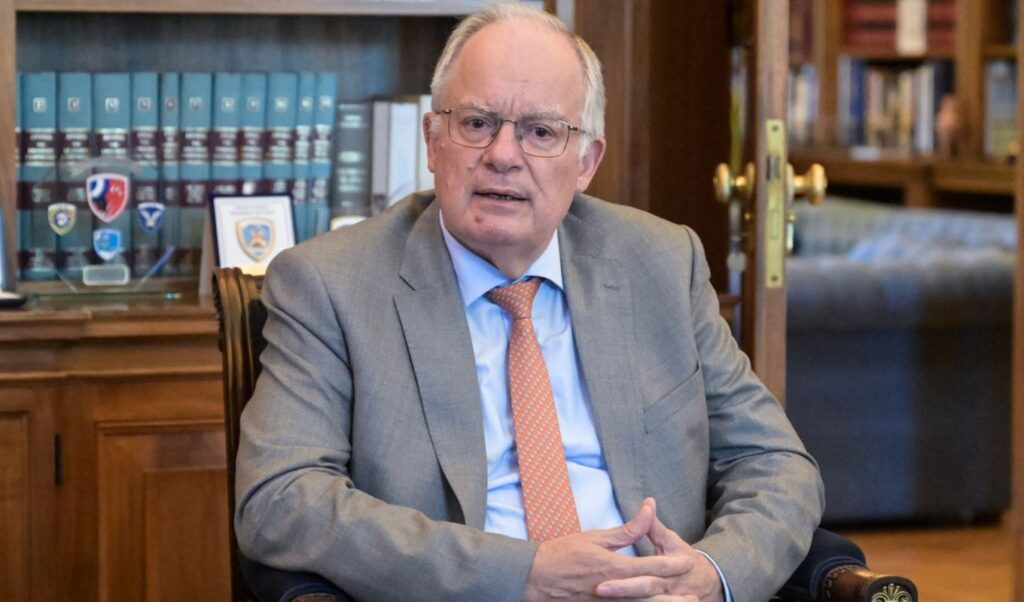
Parthenon Sculptures were among the key topics addressed by Greece’s President of the Republic, Konstantinos Tasoulas, who described their continued display at the British Museum as “ongoing looting,” while emphasizing that their return to Greece is “a debt and an obligation.”
Tasoulas on the Parthenon Sculptures: their display at the British Museum is “ongoing looting”
In an interview with NEA Savvatokyriako, President Tasoulas sent a strong message in favor of political stability, stressing that the Greek people are themselves the guarantors of that stability. At the same time, he made clear that “the electorate will decide at the ballot box whether, under current circumstances, stability is better secured by a coalition government or a majority government” — adding that he is not afraid of political deadlock, because “if deadlock prevails, someone will be held accountable for it, and sooner or later things will fall into place.”
Konstantinos Tasoulas also sent an unambiguous message to Turkey regarding the so-called “Blue Homeland” doctrine, underlining the need for national unity. As he put it: “Throughout most historical periods, the bidding war over ‘national loyalty credentials’ has left nothing behind.”
The full interview follows:
— The recent German election results are the latest example of the far right’s rise, which has now become a defining phenomenon across Europe. Against the backdrop of Ilias Kasidiaris’s release from prison, do you believe Greece is sufficiently protected?
— Greece’s system of government is a presidential parliamentary democracy, as established by the first article of our Constitution. The guarantor of this liberal and social order, as defined by the Constitution’s final article, is the people themselves — the patriotism, in the truest sense, of the Greek citizens!
Throughout the post-junta democratic era, the Greek people have consistently demonstrated their resilience against hatred, divisiveness, and extremism. The rise of the far right across Europe has economic and social roots. An unchecked, unbalanced globalization has created the conditions for what one might call a “melancholy democracy” — a democracy that grieves, because its answers are often incomplete and insufficient.
In Greece, however, we know the cost of sliding toward extremes. At the same time, all democratic forces are actively shaping a public political space where debate and pluralism ensure social participation and minimize exclusion. Despite widespread discontent, the majority of citizens do not feel that politics is as disconnected from society as people do in some other European countries.
— In recent times, there has been a marked erosion of public trust in institutions, the judiciary, and the rule of law. How can this relationship between the state and its citizens be restored?
— During the post-junta era, low trust in institutions first became a topic of serious debate in the late 1980s, and it has been a recurring theme in public discourse ever since — though it is by no means a modern phenomenon. Aristophanes’ comedies are proof enough of that.
Crises of trust surface from time to time, and different governments have, at various points, implemented reforms that eased public discontent and restored confidence. Putting an end to the political exploitation of polarization and toxicity will create the conditions for bold and meaningful consensus-building. Achieving a European standard of institutional integrity requires a more genuinely European culture of consensus and continuity in governance — and on that front, despite 46 years of EU membership, we have not made nearly enough progress or converged sufficiently.
In no other history do individuals play as prominent a role as they do in the Greek narrative. Yet there is always time and opportunity to surprise ourselves in a positive way. I would also add that the way social media functions encourages knee-jerk outrage, irrationality, and manipulation. We frequently see behaviors online that do not reflect well on us. What is needed is a disposition toward self-criticism and self-restraint. We must activate, on our own initiative, antidotes to toxicity and dysfunction.
— Our broader neighborhood is experiencing prolonged geopolitical instability, with direct consequences for the cost of living and energy security. How long can Greek society withstand these pressures?
— The state and the elected government have a duty to do everything in their power to protect national and public interests, especially in circumstances like the present. Citizens judge whether the best policies are being implemented.
It is clear that as unpredictable factors multiply and uncertainty deepens, national and social interests become increasingly dependent on our standing and credibility within Europe and on the international stage. This is yet another reason that makes national consensus on primary and pressing issues all the more imperative. I would also like to add that in the current international climate, it is critically important to take every possible measure to support citizens — and especially the most vulnerable — something that all political forces naturally accept.
— The policy of “calm waters” with Turkey is frequently tested by Turkish rhetoric. Is a genuine repositioning of bilateral relations, in your view, a realistic prospect?
— All Greek governments, without exception, have pursued and worked toward a policy of calm, dialogue, and constructive cooperation with Turkey. At the same time, Greek governments have consistently pushed the economy to its limits to ensure that Greece maintains one of the strongest and best-equipped armed forces in NATO and globally. Moreover, while we actively support friendship between our two peoples, we have made it categorically clear that we reject any attempt at revisionism — both diplomatically and on the ground at our borders.
In recent years, Turkey has continued to cultivate the spurious “Blue Homeland” doctrine. Yet the Greek people have called the sea their homeland for 40 centuries — long before the Turkish people arrived from the depths of Asia and settled, as a nomadic people, on the Anatolian peninsula. The blue and white of our flag expresses precisely this age-old, lived relationship with the sea, one that is indestructible. I would advise Turkish policymakers to read more history.
— National issues are frequently weaponized in political debate as tokens of “patriotic credentials.” How do you view the constant accusations of concession and weakness that dominate public discourse?
— Historically, in most eras, the bidding war over “patriotic credentials” has left nothing behind. Various professional agitators and self-appointed censors have ranted and raved across different historical periods of the modern Greek state, but their words quickly fade into obscurity and irrelevance, because the narrow, petty motives behind their outbursts are transparent and ultimately expose them.
The Greek people are no longer easily swayed. But there have been eras when they were. Rhetorical and divisive “patriotism” became synonymous with recklessness, leading to internal strife and national defeats — as in 1897.
National greatness and victory — as Greek history has taught us, through the Balkan Wars for example — require cool-headedness and seriousness, unity of spirit and cohesion, planning and hard work, alongside the sidelining of hotheads and all manner of “hypnotists” who believe that words can build fortresses and incantations can bring down the walls of Versailles.
— You recently welcomed Amal Clooney at the Presidential Mansion, recalling her legal opinion on the reunification of the Parthenon Sculptures. Do you believe the time has come for a mutually acceptable solution with the British Museum to make this a reality?
— Every conversation with Amal Clooney is worthwhile. I wanted to speak again with an internationally distinguished legal expert whose contribution in 2014, in renewing the formal request for the reunification of the Sculptures, was remarkable.
The Parthenon is the eternal, luminous symbol of Western thought and the European spirit. This is precisely why the Sculptures belong organically to the Parthenon, just as ancient Greek thought belongs at the very core of European civilization. Therefore, the call for reunification carries both a Greek and a European dimension. I recently raised the issue in a speech at the British School at Athens. Britain owes the reunification of the Sculptures to both Greece and Europe.
I would say that it is inevitable for the debate over the reunification of the Parthenon Sculptures to be elevated to a European-level issue. And as some form of European–British rapprochement is anticipated and already being discussed, I would also say that the reunification of the Parthenon Sculptures is a gesture that Britain owes to Europe just as much as it owes it to Greece. And let us, on this occasion, finally call things by their proper name: the continued display of the Sculptures in the British Museum is nothing less than ongoing looting.
The British Museum has allowed itself to be drawn into displaying to the world the barbaric mutilation of the Sculptures. There is no longer anything ambiguous about the Elgin affair. He was a fraudster who acted with barbarism. This historical injustice must finally come to an end. Leading British figures understand this; the majority of British public opinion and the press accept it.
The trustees of the British Museum must rise to their responsibilities. But above all, the Labour government must act — whose Prime Minister recently said of the Sculptures, “Send them back, no strings.”
— Based on statements from party leaders, a repeat election seems like a fairly likely scenario. Do you agree with the Prime Minister that majority governments are more stable, or have we developed an irrational fear of coalition governments?
— I listen to statements from political leaders, but I do not comment on them. I must remind everyone that governments are chosen by the people at the ballot box, who evaluate and compare the records, positions, and proposals of parties and their leaders.
Of course, the Greek people desire stability. There is no people that desires instability. The electorate will decide at the ballot box whether, under current circumstances, stability is better secured by a coalition government or a majority government. The people will judge according to the choices before them. They will decide whether a coalition or a majority government is the best solution for ensuring stability, progress, security, and social justice.
Ultimately, I am not afraid of political deadlock — because if deadlock prevails, someone will be held accountable for it, and sooner or later things will fall into place. And believe me, I think we are a very long way from the era of the Athenian Sicilian Expedition, when the people were easily carried away. That was when “eros enepese tois pasin ekpleusai” — when a passionate desire seized everyone to set sail — trusting Alcibiades, believing that certain victory would bring them “aïdion misthoforán,” permanent pay! And when, two years later, news arrived of the expedition’s total destruction, “chalepoi ēsan tōn rhētorōn… ōrgizonto de kai tois chrēsmologois te kai mantesin” — they turned on the politicians, the oracle-mongers, and the soothsayers who had given them false hope!
To which Thucydides added, of the outraged Athenians, “hōsper ouk autoi psēphisamenoi” — as if they themselves had not voted for it! Today, 2,439 years later, the people are the guarantors of stability. Democratic institutions are now strong and battle-tested. They genuinely serve the ongoing and mature dialogue between society and political forces. I am confident that they will ultimately transform political and social conditions into a new, stable, and functional governing compact.
— As President of the Republic, you are the person who will handle the exploratory mandates. If finding a new majority takes time, do you believe the current constitutional framework provides the necessary safeguards to prevent a vacuum during Greece’s EU Council Presidency?
— Greece’s presidency in the second half of 2027 will be of enormous significance for critical European decisions on common defense and strategic autonomy, as well as the new EU budget for 2028–2034 — at a time when the six wealthiest northern member states are already calling for cuts to agricultural and cohesion spending. I am not worried, however.
Nor am I complacent. Finding the new majority will not drag on. It will have been determined by the people and the Constitution, and the political parties will have received the message. I have confidence that the political forces and their leaders know how to read electoral results correctly. And I certainly have confidence in the people’s judgment to impose solutions and overcome any potential deadlock.
Consequently, neither the Greek EU Presidency nor any of the other major or minor issues at stake are threatened by political developments. Democracy and its institutions function, and they hold politicians and parties accountable as defined by the citizens. And above all, as I said before, a responsible popular verdict and the application of constitutional provisions will leave no room for anger toward orators, oracle-mongers, and soothsayers!