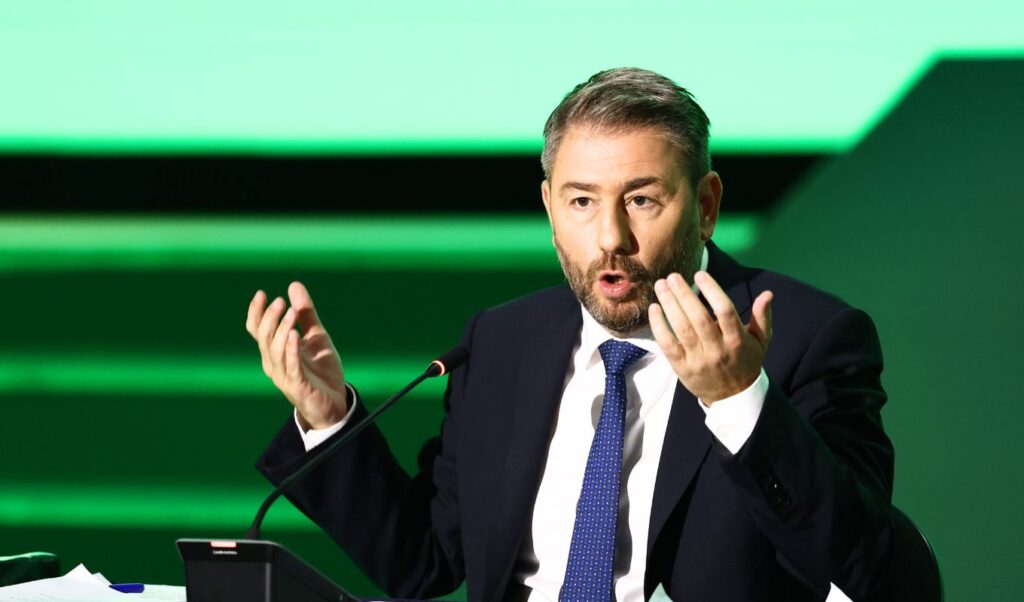
Nikos Androulakis sent two barely compatible messages during his press conference at the Thessaloniki International Fair. On one hand, he firmly shut the door on any post-election cooperation with New Democracy. On the other, he assured the public that the elections would not result in governmental deadlock. These two positions leave a critical question wide open: how exactly could PASOK contribute to forming a government if the elections fail to produce a majority and New Democracy comes in first?
The issue strikes at the heart of PASOK’s political strategy
This is not merely a matter of rhetoric. It strikes at the very core of PASOK’s political strategy and, more importantly, the image the party is trying to project about its role in the post-election landscape. Androulakis wants to maintain clear political distance from New Democracy, positioning PASOK as an autonomous and credible alternative governing force. The categorical rejection of any coalition with ND is aimed, among others, at that segment of the electorate that wants political change and would not want to see PASOK serve as a prop for yet another center-right government.
At the same time, however, the assurance that there will be no governmental paralysis creates a different kind of political expectation. If PASOK rules out cooperation with New Democracy but simultaneously takes it as a given that the country will be governed, the question that naturally arises is: what alternative governing solution does Androulakis actually have in mind? Could it involve a consensus political figure as a compromise candidate for prime minister?
The political analysis
Androulakis appears, for now, to be choosing to keep his cards close to his chest. He is trying to preserve flexibility ahead of the electoral contest, avoiding any premature commitment to either a specific governing formula or potential coalition partners. The underlying logic is that electoral results must first take shape before political moves can be determined.
This approach, however, comes with a cost. The more prominently PASOK stakes its claim to a leading governing role, the greater the demand for clarity about what it actually intends to do in the event that no party wins an outright majority. Voters are not simply being asked to choose which party they wish to strengthen — they are also being asked to weigh the likely governing outcome of their vote.
That is precisely where the political difficulty lies for Androulakis. Rejecting cooperation with New Democracy allows him to preserve his opposition credentials and reformist identity, but his commitment to preventing governmental paralysis simultaneously obliges him to offer convincing answers about the day after the election.
And as the elections draw closer and a hung parliament becomes an increasingly realistic scenario, this pressure will only intensify. The PASOK leader will increasingly be called upon to explain not only who he refuses to govern with, but — more critically — what political solution he considers viable, under what terms, and on the basis of what policy framework.
That is the real test of his strategy: to convince voters that PASOK can be a force for governmental stability without having to spell out all of its post-election options right now. Whether this balancing act will ultimately prove persuasive to the electorate is set to become one of the most significant political questions of the pre-election period for PASOK.