Greek-Turkish relations are walking a tightrope as Athens reinforces its alliances, prepares for the laying of an electricity cable east of Kasos, and keeps firmly on the table its inalienable right to extend its territorial waters.
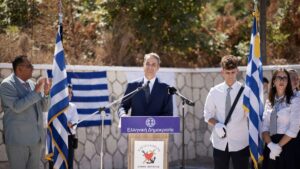
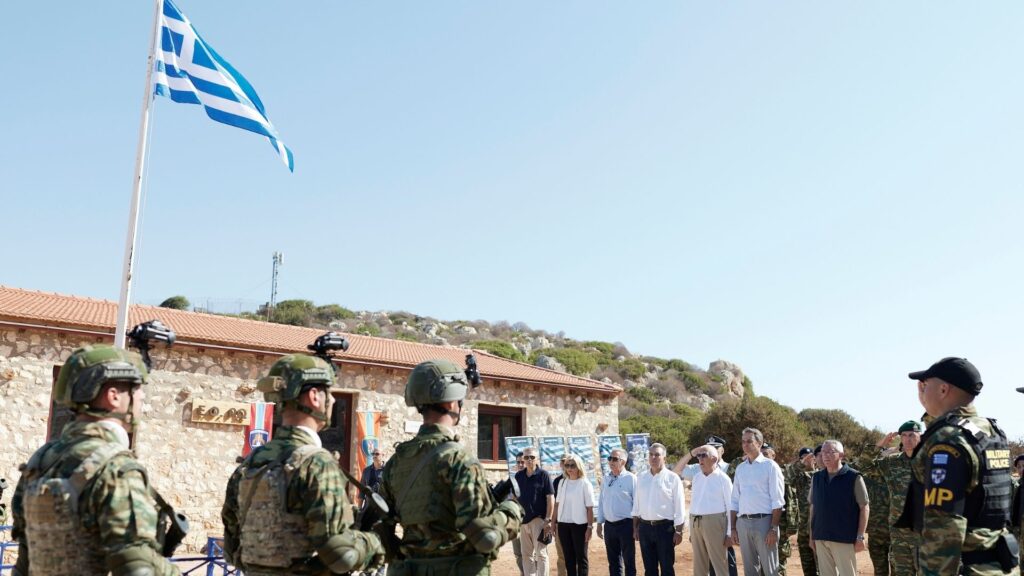
At the center of the latest round of confrontation are the imminent resumption of work on the Great Sea Interconnector (GSI) electricity cable, as well as Athens’ intention to keep active its right to extend national territorial waters to 12 nautical miles. The Greek side has made clear in every direction that it will make no concessions on matters of sovereignty and sovereign rights, flatly rejecting Turkish objections. Prime Minister Kyriakos Mitsotakis delivered this message to the neighboring country through his three-day stay on Kastellorizo. “We do not threaten anyone, but we do not accept threats or instructions from anyone either. We are ready to defend our national integrity and our sovereign rights,” he emphasized. At the same time, he left the door open for dialogue with Turkey, describing it as a choice rooted in “confidence and faith in international law.”
France’s support on the ground for the cable project, if needed
However, the reactions of Turkish media to this visit — with renewed references to the demilitarization of border islands — leave little room for de-escalation of the already charged atmosphere. This is especially true given that Greek-Turkish relations are expected to be tested further in the coming period, due to the laying of the GSI cable — a project of pivotal geostrategic importance and one of the most sensitive fronts in Athens-Ankara relations. Greece, Cyprus, and France are preparing their next steps for the resumption of seabed surveys, and by all indications these are expected to begin in the very near future. The contractor Meridiam, along with Nexans and IPTO (Greece’s Independent Power Transmission Operator), has taken charge of the operational planning.
Following Prime Minister Kyriakos Mitsotakis’ meeting with French President Emmanuel Macron in Paris, France is expected to provide on-the-ground support if the need arises. The geostrategic stakes of continuing the project are considered particularly significant, as the works are being carried out east of Kasos and Karpathos. This development will effectively nullify in practice the illegal Turkey-Libya maritime memorandum and affirm the Greek-Egyptian Exclusive Economic Zone (EEZ) delimited in 2020.
However, how Ankara will respond when Greece issues the relevant NAVTEX remains the key question, as fears of a repeat of the 2024 Kasos incidents remain very real.
In this context, Foreign Minister Giorgos Gerapetritis appeared on Saturday in an interview with Political, once again unequivocal, stressing that seabed research and cable laying constitute a fundamental freedom derived from the Law of the Sea. “On the issue of seabed research and cable laying, there is no middle ground. Whoever believes they can violate international and European rules without consequence will ultimately pay — with interest,” the Greek minister stated pointedly.
The inalienable right to extend territorial waters to 12 nautical miles
At the same time, Athens steadfastly keeps on the table its inalienable right to extend territorial waters to 12 nautical miles. The Prime Minister’s reference to this right from the podium of the Thessaloniki International Fair (TIF) provoked strong reactions in Turkey. According to well-informed sources, the Greek government appears prepared to exercise this right, studying as a first step the possibility of extending territorial waters south and west of Crete. In the same interview, Minister Gerapetritis emphasized that the extension constitutes an inalienable right of Greece under the International Law of the Sea, while the timing and manner of its exercise will be determined unilaterally by the Greek state, guided solely by the national interest. He also recalled that the current government was the one that proceeded with the extension of national territorial waters in the Ionian Sea up to Cape Tainaro.
Greek diplomacy continues to reiterate that the delimitation of the continental shelf and EEZ is the one and only dispute between Greece and Turkey that can be brought before an international court. As the Foreign Minister stated, conditions for a referral to The Hague are not yet ripe, noting that “under current circumstances, the prerequisites for meaningful discussion of a compromis have not yet been met.” The climate is expected to be tested further in the coming period, as Turkey plans to bring the “Blue Homeland” doctrine before the Turkish Grand National Assembly, in an attempt to challenge Greece’s sovereign rights. Athens declares itself ready to respond decisively through the issuance of executive decrees on Maritime Spatial Planning (MSP) and Marine Protected Areas.
To reinforce its national positions, Greece is systematically strengthening its bilateral alliances. Its strategic defense cooperation with Israel was publicly endorsed by a spokesperson for the US State Department.
Additionally, the upcoming visit of Marco Rubio to Athens before the end of the year, in the framework of the 6th Greece-US Strategic Dialogue, is expected to further strengthen bilateral relations. It is worth recalling that Rubio, along with Bob Menendez, was a leading champion of the EastMed Act, which positions Greece and Cyprus as key pillars of US strategic planning in the Eastern Mediterranean.