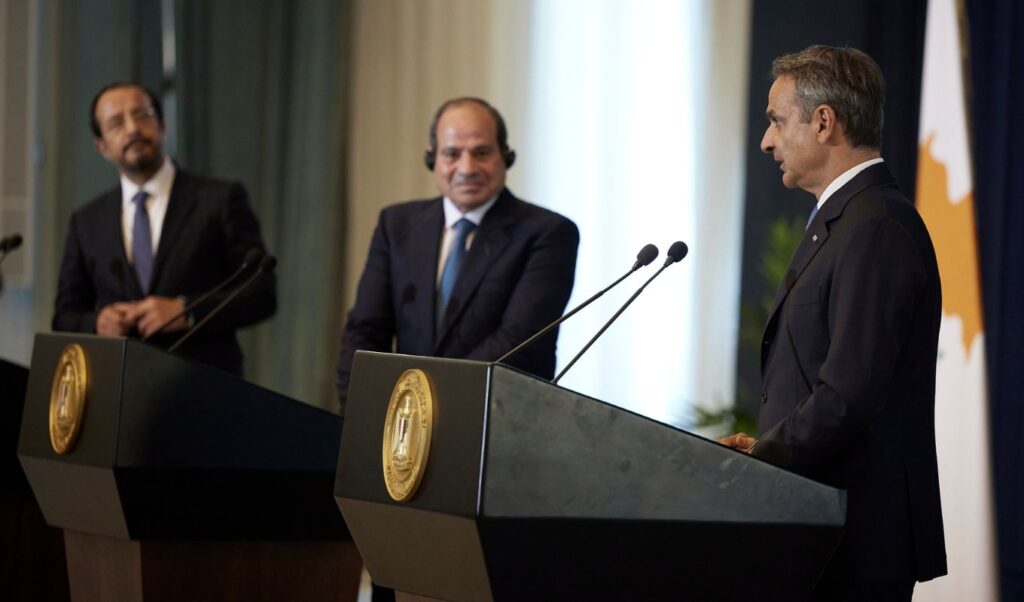
A powerful message was sent to Ankara yesterday from El Alamein. The Greek Prime Minister, the President of the Republic of Cyprus, and the President of Egypt sealed their common course in the Eastern Mediterranean through a Joint Declaration issued following the Trilateral Summit. They simultaneously signaled their firm resolve to resolve disputes exclusively “through political and diplomatic means, rejecting any actions that would escalate tensions, undermine regional stability, or threaten the peace and security of the region,” as explicitly stated in the Joint Declaration.
More specifically, Kyriakos Mitsotakis sent a clear message to Turkey that “Greece does not threaten anyone” and that it “seeks stability through functional good-neighborly relations, always grounded in International Law.” He added pointedly, however, that “stability does not under any circumstances mean concession, nor tolerance of faits accomplis,” making clear that Athens “is not afraid either to defend its positions with confidence or to engage in dialogue. These are the two sides of a responsible foreign policy,” he stressed.
The timing of these statements lends particular weight to the unity achieved yesterday between the Greek, Cypriot, and Egyptian sides, who committed to further strengthening and upgrading the Trilateral Cooperation mechanism.
Yfantis: “Egypt holds significant weight in the Muslim world — players are repositioning on the geopolitical chessboard after the war in Iran”
According to Professor of International Relations Kostas Yfantis, the Trilateral meeting aims to reaffirm cooperation among the three countries regardless of prevailing circumstances. As he tells parapolitika.gr, “first and foremost, this is a relationship with a very important country — Egypt — a country that may no longer hold, or has not reclaimed, primacy in the Arab Muslim world, but remains significant nonetheless. These relationships require constant reaffirmation because nothing is taken for granted in international politics. The second, and more important, dimension concerns how players are repositioning themselves on the geopolitical chessboard following the war in Iran — that is, how all regional actors are processing the perceived unreliability of the United States. As a result, we see countries like Greece, Egypt, and Turkey all seeking to strengthen their diplomatic standing through bilateral or trilateral partnerships. This meeting does not send an anti-Turkish message to Ankara — it is not a gathering directed against Turkey. However, it does remind Ankara that significant countries like Egypt have developed a strategically deep partnership with Greece and Cyprus.”
Meanwhile, Ankara is closely monitoring developments. A telling sign of Turkey’s concern over the Greek-Egyptian alliance is the phone call placed by Turkish Foreign Minister Hakan Fidan to his Egyptian counterpart Badr Abdelatty just one day before the Egyptian Summit — at a moment when Cairo is resisting pressure to join the “Mecca Alliance” alongside Saudi Arabia and Pakistan.
Stavrinos: Egypt and the Mecca Agreement — betting on EU deals, the emphasis on International Law, and the message to Turkey
Retired Ambassador Michalis Stavrinos tells parapolitika.gr that the very fact that Fidan called Abdelatty the day before the summit speaks volumes about Turkey’s anxiety and its attempt to preempt the trilateral meeting. As he puts it: “I believe this was a highly successful meeting. Not everything that was agreed upon is typically disclosed publicly, but energy issues — which are critically important for us — were certainly on the table. This is a trilateral alliance, in whatever form Turkey perceives it from across the way, and I believe it will play a key role in deterring Egypt from being drawn into the Mecca Agreement.”
All indications suggest that Egypt has chosen the European path, placing its bets on agreements with the EU on energy and connectivity. Most importantly, however, as reflected in President al-Sisi’s statements and the content of the Joint Declaration, Egypt’s commitment to resolving major regional issues — the Cyprus dispute, Gaza, Libya — through International Law has been firmly reaffirmed. Of particular significance is the Declaration’s explicit reference to the delimitation of maritime zones “on the basis of international law, including the United Nations Convention on the Law of the Sea (UNCLOS).”
This reference sends a clear signal to Turkey regarding Cairo’s strategic choice ahead of an Exclusive Economic Zone (EEZ) delimitation agreement with Athens in the Eastern Mediterranean.
Retired Ambassador Michalis Stavrinos argues in parapolitika.gr that “this reference is particularly positive. However, Turkey always claims that ‘we do not violate International Law’ — a principle it interprets selectively and in many cases contradicts itself. For instance, Turkey recognizes the 6 nautical miles for Greek islands, yet considers any extension of territorial waters a cause for war. The two positions cancel each other out. You either don’t accept that the islands have any maritime rights at all — as Turkey used to claim — or, if you accept the basic 6 nautical miles, you are obliged to accept the maximum that International Law recognizes.”
Next Sunday, Kyriakos Mitsotakis is scheduled to visit Kastellorizo. The Greek Prime Minister’s upcoming presence on the island is being interpreted as an indirect response to the recent threats issued by the Turkish President against Greece, made shortly after a session of his own cabinet.