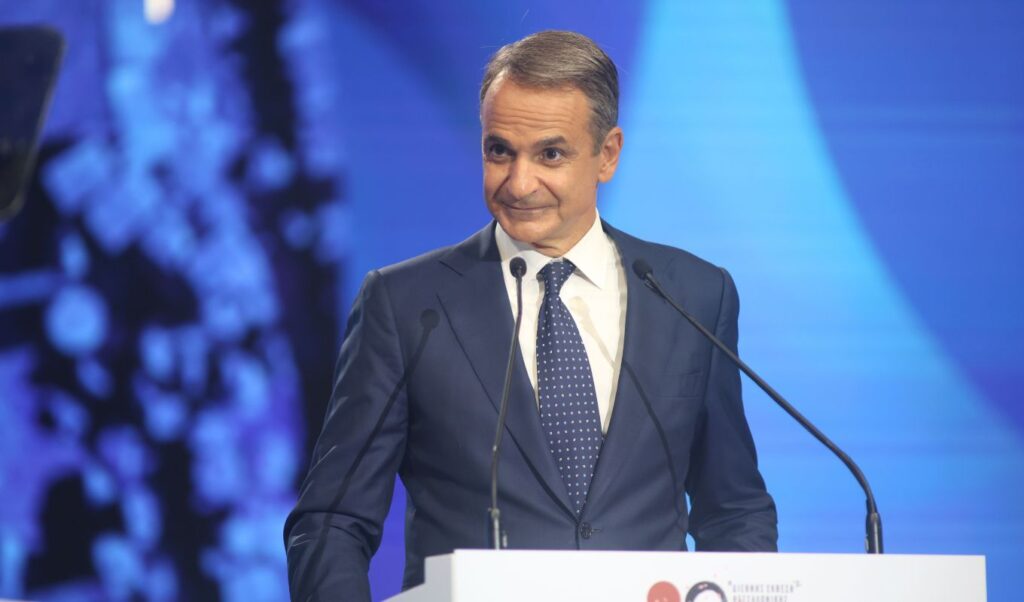
Kyriakos Mitsotakis‘ appearance at the Thessaloniki International Fair may be over, but inside the Maximos Mansion the real bet has only just begun — and it is being placed against a backdrop where Greek-Turkish relations are moving to center stage, as Ankara appears to be actively seeking to escalate tensions in the Aegean. With a €2.2 billion package of interventions for the 2026–2027 period — encompassing targeted relief measures for the middle class and families, the ambitious “My Home 3” housing program, and the “New Generation Piggy Bank” savings scheme — the Prime Minister sought to chart a roadmap with one eye firmly fixed on the next election. From here on, the government’s task is to translate the promises made in Thessaloniki into measurable results that citizens feel in their pockets and daily lives.
Polls
At the same time, Maximos Mansion must work to maintain New Democracy’s political dominance, and in that spirit, everyone across the government’s ranks is holding their breath ahead of the upcoming opinion polls. The first post-Thessaloniki surveys will serve as a barometer of momentum — one that the ruling camp wants to see registering above 30%, providing a solid foundation for the months ahead as the party sets its sights on an outright parliamentary majority. If the social measures announced by Mr. Mitsotakis fail to show up in the qualitative indicators of those polls, pressure for corrective action — or even a structural cabinet reshuffle — will intensify. And if citizens do not see a tangible improvement in their daily lives over the coming months, the government’s narrative of prosperity in a third term risks being seriously called into question.
At the same time, Greek-Turkish relations loom as the single most unpredictable factor capable of upending the government’s plans. Keeping communication channels with Ankara open sits uneasily alongside the need to draw clear “red lines” on matters of national sovereignty — a point Kyriakos Mitsotakis stressed repeatedly during his appearances in Thessaloniki.
The arbiter
Any sudden escalation or incident in the Aegean or the Eastern Mediterranean — however limited in scale — carries the risk of reshuffling the entire political agenda. The gradual resurgence of Turkish provocativeness and the erosion of regional stability are together shaping a new and exceptionally complex political landscape, one in which Greek-Turkish relations are no longer merely one variable among many but could well emerge as the central arbiter of domestic developments.
For Maximos Mansion, keeping communication channels with the Turkish side open and maintaining “calm waters” has been a cornerstone of a broader strategy aimed at healing the wounds left by the debt crisis and subsequent shocks — the pandemic, external inflationary pressures, and more. Yet Turkish revisionism, ranging from challenges to maritime spatial planning and environmental zones to objections over strategic infrastructure projects such as the Greece–Cyprus electricity interconnection, is steadily narrowing the room for maneuver available to Greek diplomacy.
Against this backdrop, the government must walk a very fine line: maintaining deterrence through arms procurement programs and international alliances, while simultaneously working to prevent an artificially engineered escalation at Turkey’s initiative. Reports are mounting that Ankara is actively seeking a hot incident, with the apparent goal of triggering third-party arbitration — most likely by the United States.
The dilemma
The interplay between Greek-Turkish relations and the domestic political agenda is therefore acquiring extraordinary significance. Should pressure on national issues escalate sharply, the electoral dilemma could shift abruptly — away from the economy and everyday concerns, toward a call for national unity. In any scenario, Greek-Turkish relations are no longer operating as a parallel track running alongside domestic political life; they are becoming the catalyst that will determine party alignments, ideological fault lines, and the ultimate shape of the issues placed before the electorate.
On the purely domestic front, government teams are on standby awaiting the first opinion polls, which will capture the public’s reaction to the Prime Minister’s announcements. What the government needs is not simply the preservation of political dominance, but confirmation that its measures are being perceived as genuine help with the everyday problems of ordinary people — not as fleeting political fireworks. And as economic and geopolitical challenges converge at this critical juncture, the government’s ability to deliver swift and visible results will go a long way toward determining whether the road to the ballot box is traveled from a position of political strength, or under the weight of mounting public discontent.
Published in Apogevmatini