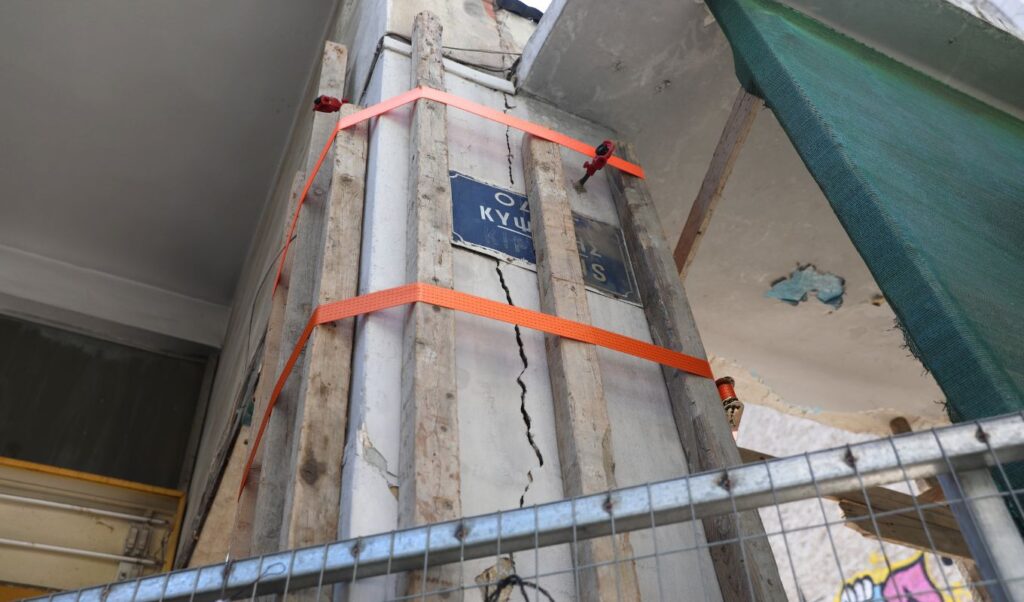
Tasoula Paziou, owner of a two-story building near Kypseli Square, spoke to Parapolitika 90.1 and the “On Air” programme with Niki Lyberaki about the cracks that appeared in her home after the tunnel boring machine passed beneath the neighbourhood. Ms. Paziou described the extent of the damage, challenged the assurances given by Attiko Metro and the Municipality, and raised questions about the depth of excavation near her property. Describing the situation, she noted that “our homes are wounded, their structural resilience has been reduced, and our souls are wounded too.”
Read also: Kypseli: “These are not hairline cracks — they are openings and subsidence in apartment buildings” — What geology professor Zelilidis told Parapolitika 90.1 (Audio)
Kypseli resident: “The cracks appeared the moment the tunnel boring machine passed”
Ms. Paziou, a Kypseli resident for 48 years, described how her entire building sustained damage — both internally and externally — which appeared immediately as the tunnel boring machine passed beneath the area, and continued to grow or reappear as long as the activity remained ongoing. She described the first night in particularly dramatic terms: “We woke up in the morning and couldn’t get out of our bedrooms. Diagonal cracks had formed across all the windows and interior doors, causing the doors to jam so we couldn’t open them.”
“There was nothing pre-existing in any of the 200 homes”
When asked about statements made by Deputy Minister of Infrastructure and Transport Christos Tachiaos — who claimed that several of the cracks recorded in the area were pre-existing — Ms. Paziou responded categorically: “No. There was nothing pre-existing in any of the 200 homes. There was not a single crack, not one interior crack — none.”
“Why won’t they give us written confirmation of structural safety?”
Asked whether she was reassured by Attiko Metro’s announcement that there are no structural adequacy issues, as well as the Deputy Mayor of Technical Services’ statement that no structural problems were identified, Ms. Paziou answered with a firm no. She noted that despite residents’ repeated requests over four months, they have received no “written and signed” assurance that their homes are safe — only verbal guarantees. She posed the question directly: “If Metro and the construction company are certain that the structural integrity of the buildings has not been compromised, why won’t they give us the written confirmation?”
What she said about the inspections carried out
Ms. Paziou explained that the inspections conducted — both by the contractor and by the urban planning authority — were exclusively visual, with no full structural assessment carried out. She noted that a visual inspection cannot be comprehensive, as in many homes “bathrooms are hidden behind tiles, kitchens have enormous pieces of furniture covering the walls that cannot possibly be moved.”
The air raid shelter beneath her home
Ms. Paziou mentioned that her property contains an official, registered air raid shelter belonging to the state, regularly inspected by police and military authorities, situated at a depth lower than the basements of the surrounding apartment buildings. She expressed concern that if the metro excavation was carried out at a depth of 13 to 15 metres, the foundations of her home may have “embraced” the tunnel boring machine in a “loose embrace” — and it remains unclear whether they will hold.
The independent study by the Technical Chamber of Greece
Ms. Paziou confirmed that both the Municipality and the Ministry committed to commissioning an independent study by scientists from the Technical Chamber of Greece (TEE), something she said she was “extremely pleased and grateful” about. She made it clear that only the findings of this independent study would be accepted by residents: “I will not listen to the state agency… I will not listen to the private contractor. They will not be entering our homes again unless the TEE says so.”
“Families have already abandoned their homes”
Asked whether any provision has been made for residents who wish to stay elsewhere while awaiting the study’s findings, Ms. Paziou replied that “no one has dealt with the issue” over the past four months. She noted that some families have already left their homes, and that tenants have moved out as well, leaving property owners facing rental income losses.
Ms. Paziou added that following its visual inspection, the urban planning authority suggested that residents themselves commission a full structural assessment — at a cost of €15,000 to €20,000, compared to €2,500–€3,000 for a basic visual inspection through the TEE, or approximately €4,000 in her own case. “How am I supposed to cover that overnight?” she protested. She noted that, according to the responsible deputy mayor, developments are expected within approximately two weeks.