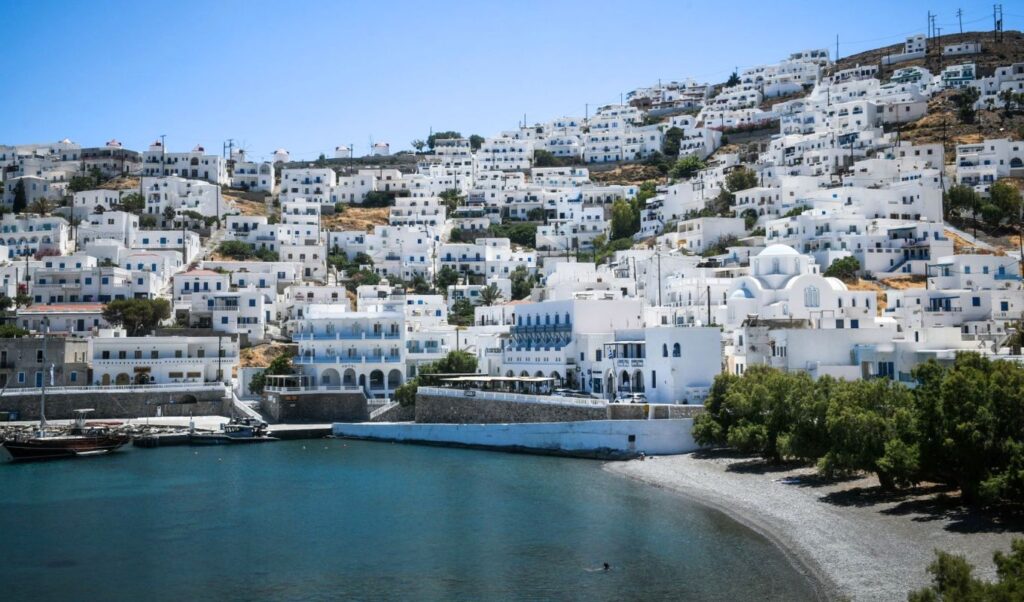
The serious problem of water shortage facing several Greek islands has been brought to international attention in an extensive report by Reuters, highlighting that seven Aegean islands have declared a state of emergency due to a severe lack of water resources. According to the report, local authorities are rapidly pushing forward with desalination projects, imposing restrictions on irrigation water use, and seeking immediate solutions as pressure on available water supplies continues to mount. Reuters attributes the deteriorating situation to the effects of climate change, noting that rising temperatures and increasing uncertainty over rainfall are making it ever harder to replenish water reserves.
Read also: Poros: Three-month state of emergency declared due to water shortage
There is also growing concern over whether next winter’s rainfall will be sufficient to meet the needs of residents and the thousands of visitors who flood the islands during the summer season, when water consumption peaks.
Astypalaia at the center of the crisis
A striking example is Astypalaia, which relies heavily on bottled water for drinking and did not benefit from the increased rainfall recorded in other parts of the country last winter. According to local authorities, this year was the second driest since 2020, creating serious challenges in managing the island’s available water resources.
“If we gathered all the rain that fell throughout the year, the total water depth would barely reach 2.5 centimeters,” Astypalaia’s mayor, Nikos Komnineas, told Reuters, standing beside the island’s artificial reservoir — its only primary water source — now surrounded by parched, barren landscape.
Impact on agriculture – Farmers turn to wells
The water shortage has already taken a significant toll on the agricultural sector. Since April, local authorities have cut off water supply from the reservoir to farmland in order to preserve adequate reserves for the population’s drinking water needs. Seventy-one-year-old farmer Evdokia Palatianou said she was forced to irrigate her crops with brackish water drawn from a private well, which ultimately destroyed her vegetables.
“If it doesn’t rain, I won’t plant anything,” she said, pointing to a withered mandarin tree in the Livadi area.
Reserves sufficient for only a few more months
The reservoir supplying Chora and Livadi currently holds approximately 150,000 cubic meters of water — just one-sixth of its total capacity. With summer consumption reaching around 900 cubic meters per day, the available reserves are expected to last approximately five and a half months, according to Reuters.
In May, authorities declared the island in a state of emergency due to the water crisis, in order to fast-track the installation of a temporary desalination unit with a daily capacity of 600 cubic meters. Irrigation of crops was also banned until autumn as a measure to conserve remaining supplies.
Tourism drives water consumption to record highs
The problem intensifies dramatically during the summer months, as Astypalaia’s population swells from around 1,400 permanent residents to more than 7,000 visitors. The existing desalination unit is insufficient to meet the surge in demand, prompting the installation of a second temporary unit, while construction of a permanent facility is underway and expected to be operational by the end of the year.
Concern for the future despite emergency measures
According to the Copernicus European Drought Observatory map, Astypalaia was already classified as early as June among areas showing the first signs of drought. Despite the emergency measures put in place, the island’s mayor expresses deep concern about what lies ahead.
“The temporary desalination unit gives us some breathing room, but my biggest worry is what will happen if we don’t get enough rainfall this year either,” he stressed, underscoring that water resource management has become one of the greatest challenges facing Greek islands today.