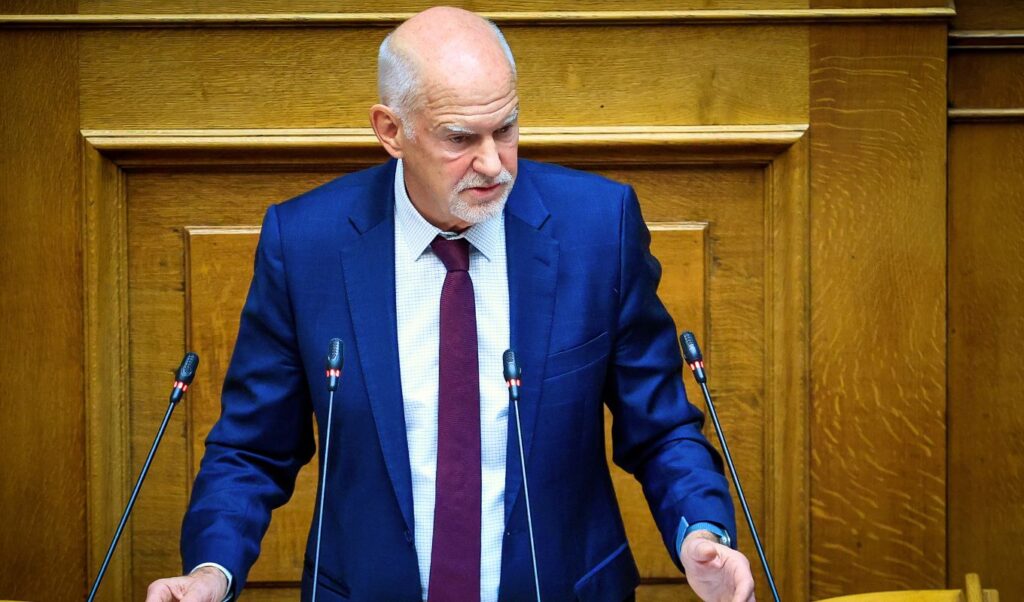
During discussions at the Parliament’s Committee on Social Affairs, former Prime Minister and PASOK MP for Achaia, George Papandreou, took a clear stance on the proposed new regulatory framework for cannabis products. These provisions have been incorporated into a bill concerning Personal Assistants for People with Disabilities.
Read also: Drug landscape shifts in Greece: Cannabis and cocaine dominate as synthetic cannabinoids emerge as new threat
In his address, Papandreou acknowledged as a positive step the bill’s provisions targeting the detection and handling of adulterated, so-called “spiked” products, as well as synthetic cannabinoids with unknown and dangerous chemical compositions. Nevertheless, he levelled sharp criticism at the bill’s core philosophy, arguing that it remains anchored to outdated models of repression.
Calling for a fundamental change of direction and presenting seven proposals to reshape Greece’s national cannabis strategy, the former Prime Minister stated: “Controls are rightly included. But the chapter remains trapped in the same old, failed logic: more prohibitions, broader criminal provisions, harsher penalties. It doesn’t touch the root of the problem.”
He argued that the critical question is not whether the state approves of cannabis use, but who controls the market and determines the composition, potency, price, and recipients of cannabis products.
“Illegal networks decide what is sold, how potent it is, what it’s cut with, who it’s sold to — including minors — and at what price. They pocket the profits. They launder the dirty money. Prohibition didn’t eliminate the market. It handed it over to the mafia,” he said.
George Papandreou on cannabis: “The process itself becomes the punishment”
The former Prime Minister criticised the existing legal framework, noting that Article 29 of Law 4139/2013 still provides for a prison sentence of up to five months for the possession, use, or cultivation of cannabis solely for personal use. “A minor penalty, you might say. It is not minor for the nineteen-year-old who gets arrested. It is not minor for his family. An arrest, fingerprinting, lawyers, court appearances, stigma, fear for the future. Even if there is no conviction, the process itself is the punishment,” he said pointedly.
He also noted that the existing system may treat the habitual user more harshly — that is, in his words, the person who most needs support and health services. “A social, psychological, and public health issue is being treated as a law enforcement matter. Is that public health policy?” he asked.
According to the opposition MP, Article 84 “even includes the ‘purchase’ of non-permitted products and refers to the penalties of Article 20 of the narcotics law. Article 89 references, in general terms, the same article. Yet Article 20 provides for a minimum sentence of eight years’ imprisonment and a financial penalty of up to €300,000. So I ask the government directly: do you want to create a situation where a buyer could be treated as a trafficker? Do you want a labelling violation on a CBD product in a legal shop to result in treatment equivalent to that of an organised criminal network? The same penalty for radically different behaviours is a violation of proportionality. It is deeply flawed legislation,” Papandreou stressed.
“No substance is without risk”
He also noted that no substance is without risk — not cannabis, not alcohol, and not tobacco, both of which are sold legally. The real risks associated with cannabis are early initiation, daily long-term use, high-THC products, driving under the influence, and products adulterated with synthetic substances. “That is precisely why regulation is needed: because in the illegal market there is no laboratory testing. No label. No known potency. No age verification. No batch recall. No accountable producer.”
Prohibition, the former Prime Minister stressed, “does not eliminate the risk. It eliminates the state’s ability to manage it. And the illusion that police can control the market collapses in the face of one simple fact: drugs are still trafficked inside prisons.”
He went on to note that “prohibition creates contact with illegal dealers — and therefore gives the dealer the opportunity to push harder drugs,” while “legal, regulated access breaks that connection. It distances the user from the dealer. It strips the mafia of customers and revenue. That is why the mafia is the most ardent supporter of prohibition. Decriminalization costs them dearly — and they know it. […] And wherever such profits exist, there is — demonstrably, not theoretically — corruption: from the police officer, to the judge, and I would add, to the politician. […] The most powerful trafficking networks have a vested interest in keeping cannabis illegal — so they can replace it with other substances that are more profitable, more dangerous, and more addictive.”
He also referenced reports, “particularly from tourist areas and islands, of allegations that operations target cannabis while cocaine availability is rising — because that is where the real money is. I do not adopt these as established facts. I am calling for them to be investigated. And I am asking the government for data: how many operations per substance? How many complaints has the Internal Affairs Directorate examined? If you don’t have the data, you don’t know whether your policy is working. If you do have it, make it public.”
The Portugal example: how cannabis decriminalization and investment in prevention transformed the landscape from 2001 onwards
Drawing on international experience in his address to the parliamentary committee, Papandreou noted that Portugal decriminalized the personal use of all substances in 2001 and invested in prevention and treatment. “Portugal did not become a ‘drug haven,’ as the scaremongers predicted. It became a model of public health.” Canada legalized and regulated cannabis in 2018. Before regulation, only one in five purchases came from legal sources; within a few years, the vast majority of the market had shifted to legal, regulated channels.
Cannabis use among 15–17 year olds did not increase. Billions were stripped from organized crime and redirected into the legal economy. In the United States, 24 states have regulated the cannabis market, generating over $28 billion in tax revenue — money that now funds schools, prevention programmes, rehabilitation, and mental health services. Money that previously went to the cartels. In Europe, Germany regulated possession and cultivation in 2024. Malta, Luxembourg, the Czech Republic, Switzerland, and the Netherlands are moving in similar directions. “Europe is turning a new page. Are we going to remain stuck with a policy that has failed everywhere? The success of a drug policy is not measured by the grams seized, nor by the young people dragged into police stations. It is measured by how much the illegal market has shrunk. How much criminal revenue has been seized. How much sales to minors have been reduced. How much adulterated products and hospitalisations have decreased,” Papandreou said.
“Punish organised crime — not the user”
Concluding his remarks, George Papandreou emphasised that he is not calling for indifference toward drug use, but for genuine control over the production, composition, and potency of products, along with strict protection of minors. “Decriminalizing the user is not surrendering to the mafia. It is the first step toward taking the user out of their hands,” he said pointedly.
According to the MP, state regulation does not amount to promoting cannabis, but rather an attempt to reclaim control that currently lies in the hands of organised crime. “A policy that punishes the user while preserving the dealer’s profits is not a drug policy. A policy that can ruin a young person’s life for personal use while leaving the flow of dirty money untouched is both unjust and ineffective,” he noted.
“This bill is an opportunity to change direction. Not to loosen control, but to finally make it real. For the health of young people, for the protection of families, for the credibility of our institutions, and for a state that punishes organised crime — not the person who needs information, protection, or help,” he concluded.
George Papandreou’s seven proposals
The former Prime Minister presented seven proposals to reshape cannabis policy:
- Immediate decriminalization of the procurement, possession, use, and limited cultivation of cannabis exclusively for personal use.
- Removal of personal-use purchases from Article 84 and an explicit exemption of users from the penalties set out in Article 20.
- Replacement of Article 89 with a tiered system providing for administrative sanctions for regulatory violations, and strict criminal penalties for the knowing commercial distribution of dangerous or adulterated psychoactive products.
- Mandatory laboratory testing of every batch for THC, CBD, synthetic cannabinoids, pesticides, and heavy metals, with full traceability and immediate recall capability.
- A ban on advertising, strict protection of minors, age verification requirements, and meaningful risk communication to consumers.
- Creation of a strictly regulated legal distribution system for adults, without aggressive commercialisation, with oversight of production, potency, pricing, points of sale, and the origin of capital.
- Suspension of pending prosecutions and expungement of relevant records for acts of personal use that would no longer constitute an offence.