Another night of intense escalation gripped the Middle East as US armed forces announced they had launched a new wave of strikes against Iran, aimed at preventing Iranian forces from attacking ships in the Strait of Hormuz. The strikes resumed at midnight Greek time, US Central Command (CENTCOM) announced via X, stating that the goal was to “degrade their ability” to “attack civilian maritime crews and commercial vessels” transiting the strait.
The “supreme commander” of US armed forces ordered the strikes “to make Iranian forces pay,” the statement added, referring to President Donald Trump. According to a US official, the operations lasted more than three hours. CENTCOM stated that the attacks began at 5:00 PM Eastern Time (midnight in Greece) with the aim of continuing to degrade Iran’s capacity to attack commercial shipping passing through the Strait of Hormuz.
US forces announced in the early morning hours that they had completed a new wave of bombardments targeting “dozens of targets” inside Iran — the second consecutive night of strikes — and emphasized that they stand ready “to guarantee freedom of navigation” in the Strait of Hormuz, which they assert Iran does “not control.”
Targets struck included “air defense systems, coastal surveillance radars, missile capabilities, unmanned aerial system capabilities, and small watercraft,” according to a statement released by CENTCOM.
One killed and four wounded in US strikes on Iran
At least one person was killed and four others were wounded in the early morning hours following a US airstrike on the city of Masar in southwestern Iran, according to a local official cited by the state-run news agency IRNA. The fatality was a telecommunications worker.
“Due to an attack by the American enemy this morning, which struck an agricultural irrigation pumping station in the city of Masar, one person was martyred and four others were injured,” said Valiollah Hayati, deputy governor for security affairs in Khuzestan Province, speaking to IRNA.
The pro-government news agency Mehr reported that the head of the telecommunications authority in Hormozgan Province was killed on Qeshm Island, where he had reportedly been dispatched on a repair mission. Mehr also reported that two other telecommunications staff members were injured in the strike.
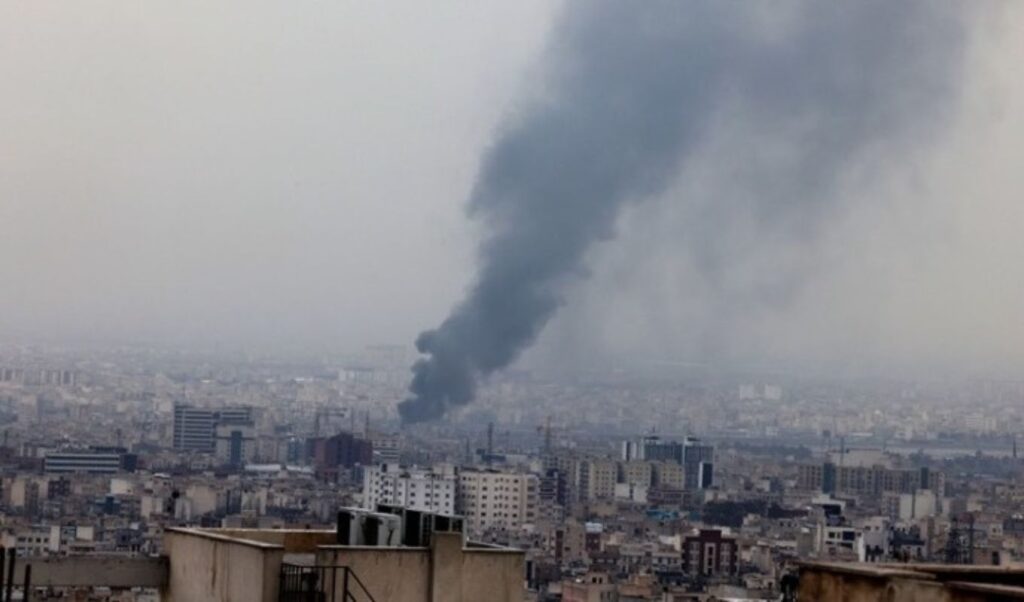
Iranian media reported further explosions along the country’s southern coastline near the Strait of Hormuz. The Tasnim news agency reported explosions at the port of Bandar Abbas and near Qeshm Island in the Gulf. The cause of the explosions has not yet been confirmed.
BREAKING: Fresh, massive strikes reported near Bandar Abbas, Iran.
Multiple explosions are rocking Iran’s most critical naval port on the Strait of Hormuz right now. The pressure on the IRGC isn’t stopping. pic.twitter.com/Mp3BOUQXaI
— سيف الدرعي| Saif alderei (@saif_aldareei) July 12, 2026
IRNA described “hostile attacks” on Bandar Abbas, where a series of successive explosions were heard across different parts of the city overnight. According to IRNA, military installations are located in the affected areas.
Iran strikes Jordan, Bahrain, and Kuwait — Revolutionary Guards target US bases
Iran’s Revolutionary Guards — the ideological army of the Tehran regime — announced today that they had struck US military bases in Jordan, Bahrain, and Kuwait, according to the official IRNA news agency, while the United States confirmed, as noted above, that it had hit “dozens of targets” inside Iran.
IRNA, citing the Revolutionary Guards, reported that strikes were carried out against Prince Hassan Air Base in Jordan, a US command and control center for drones in Bahrain, and Ali Al Salem and Ahmad Al Jaber bases in Kuwait.
Tehran: US has destroyed Middle East peace efforts — pressure mounts on Oman over the Strait of Hormuz
Meanwhile, Iran’s Foreign Ministry issued a statement “strongly condemning” the US strikes and accused Washington of having “nullified all efforts of recent months” aimed at restoring peace in the Middle East.
Tehran further accused the United States of “openly violating almost all the terms” of the Islamabad Memorandum of Understanding and of triggering the “return of insecurity” to the Strait of Hormuz.
The statement noted that negotiations had focused on arrangements for managing the Strait of Hormuz, and that “unfortunately, the US obstructed progress on this issue through open and covert pressure on Oman.” Iran also dismissed Trump’s claims about the outcome of the negotiations as “outright lies born of desperation.”
Trump had told US media that Iran had agreed to a deal on Saturday under which it was “giving up everything,” but that “then, suddenly, two hours later, they hit a ship with a drone.”
It is worth recalling that US forces had begun striking Iran the previous week, with Iran responding on Sunday by closing the Strait of Hormuz and launching a series of ballistic missile strikes against US positions across the Middle East.
Earlier, Iran had attacked a Cyprus-flagged commercial vessel on the grounds that it was following an “unauthorized route” through the Strait of Hormuz. An Indian sailor remains missing following the attack.
Oil prices surge
Oil prices jumped in the early hours of Monday following the latest US strikes on Iran.
The price of North Sea Brent crude, the international benchmark, for September delivery was up 3.75% at $78.86 per barrel around 1:10 AM, following the opening of Asian markets. Meanwhile, the US benchmark, West Texas Intermediate (WTI), for August delivery rose 3.65% to $74.02 per barrel.
Analysts, as noted by Al Jazeera, believe that if the current wave of strikes and retaliatory attacks continues, oil prices could once again surpass $80 per barrel, with the risk to the oil-dependent economies of the Middle East remaining very much in play.