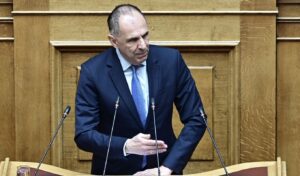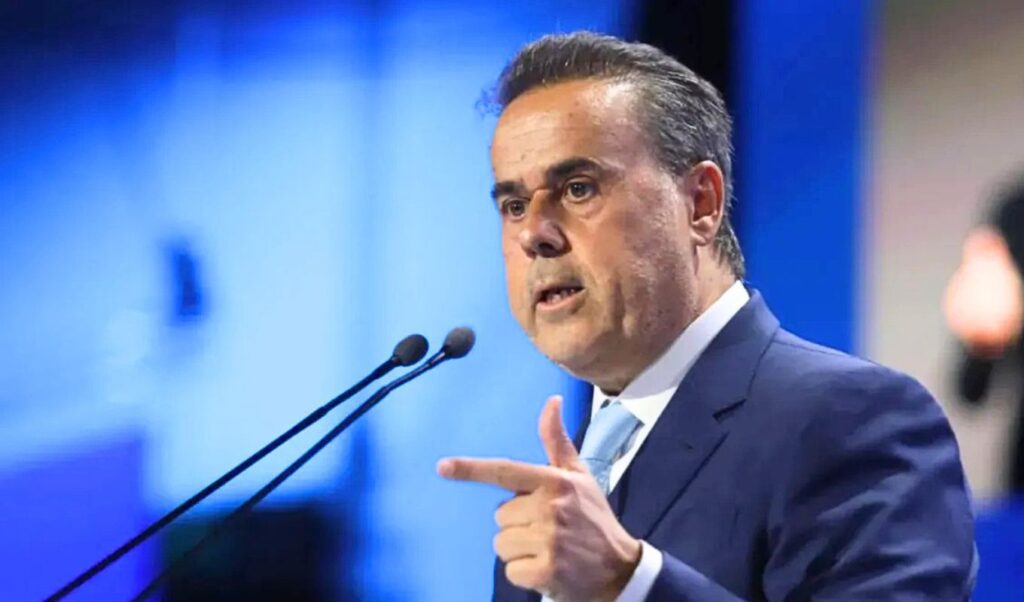
Greece’s Minister of Environment and Energy, Stavros Papastaurou, highlighted the strategic importance of Greek mineral wealth, the country’s development prospects, and its pivotal geostrategic role in the region. Speaking at the annual conference of the Hellenic Authority for Geological and Mineral Exploration (EAGME) — themed “Earth & Future: Underground Solutions for Above-Ground Challenges” — the minister praised the Authority’s work and long-standing contribution to the nation.
Reflecting on EAGME’s enduring legacy, Papastaurou noted that the institution has maintained a public presence for over a century. He described it as a valuable and steadfast ally of the state in its efforts to map, study, protect, and responsibly utilize Greece’s subsurface resources — while also serving as a “vigilant scientific guardian” of public safety against natural phenomena and disasters.
Papastaurou on green development and critical raw materials
When asked about Greece’s strategy regarding critical raw materials, the Minister of Environment and Energy stated: “Our country has a long history with critical raw materials that is almost unique. What is very important to make clear is that subsurface solutions are developed with full respect for the environment, and even more so for public safety and local communities. Harnessing mineral wealth is entirely compatible with protecting nature and the communities that live alongside it.”
“The government’s political will is to develop the natural wealth that Greece possesses. If we learned anything from Russia’s invasion of Ukraine and from the crisis in the Strait of Hormuz, it is the paramount importance for every country to reduce its energy dependence,” he said. Papastaurou pointed out that Europe has fallen behind in developing its critical raw materials, “and is now discovering the cost of that choice. Europe, in order to remain competitive, must develop its critical minerals today.”
“Our country is among the four or five nations at the forefront of mineral wealth development. It has the scientific knowledge. It has the human capital. It has the government’s political will. What we need is the scientific expertise of the National Authority,” the minister said.
Asked about the emerging energy architecture, he added: “We have moved very quickly and we are one of the countries at the heart of this new architecture. Hydrocarbon development is not a matter for today, tomorrow, or the day after — it is a long-term endeavor. Developing our homeland’s mineral wealth is a national cause. It does not belong exclusively to any political camp. It belongs to the Greek people. It is the wealth of the Greeks. And it must be pursued in modern ways, with respect for local communities, but without fear.”
“The developments in the Gulf make one appreciate the strategic importance of the Eastern Mediterranean even more,” he added. Turning to progress on the Vertical Corridor energy initiative, he explained: “It was a difficult undertaking because there was no established culture of cooperation. Our countries had been divided by geography, ideology, and history. That is now being overcome. This is why the Vertical Corridor, beyond its significance for natural gas, carries tremendous value as a catalyst for a broader shift in mindset across southeastern Europe.”
The timeline for hydrocarbon exploration
Papastaurou also addressed Greece’s ongoing hydrocarbon exploration program, noting that the first exploratory drilling at the Asopos site in the northwestern Ionian Sea is expected by mid-February 2027. Additionally, seismic surveys south of Crete and south of the Peloponnese are scheduled to be completed before the end of the current year.