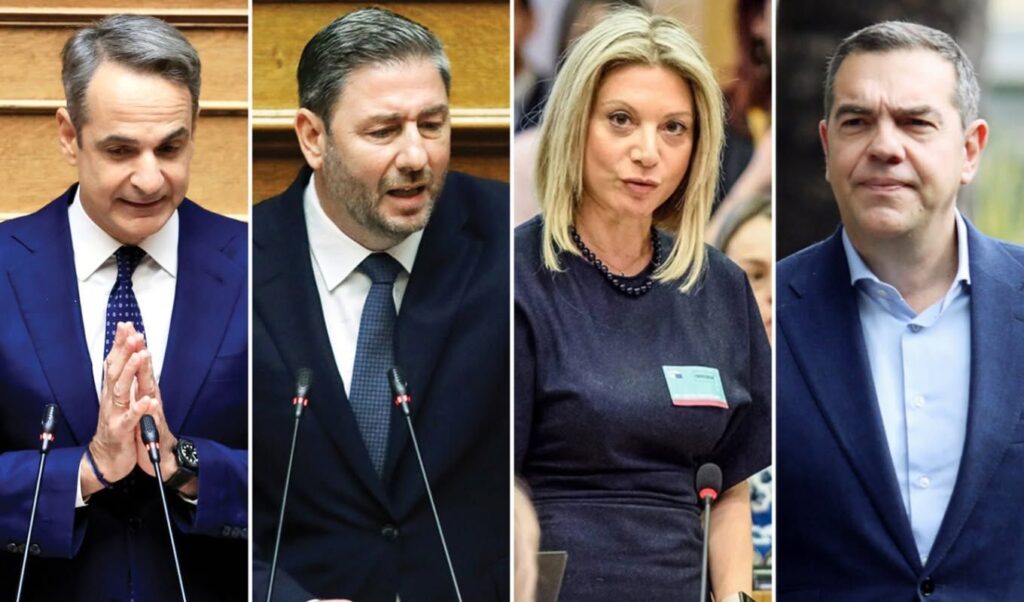
The vision of an outright parliamentary majority has captivated the leaders of two newly formed political parties — even at a stage when they have yet to establish formal programs or institutional structures. Their ambitions add to the declared intention of New Democracy to seek an outright majority for a third consecutive time, as well as PASOK’s drive to finish first, even if only by a single vote over the ruling party. All of this unfolded within just a few days.
Speaking before his party’s central committee, the Prime Minister was unequivocal: “There will be one Sunday of great choice. And that one Sunday must deliver an outright majority.”
Alexis Tsipras was equally ambitious at a rally held by his party in Nikaia: “ELAS became the official opposition within 24 hours. In a few months, we will manage to become the government,” he declared.
Before him, Maria Karystianou had already staked her claim: “I believe the Greek people will give us an outright majority. The people have moved away from the old party system.”
In a particularly noteworthy statement, PASOK Secretary Yannis Vardakasthanis suggested, through a distinctive line of reasoning, that his party’s dominance represents the only clear political solution for the country: “Political change with New Democracy in any governing role is impossible. Political change can only come through PASOK, at a time when we are witnessing sponsors backing New Democracy and the manipulation of public opinion for the government’s benefit.”
Read also: The battle for second place against Mitsotakis: Tsipras is rising, PASOK is under pressure, and Karystianou becomes the wild card — two experts analyze the race
What the polls show
How closely does each party’s majority ambition align with its actual polling strength? New Democracy is tracking at around 30% of the projected vote share, maintaining its lead and keeping alive the prospect of a majority victory — a significantly more difficult goal than in any previous election, but not an impossible one. Tsipras’s ELAS is polling at approximately 15% — far from any realistic projection of an outright win. PASOK is showing signs of decline, hovering at around 12%, while Elpida gia ti Dimokratia (Hope for Democracy) stands at roughly 10%. None of these figures provide any basis for majority declarations — yet they do reveal that, beyond New Democracy, the newer parties understand that the call for an outright majority is not simply a numerical target.
In Greek political culture, it is associated with the concept of a “clear mandate”: a government that does not depend on coalitions, is not forced into compromises, and can implement its program without distraction. This alone explains why the pursuit of a majority remains a dominant theme in public political discourse. Behind this rhetoric, however, lies a deliberate strategy. Parties that set an outright majority as their goal are attempting to cultivate what political analysts call a “psychology of victory.” A voter is more likely to support a political force that appears to have winning momentum — particularly among undecided voters. And the undecided at this juncture are numerous, accounting for approximately 15% of respondents in surveys. At the same time, invoking the prospect of a majority serves as a rallying mechanism. Voters are mobilized when they believe their vote can determine the outcome. The dilemma is clear-cut: strong government or political instability. In this way, parties seek to curb abstention rates. For major parties like New Democracy, an outright majority remains a genuine possibility — though by no means a certainty.
The ballot box of high expectations
The current electoral system favors the leading party, but it still requires high vote shares and specific electoral dynamics. The volatility of the electorate simultaneously gives New Democracy hope for a historic third consecutive majority term, while scenarios of a result below 25% continue to circulate — with all the implications that would carry for the party’s post-election future and the broader realignment of the political landscape.
The situation is even more complex for PASOK. Its drive to finish first — even by a razor-thin margin — is primarily aimed at overturning the perception of a party that plays a supplementary role. Despite the obstacles posed by electoral realities, this strategy seeks to reposition the party at the center of events and cast it as a leading player in post-election negotiations. This is all the more pressing now that PASOK finds itself in direct competition with Tsipras’s party for leadership of an alternative opposition bloc.
Ultimately, the pursuit of an outright majority functions simultaneously as a political objective and as a communications tool. It may be realistic only for the leading party and only under specific conditions. For all others, it serves primarily as a means of shaping perceptions and influencing the electorate. In other words, it does not merely reflect the political landscape — it actively attempts to shape it. An ambitious undertaking, and one that has yet to prove its effectiveness.
Originally published in Karfi