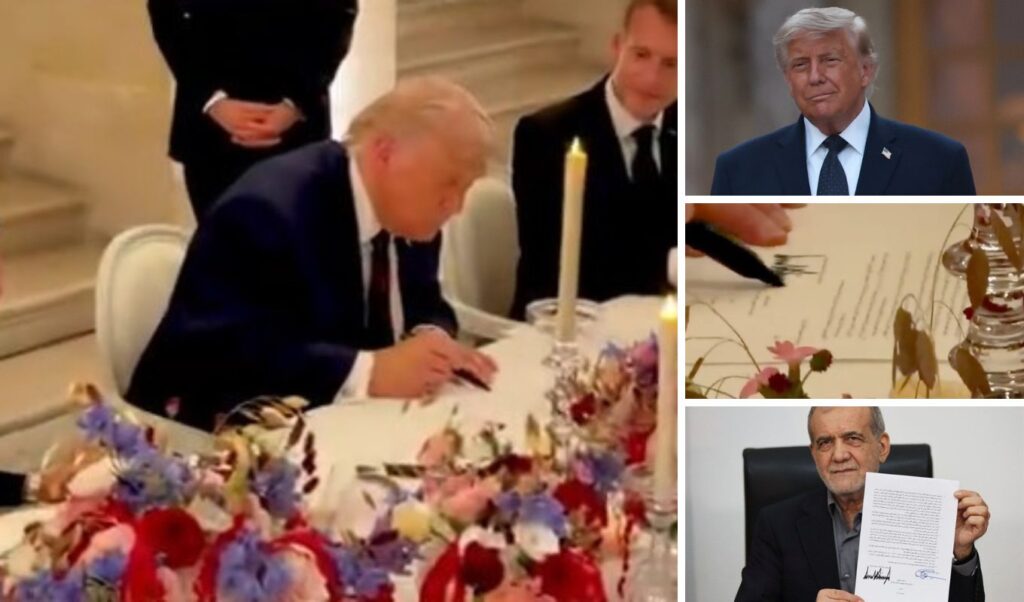
From France and the Palace of Versailles — perhaps not the most auspicious of settings, given the history of the 20th century — Donald Trump officially put his signature on the dotted line, as did Iranian President Masoud Pezeshkian, on a Memorandum of Understanding between the United States and Iran, aimed at ending hostilities. The interim agreement appears to “open a window” for a new balance of power in the Middle East, offering Tehran significant concessions — some of them immediate — while the more complex issues, most notably the nuclear program, are deferred to a second phase of negotiations, with a 60-day deadline. All of this unfolds with what appears to be the primary benefit for the West: the immediate reopening of the Strait of Hormuz — though with the significant caveat of whether safe navigation through this critical artery of the global economy can truly be guaranteed.
At the same time, criticism is coming even from within Republican ranks in the United States, criticism that appears to be partly personal in nature, reflecting the shifting fault lines of America’s domestic political landscape.
US-Iran agreement: The Strait of Hormuz and sanctions
The most immediate outcome of the agreement concerns navigation and trade. The United States commits to gradually lifting its naval blockade, while Iran pledges to ensure safe passage for commercial vessels through the Strait of Hormuz for at least 60 days.
This provision carries critical importance for international energy markets, as a significant share of the world’s oil trade passes through the Strait. In parallel, the US Treasury Department will issue exemptions allowing Iran to export oil and petroleum products, while a gradual unfreezing of Iranian assets is also envisaged.
For Tehran, this represents immediate economic relief. For Washington, however, it means surrendering a significant amount of leverage before the difficult negotiations over the nuclear program have even been concluded.
The nuclear program remains the major sticking point
Despite the political and economic provisions, the most critical issue remains essentially unresolved. Iran reaffirms that it will not acquire nuclear weapons and commits to downgrading a portion of its enriched material under the supervision of the International Atomic Energy Agency. However, the material is not required to be removed from Iranian soil.
Until a final agreement is reached, Tehran commits to making no further progress on its nuclear program, while the United States commits to imposing no new sanctions and to not reinforcing its military presence in the region. In effect, this amounts to a return to the status quo ante — which, needless to say, was anything but desirable from the perspective of both Tel Aviv and Washington.
Lebanon and the “defeat” for Israel
Beyond the nuclear issue, Lebanon is clearly a hot-button topic and a distinctive element of the agreement — one that suggests Israel is now finding itself in an increasingly difficult position in the power game centered on Beirut. “The Islamic Republic of Iran and the United States, together with their allies in the current war, hereby declare, through the signing of this Memorandum of Understanding, the immediate and definitive cessation of hostilities on all fronts, including Lebanon, and undertake not to launch any hostile action against one another and to refrain from the threat or use of force against one another.” This unambiguous clause now firmly links the Iranian and Lebanese fronts — in direct defiance of Israel’s demands. At the same time, the Memorandum appears to close the door on regime change, with Washington and Tehran pledging not to interfere in each other’s internal affairs — a commitment that stands in stark contrast to the White House’s continued references to the “Death to America — Death to Israel” chants that have rung out since the consolidation of the Islamic Revolution.
These developments, combined with Trump’s latest remarks this week regarding a possible role for Syria in the Lebanon question and the disarmament of Hezbollah, make for deeply uncomfortable listening for Benjamin Netanyahu — a leader already under significant domestic pressure and facing an upcoming election.
“Reagan would be rolling in his grave” — “Appeasement”
The US-Iran agreement may generate broader anxieties among Washington’s allies, who may now find themselves questioning the true extent of the “American umbrella.” After all, it is not an unreasonable leap to suggest that the American president may have stepped back from his stated objectives, pivoting toward “coexistence” with an adversary rather than continuing the maximum pressure campaign — a calculation clearly informed by the economic cost, the cost in military assets, the opportunities for what might be called “real estate diplomacy” (against the backdrop of a $300 billion fund), and the looming midterm elections in November.
CNN’s analysis described it as a “failed deal that may nonetheless give Trump what he wants,” while Axios noted that Trump entered the confrontation with exceptionally ambitious goals: the “complete surrender” of Iran, zero uranium enrichment, restrictions on ballistic missiles, and a halt to support for militias and proxy forces across the region. The final text, however, contains no reference to ballistic missiles, makes no provision for the dismantling of the nuclear program, and allows Tehran to receive economic benefits before the outstanding issues are definitively resolved.
Beyond media criticism, Republican fire — from at least one wing of the party — has also been trained squarely on the deal Trump “closed.” Senator Bill Cassidy, a Republican who lost his primary last month after President Donald Trump backed his opponent, wrote on X: “This is the worst foreign policy blunder in decades.”
“Reagan would be rolling in his grave,” Cassidy posted on Wednesday. “Iran’s nuclear ambitions have not been curtailed, and they have learned that threatening the Strait of Hormuz pays dividends — they will undoubtedly use that leverage again in the future. Iran can now build brand-new infrastructure under this deal.”
“Before the war, the strait was open, Iran was being crushed by sanctions, and 13 servicemembers were still alive. Now, 13 Americans are dead, families have paid billions at the gas pump, sanctions will be lifted, and the bombing has stopped. This is the worst foreign policy mistake in decades,” he said.
Former Vice President Mike Pence struck a similar chord, using the word “appeasement” in an interview on CNN on Tuesday — rhetoric that, in a curious way, circles back to the Versailles setting where this story began, echoing the language once used to describe Britain’s policy toward Nazi Germany in the years before the Second World War.