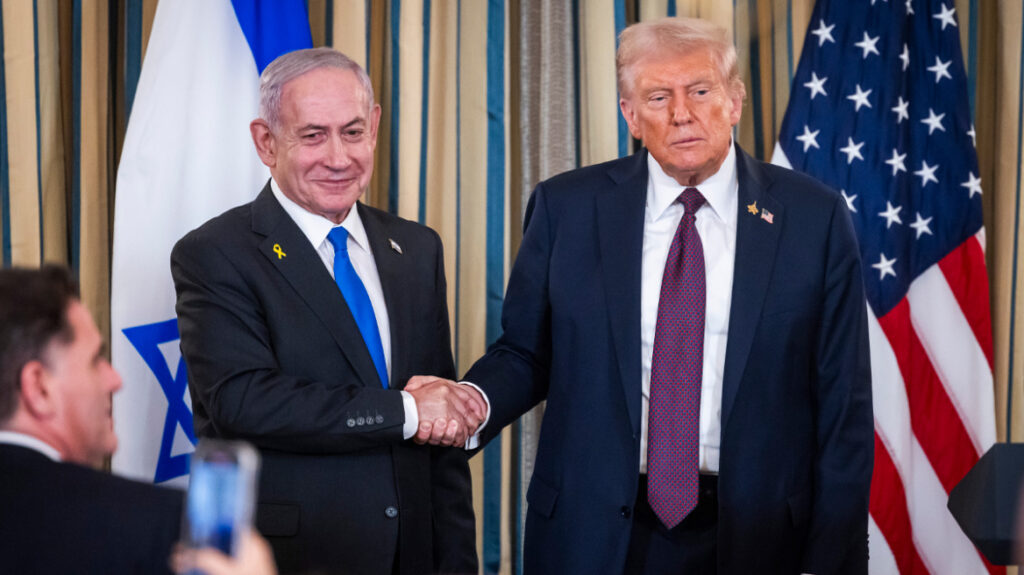
American President Donald Trump has signed a deal that Israeli officials consider a strategic and political catastrophe, with Israeli Prime Minister Benjamin Netanyahu remaining conspicuously silent, according to Axios. At the G7 Summit on Wednesday, Trump thanked Netanyahu for his cooperation during the war with Iran, while simultaneously taking shots at the prime minister. “Bibi is a good man. Sometimes he gets a little over-excited. But we have an incredible partnership. We are the big partner and he’s the very small partner,” Trump said, referring to Netanyahu by his nickname. Days earlier, Trump had told Axios that Netanyahu had shown “no judgment” by ordering a strike on Beirut that nearly derailed the deal. Netanyahu was caught off guard when Trump announced the agreement on Sunday, and Israeli officials claimed as recently as Tuesday that Israel had not yet had the opportunity to review the Memorandum of Understanding.
The Trump-Iran deal: Netanyahu’s commitments
Netanyahu had promised the Israeli public “total victory” over Iran, yet has been forced to settle for Trump’s memorandum of understanding and frequent criticism from the American president, just four months before elections. He is among the few world leaders who believes the deal is a mistake and that the war should have continued. Even the United Arab Emirates, which had been the most hawkish of the Gulf states, chose to join the regional consensus in favor of the agreement. And in Washington, Netanyahu’s allies within the Republican Party and in the media are reluctant to fully reject a deal that carries Trump’s seal of approval.
There will be no repeat of Netanyahu’s 2015 address to Congress to rally opposition against President Obama’s Iran deal. Netanyahu cannot even appear on television news programs and openly oppose the agreement without risking a direct confrontation with Trump. Rather than making public denunciations, Israeli officials have expressed deep concern about the deal behind closed doors.
Meanwhile, media outlets aligned with Netanyahu — most of which had been staunchly pro-Trump — have begun turning their fire on Trump and his team. In a prime-time broadcast on Channel 14, a presenter close to Netanyahu called Vice President Vance a “scoundrel” and used an antisemitic slur to accuse Trump’s envoys, Steve Witkoff and Jared Kushner, of selling out Israel for personal financial gain.
A senior American official acknowledged in a press briefing on Wednesday that Netanyahu may not have seen the final text of the agreement, but claimed that Israeli officials never asked for it and that the White House had provided Netanyahu with detailed briefings throughout the negotiations. During Wednesday’s press conference, Trump stated that he had sent Netanyahu a copy.
The American official maintained that despite Netanyahu’s skepticism, the prime minister had told Vance, Kushner, and Witkoff that if Iran upheld the nuclear concessions it had told the US it was prepared to make, “this would be a successful deal.”
The issue causing Netanyahu the most immediate concern is Lebanon. The Memorandum of Understanding states that the ceasefire encompasses the fighting between Israel and Hezbollah, and that Israel will be required to withdraw from Lebanon under any final agreement. A Netanyahu adviser stated that Israel does not consider itself bound by the portion of the Memorandum of Understanding relating to Lebanon. The adviser noted that Netanyahu told Trump that Israeli forces would not withdraw from southern Lebanon unless Hezbollah is disarmed.
Trump on Lebanon
“We have a little bit of a disagreement on Lebanon,” Trump said on Wednesday. The White House maintains that this is not a “one-sided ceasefire” and that Israel will retain the right to respond if Hezbollah attacks. American officials are also hopeful that Israel will use the next 60 days to make progress in its negotiations with Lebanon toward a political settlement, and that an Israeli withdrawal could emerge from those talks — rather than from a nuclear deal with Iran.
Trump also renewed his criticism of Israel’s tactics in Lebanon on Wednesday, saying it is unacceptable “to knock down an apartment building every time you’re looking for somebody.” Even the presidents with whom Netanyahu frequently clashed were never so bluntly critical of Israel. It was yet another blow Netanyahu was forced to absorb from his indispensable ally.