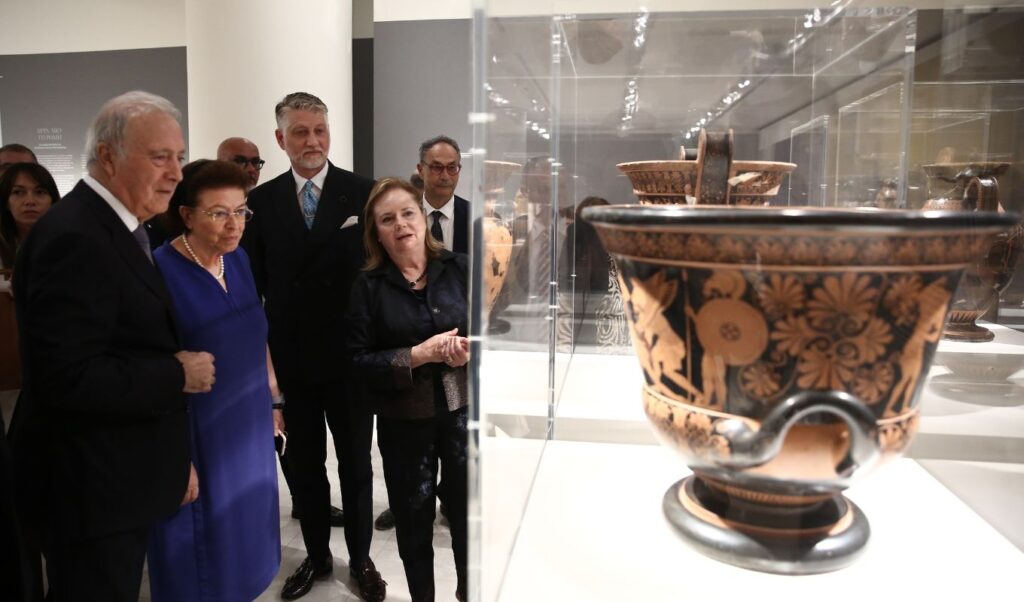
The return of antiquities to Greece — as demonstrated by the repatriation of 145 bronze coins from Italy, officially presented at the Archaeological Museum of Thessaloniki — is sending a clear signal regarding the Parthenon Marbles. The culture ministers of both countries, Lina Mendoni and Alessandro Giuli, signed an extension of their Memorandum of Understanding, which aims at the restoration of seized and fragmented antiquities. The goal goes beyond simple repatriation — it also encompasses the reassembly of thousands of broken artifacts and the reconstruction of their historical narratives.
“In favor of the return of the Parthenon Marbles”
Italian Culture Minister Alessandro Giuli hit straight to the point when he addressed the issue of the Parthenon Marbles’ return. Specifically, he stated: “I recently reread a book by Christopher Hitchens in favor of the return of the Parthenon Marbles. I hope that today’s occasion and the Greek-Italian cooperation in the protection of archaeological heritage will serve as an example for our British friends.” Regarding the bilateral cooperation with Greece specifically, he described it as the outcome of a complex joint operation between the two countries, noting that the progress achieved confirms both the value of collaboration and the need to continue working toward the full restoration of the material. “This joint effort has allowed Italy and Greece to recover thousands of works of art that had been stolen and trafficked on the black market by Robin Symes. The results achieved so far are particularly significant, but they also highlight the complexity of the work still underway,” he said.
For her part, Culture Minister Lina Mendoni outlined the foundations of a cooperation that officially began in June 2025 with the signing of the Memorandum in Athens. “The memorandum of cooperation concerns the joint management, documentation, conservation and restoration of antiquities — primarily pottery sherds, meaning fragments of vessels that were in the possession of the liquidators of Robin Symes Ltd. We are talking about approximately 70,000 fragments,” she said. She further emphasized that the case of British antiquities dealer Robin Symes represents one of the largest international cases of illicit cultural property trafficking in recent decades. Greece’s investigation began in 2006, following an operation on the island of Schinoussa, and led — after 17 years of coordinated efforts — to the repatriation of hundreds of antiquities.
The sheer scale of the looted material
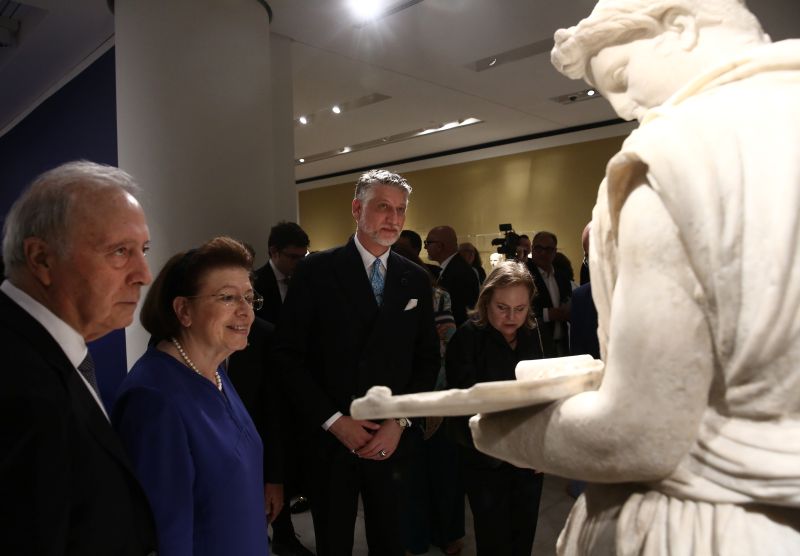
In May 2023, a total of 351 objects returned to Greece — including statues, figurines, sculptures, vessels, jewelry and utensils — dating from the Neolithic to the early Byzantine period. Alongside them came tens of thousands of individual fragments, which are currently housed and studied in the laboratories of the Archaeological Museum of Thessaloniki. The scale of the looting, however, was far greater than initially apparent. When the boxes containing the seized material were opened, the full extent of the destruction became clear. Experts cataloguing and examining the objects were confronted not only with an enormous volume of material, but also with the disturbing manner in which it had been trafficked and stored.
As described by the new Secretary General for Culture, Olympia Vikatou, in July 2023 five crates arrived at the Archaeological Museum of Thessaloniki, containing approximately 300 smaller boxes filled with pottery fragments. When they were opened a few months later, the sight was deeply shocking. “The antiquities were not accompanied by excavation records, but by dates and notes with attempts at identification. They had even been placed inside hotel soap boxes, and one particularly striking detail was a card accompanying sherds that had been sent as a Christmas gift,” she said. As she emphasized, this image revealed not only the extent of the illegal trafficking, but also the violent severing of these objects from their archaeological context — a loss that deprives the finds of critical information about their origin and use.
Despite the complexity of the undertaking, the initial results are considered highly encouraging. To date, five joint working sessions have been held at the Archaeological Museum of Thessaloniki, and through systematic classification and reassembly, more than 70 vessels have already been restored. “The systematic study, documentation and reassembly of the seized archaeological material has revealed not only its exceptional scientific and historical value, but also the power of collaboration between scholars, conservators and the services of both countries. The results achieved so far confirm that the protection of antiquities and the fight against their illicit trafficking are a shared responsibility and a common goal,” said museum director Anastasia Gadolou.
The joint team’s work has already begun to reveal the particular archaeological significance of the material, including the identification of high-quality vessels and the gradual reconstruction of artifacts. As Luigi La Rocca, head of the Italian cultural heritage protection agency, noted, even the initial scientific processing yielded findings of exceptional interest. “It has been possible to assess the extraordinarily high quality of the ceramics, which in some cases can be attributed to major artists of Attic vase painting,” he said. The Memorandum has now been extended until March 2027, with the aim of completing the identification, conservation and attribution of the material to both countries.